The mini-train does not connect Kashmir with other parts of the world, it runs like a crawling caterpillar bisecting the valley plain. Maroosha Muzzaffar takes a ride on the train connecting south Kashmir’s Islamabad with north Kashmir’s Baramulla.
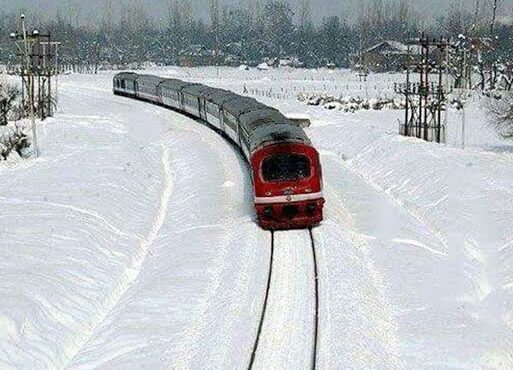
A loud toot from the train engine announces our journey and a sluggish drag begins on an elevated track that dissects the valley plain. Soon the grind of the wheels grows faster till it turns rusty, taking the train to its maximum speed. Through the windscreen, the fields – with their early spring patches of green and yellow – dash by. Through these fields, the train will take us to Baramulla, the north end of Kashmir valley from this southern apex Islamabad. On its way, the train will stop at 11 other stations and traverse four districts in a two-and-a-half-hour journey.
Unlike the trains in India that trip thousands of miles across its mainland, the mini-train runs only 99 kilometres on a linear track. But the train service is loyal to Indian Railway’s late arrivals and departures. Our train too is late. “It leaves at four. We have fifteen minutes to catch it,” my friend had said, looking at his watch while we ran towards the Islamabad railway station. Locating the station was not difficult, with people giving instructions, and pointing their fingers in certain directions after eyeing us thoroughly.
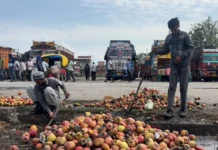
Outside the station, he grabbed my hand as we ran towards it, huffing and puffing. The long yellow building of the station rose in front of us. The fruit vendors with stacks of apples, oranges and bananas on their worn-out wooden carts shouted, beckoning the hassled passengers to taste them. The scene outside the station was of constant commotion. People loved shouting and pushing.
We had yet to buy the tickets. Through the burgeoning crowd at the ticket counter, where a long queue of phiran-clad people was being manned by police personnel with bamboo sticks in their hands, we made our way to the counter. My friend craned his neck through the pigeonhole in the glass window and after a couple of pleasantries exchanged with the crushing crowd at his back, bought the tickets. I somehow managed to save myself from the nudging elbows and prodding shoulders. The ticket wished us a “Happy Journey”.
With a ticket in hand, we approached the platform. The bustling crowd, the railway tracks, the vast fields, the mountains beyond the fields greeted us. The crowd too was colourful. A woman, wearing an overcoat held onto her little girl in pink. A man, donning a kantoop and a phiran carried a bulging bag in his hands. “I have been waiting for one hour,” he said. Some talked about the train. “It is late, it is never on time.” Some laughed, some were grave, and still others scuttled on the platform, darting from here to there. It was a montage of faces portraying various moods.
The scattered crowd soon grew restless. More people were pouring in, keeping the police on its toes. And then we heard the honk, causing a sudden commotion. We stayed together. Policemen whistled and shouted, wielding their bamboo sticks. Restless, passengers advanced for the edge of the platform, slightly bending their bodies, their heads turned towards the right. Policemen drove the surging crowd back from the platform. There was whistling and shouting and pressing. We preferred to stay at the back of the crowd.
The engine could be heard now; its groaning and moaning was audible. Soon the red patina of the train emerged. I saw it in the background of numerous heads jostling to get in. It rumbled to a halt in front of us and the engine sent out a final groan.
I took it in, watching its red and blue facade. Before I could admire it properly, someone dealt a push from behind. In the confusion of boarding the train, people bump into each other. Mothers held their kids’ hands. “Take care of your pockets,” somebody shouted. The chaos of the crowd is what a smart pickpocket wants. “I hope my cigarettes are safe,” said my friend, fishing into his jacket pocket. We laughed and after a lot of pushing and shoving, we got into the train.
We have settled back into our seats now. Eager passengers roam between compartments, searching for any available spaces. The din is yet to end. But the mini-train has suddenly begun to decelerate. Within a few minutes, we reach Bijbihara. Like the Islamabad Station, a CRPF camp encircled by concertina wire rests close to the eastern end of the station.
Concrete sledges lay scattered around the track. Steel rods emerge out of the rectangular craters filled with concrete. The bars will tie the brick walls of the upcoming station building with the concrete foundation – a necessary precaution taken during constructions in a seismic zone.
The train begins to move again. New passengers stand in the alley between the seats of our compartment. The double-engine mini-train has eight compartments with a capacity of 530 seats – six of them are 75-seaters while the other two have 40 seats each. With people standing in passageways and other spaces, our train carries more people around 700 people to different destinations. Making his way through the packed compartment appears
Shyam Lal, the Train Ticket Examiner. Shyam Lal is accompanied by two policemen. He politely asks for the tickets, scrutinises them and hands the ticket back to the passengers with a smile. “I have been serving in Indian Railways for many years,” he tells us. He has served in Utter Pradesh, Rajasthan and Madhya Pradesh before the railways appointed him as the first ticket examiner in J&K. “I enjoy it here,” he says. Two of his colleagues do the job in other compartments as the train moves on.
We reach Awantipora, a historic township where King Awantiwarman built his castle. The train stops for the boarding and disembarking ritual. As soon as it moves on, the passengers’ attention is caught by a skirmish between two groups of persons at the other end of our compartment. It is a drunken passenger’s smell that is irritating a fellow passenger. Others have joined in the chorus of arguing whether the two should be allowed to stay in the compartment or not. The matter is reported to police who rush to maintain order. At Kakpora, the drunken are handed a few bamboo blows before they are barred from journeying further.
We soon cross Pampore to reach Budgam, the central district. Its first station at Nowgam is named the Srinagar Station. It is the nearest station for passengers from the capital city and undoubtedly the busiest one. The train halts here for a few minutes more than usual. The passenger rush demands so. In a few minutes, we leave the station towards the station near Ompora, passing over a bridge near Baghimehtab. It reminds us of the boy who was crushed by a speeding train while he climbed the overhead bridge for a video of the train. In a turmoil hit Kashmir, someone dies every day. The boy, however, was the first to die due to the mini-train.
At Ompora, the biggest station in the valley, a train compartment on a parallel track reads emergency service. The railway’s emergency response team sits inside, ready to act in case the train meets an accident. Beyond the compartment and several parallel railway tracks, a long station building stands amidst paddy fields. Bulldozers and heavy machinery are at work to complete certain sections of the station building. While the station is the biggest in Kashmir, fewer passengers board the train here. After the efflux at Srinagar Station, the train is partially empty. At Mazhama station, the influx is even lesser. Soon the fields around the train begin to disappear in sundown. Through the windscreen, I can only see the dim electric bulbs far away from the railway track.
Inside, the compartment is radiant with lights shining at the top of the alley. After a few moments at top speed, the train moves into Hamre station near Pattan town in north Kashmir. Children rush into our compartment and cheerfully occupy the vacant seats. Others stand in the passageway holding onto the seats for support. “We are going to Baramulla. We will come back in the same train,” a boy tells us. For them, it is a joyride. Probably the ticket checker too ignores them, allowing them some moments of fun without paying for it.
The train chugs past undulating expanses of land to reach Baramulla. We dislodge at the last station. It is 7:00. The sun has disappeared and the sky is starry. We leave the station, thinking of our journey back to Srinagar. We had reached the north end of the valley.