Railway alignment surveys across South Kashmir have sparked anxiety as tracks cut through apple orchards, threatening livelihoods, ecology, and homes, with residents alleging no consultation, notice, or impact assessments, reports Babra Wani
On January 4, 2026, a morning stroll to his four kanal orchard made Malik a resident of Batakoot, realise that there was something suspicious going on in the nearby Lidder river. He noticed men installing a yellow pole and was told it was marking the area for the upcoming railway line.
A dread of helplessness washed over him as the track to Pahalgam, a health resort and the base camp for Amarnath Yatra will cut through his orchard.
It was Batakoot’s Buta Malik who had once discovered the Hindu cave shrine. They were managing it till the Shri Amarnath Yatra Shrine Board pushed them out of business. Now, the track could dispossess them of their actual inheritance. Now Malik, the orchard owner, started linking the sentence he had overheard when a group of young men were discussing something on a shop front: “Amarnath is taking away the earnings the Maliks have made over the generations from his cave”.
Watching the frustrated Malik roaming around, a man from the track-marking team approached him. “He told me the Lidder Valley will be unharmed,” Malik said. “He told me that the track in this section will be constructed on elevated pillars for around seven kilometres. After this, the track will enter a tunnel before reaching the next village.” The marking team lacked any information about where the tunnel would come up, but Malik presumed it could be in the Liddroo area.
Lidder River drains the valley for more than 70 km and is the main source of water for survival and agriculture. Malik’s problem is that he does not locate the same sentiment in his fellow residents who are not ‘as bothered’ as he is.
“The marking was done without any prior notice to landowners,” Malik said. “I was in my orchard when I saw two or three labourers fixing yellow poles with sand and clay to mark the alignment. No railway or government official was present. One labourer appeared to be supervising and was using a GPS-like digital device, indicating the markings followed satellite-based survey coordinates.”
Now Malik related earlier happenings. The first such survey was in 1999, but the direction was different. Then another survey was carried out in November 202,5 during which soil testing was also done. Seemingly, the ongoing marking is the track.
The Alignment
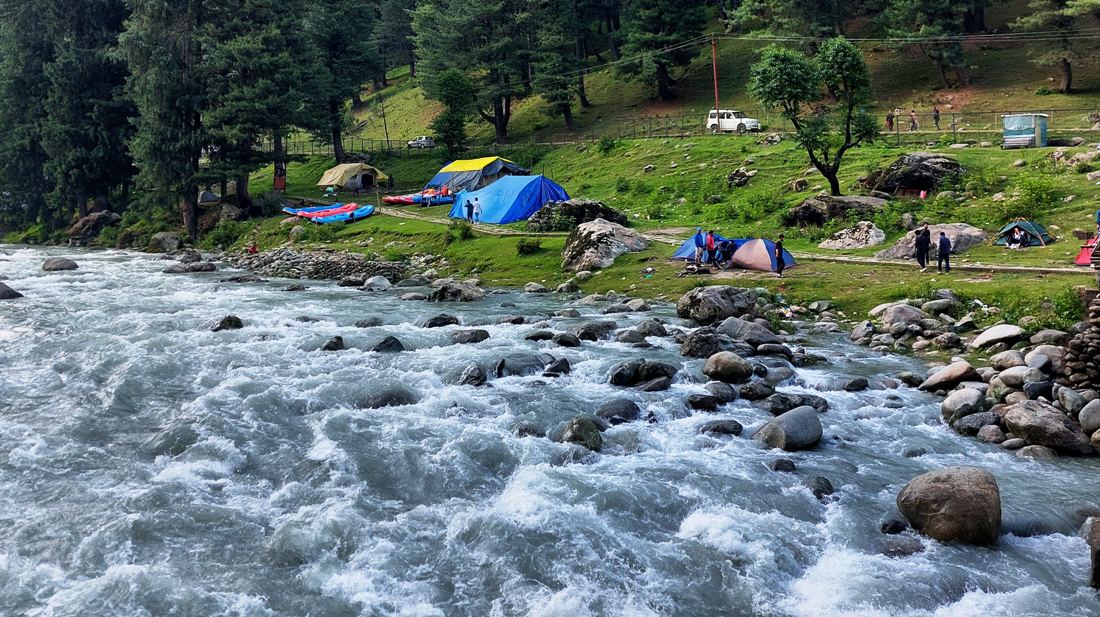
The proposed alignment is presumed to run from the Shalbairan area, passing below Dahwatoo and moving towards Laddi. From there, it crosses the Lidder River and passes through Batakoot, specifically the area below the Aabshar Park, where residential houses exist. The line then proceeds towards Khellan, Malik explained.
The proposed railway alignment would affect about 100 feet of land, 50 feet on each side of the centre line, impacting an estimated 45 kanals in Batakoot alone, Malik said. From his orchard, Malik said, only about one kanal might remain usable, while the remaining three kanals would be lost. “I heard a neighbour objected as the marking cut through his residential courtyard, forcing the labourers to stop. Later, we were told his Aadhaar details were taken, and he was warned of possible police action, though no police arrived and no formal action followed.”
Residents are aghast over the fact that no written notices, land acquisition documents, or compensation details were provided during the marking process.
A Tense Region
It is the same story in Laddi, Virsaran, Dahwatoo and Wullarhama villages. A sense of deep “depression and anxiety” has taken over as locals are frightened that their orchards will be consumed by the track. They are concerned about their livelihoods.
“The worst part is that we converted our rice fields into orchards for our livelihoods,” said Mir, a resident of Laddi. “We sold land and built hotels and restaurants along the Pahalgam route for tourism, only for it to be marked this way.”
Mir had recently constructed a 10-room hotel in his locality. In August 2025, when the village was surveyed for the track, it survived. In the latest survey, on January 4, 2026, however, it was marked to be consumed.
“Horticulture and agriculture are our lifelines, and both are being affected. We are under severe stress. We only want the line to be diverted in a way that does not harm our livelihoods,” Mir said. “The entire Laddi village is affected, including around 20 orchards. Even four-times compensation falls far below market rates of Rs 1 crore per kanal. The 100-foot-wide railway alignment cuts through orchards and land, wiping out investments, hotels, and livelihoods with only one-time compensation.”
There were protests in the area, but the surveying labourers threatened landowners with police cases. Mir said the entire belt is in mourning as the track runs through the centre of Dahwatoo, Kullar, Naagipora, Virsaran, Batakoot, and Wullarhama villages. “A man in his 80s in the nearby village tried resisting it (marking), but he was misbehaved with.” He said, “More than 40 families are affected.”
A Viral Clip
It was from this belt that a video clip went viral on social media. It showed a man resisting the surveying labourers. “How can you? I will not allow anyone to touch my land,” a person is telling them.” Already, a lot of our land has been taken over, sometimes for road widening and sometimes for another project. Do not touch our land.”
The labourers are shown replying: “We have been asked by the officer who has already surveyed this land before. If you had any objections, you should have told them. We are just labourers. The engineers and officers have already surveyed this; they even told us to carry out the marking process.”
A Major Project
The proposed 77.5 km broad-gauge Anantnag-Bijbehara-Pahalgam railway line is among the five railway projects spanning over almost 190 kilometres across Kashmir. Bijbehara residents have been opposing it since 2024.
Recently, Iltija Mufti registered her protest along with other party leaders in Wullarhama. She held a poster that read, “No land grabbing in the name of development.”
This project, a vocal leader accompanying the Mufti Jr said, has been initiated without consulting the people. “A project imposed upon people should be reviewed, and dropped. What benefit does this project bring to the population? It serves only the location, not the people who live here”.
The other track that is in debate is the 27-km Awantipora-Shopian line, supposed to connect the two towns, barely 20 km apart. This track witnessed the return of the coveted Chipkoo movement scenes when owners were clicked hugging their trees.
A resident of Babhara in Pulwama, whose two orchards have been marked, said it was unfortunate that the only means of livelihood in his village was being taken away.
“My land at two locations, measuring around two kanals, has also been marked. When the process was underway, we questioned those carrying it out, but they said they were only labourers. There were no officials at the site whom we could speak to or seek further clarification from,” he said, adding the labourers told him the work was being executed under a contract.
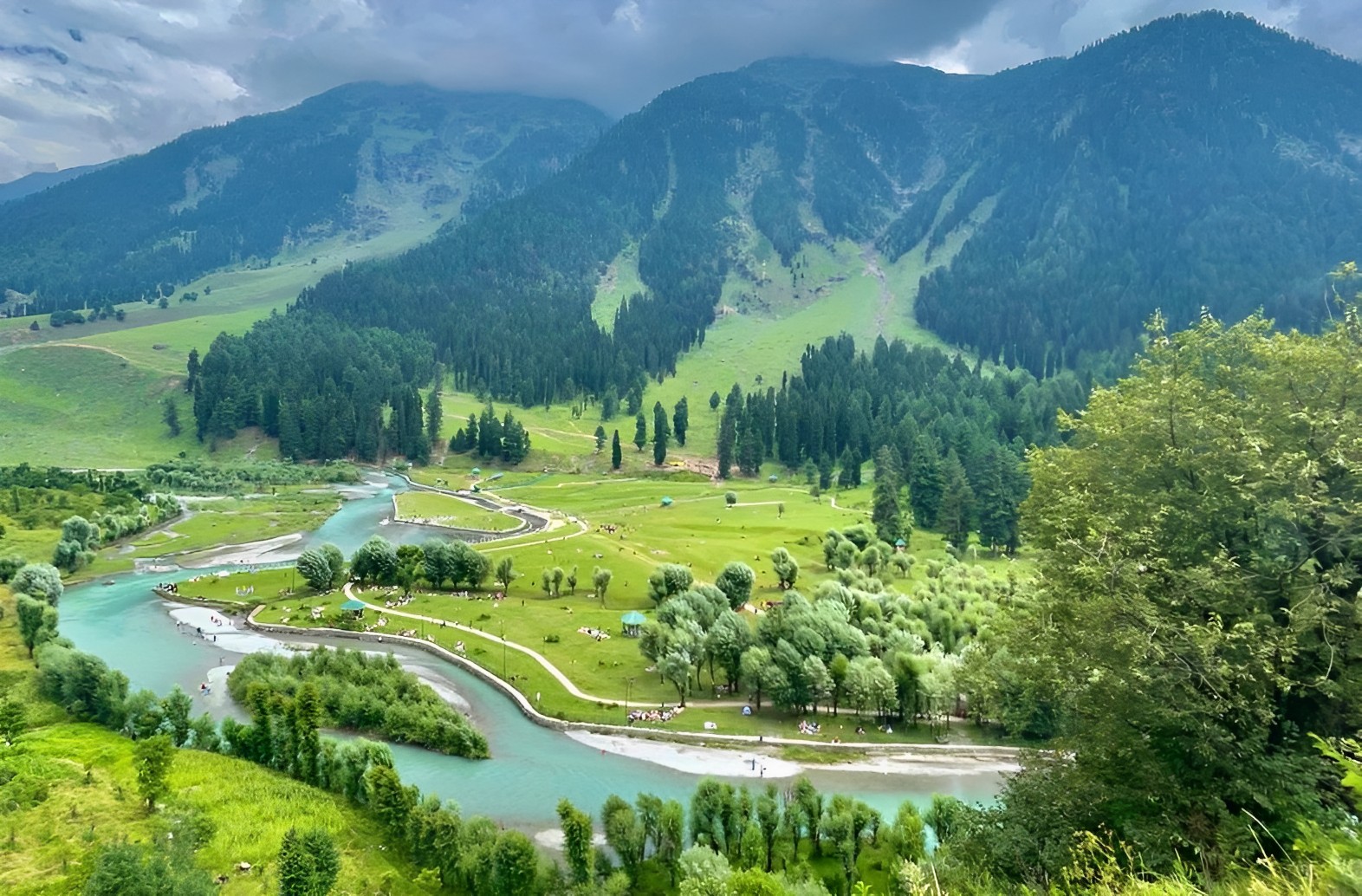
Beginning from the Kangan area in Pulwama, where the marking first started, and extending up to Shopian, most of the land identified is horticultural land, predominantly apple orchards. “If you look at the map, it is all apple orchards. Yellow pillars have been installed. This process was carried out about two months ago,” he said.
He described these orchards as the “windpipe” and lifeline of the people, who depend entirely on this land for their survival.
“We have grown, nurtured, and cared for these orchards for years, and in a moment, they will be taken away. Even if compensation is given, will it ever be enough? Our cattle depend on these orchards, as do our families and children. Nearly 60 households are losing their land, and more than five lakh apple trees will be felled. The loss is simply too much to bear,” he said.
Pertinently, the apple cultivation sustains nearly 35 lakh people across Jammu and Kashmir, feeding the local economy with an annual turnover of more than Rs 15,000 crore. The sector is woven into every layer of rural life, from school fees and dowries to health expenses and small loans.
Ecological Concerns
According to a local activist from South Kashmir, who spoke anonymously, the proposed railway projects were not only affecting the livelihood but has it environmental costs too. He lamented that a railway track cutting through vital horticultural land would lead to a serious ecological imbalance, with construction dust settling on the pores of fruit trees, clogging them and significantly reducing their productive capacity. He said the project would also disrupt local irrigation channels, and without assured irrigation, agricultural activity would collapse, setting off wider environmental damage.

There is no active demand for this railway project from the people of Pulwama and Shopian, particularly given that the distance involved is less, he said. “Any infrastructure project that causes destruction or displacement must ensure that the harm is proportionate to the development it promises. If this balance is not maintained, it violates the principle of distributive justice.”
The activist further noted that under the Land Acquisition and Rehabilitation Act, 2013, there is a clear mandate to conduct social and environmental impact assessments before undertaking mega infrastructure projects like a railway.
“No environmental or social impact assessment has been made public so far, and we do not even know whether one was conducted at all,” he said.
Questioning the utility of the proposed railway line, he asked, “The distance is barely 20-25 kilometres. Why would people wait for a train instead of using their own vehicles, especially when Pulwama has a high level of private vehicle ownership?”
He also pointed out that residents were never consulted. “Before initiating any major development project, the government must take people into confidence and seek their consent. Without people’s consent, development becomes an imposition rather than a participatory process,” he said.
A resident of Shopian, breaking down while speaking to Kashmir Life, said, “They will have to lay these tracks over our bodies. These orchards, these trees are our babies. We are already suffering losses; some days it is the weather that destroys us, on other days it is the administration. Why is the Kashmir government silent on this?”