At the crossroads of history and geography, Matayan, the only Kashmiri-speaking village in the Ladakh region, stands as a unique cultural identity while bearing witness to centuries of shared legacy and migrations, reports Humaira Nabi
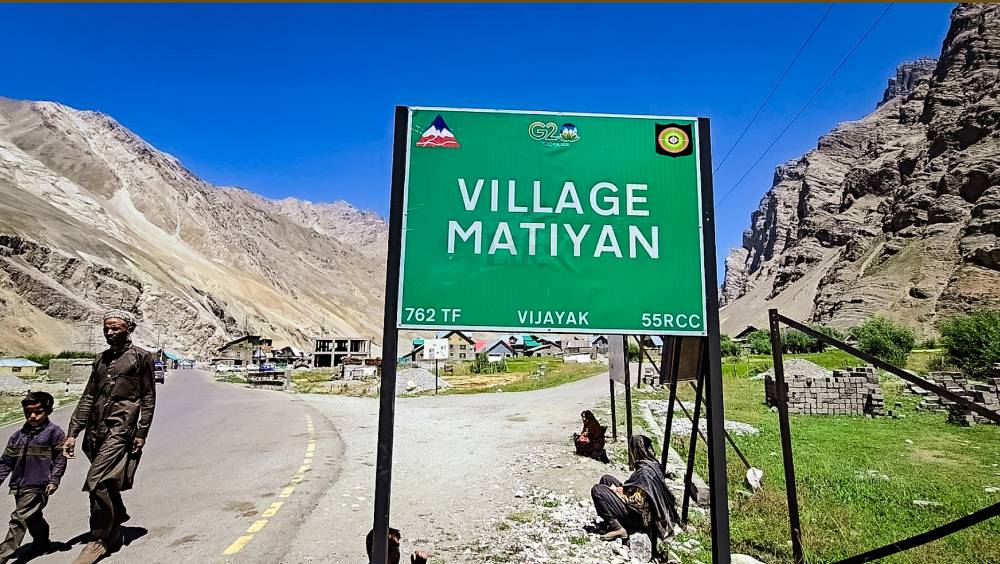
As one descends the treacherous, winding bends of Zoji La, the landscape undergoes a dramatic transformation. The stark, rocky terrain of the pass gradually gives way to an expansive plain of lush emerald green, stretching endlessly under the watchful gaze of the surrounding mountains. Nestled against the formidable cliffs lies Matayan, a village that breathes life into the shared legacy of Kashmir and Ladakh.
An Ancient Oath
The bond between Kashmir and Ladakh is an ancient one—a landscape woven through centuries of shared history, culture, and, at times, conflict. These two regions have stood as both allies and adversaries, coexisting under common rulers and leaving profound influences on each other. Throughout this intertwined past, numerous treaties were forged, seeking to formalise a relationship of cooperation and peaceful coexistence. Though the ink on those treaties has long faded, the connections between Kashmir and Ladakh endure in myriad forms. One such testament to this enduring link is Matayan, the only Kashmiri-speaking village in Ladakh.
This unassuming settlement serves as the first inhabited area along the Srinagar-Leh highway, standing as a living relic of centuries-old ties. Beyond its geographic significance, Matayan is culturally unique, being the sole Kashmiri-speaking village in the entire Ladakh region. It is home to a harmonious blend of Sunni Muslim and Balti-speaking Shia families, their coexistence emblematic of the region’s diverse heritage.
With its tranquil air, Matayan is surrounded by vast stretches of grassland, interrupted only by a small patch of cultivated land, where barley sways gently in the breeze. A few scattered trees punctuate the landscape, offering sparse shade. Along the roadside, a handful of modest shops, recently built, provide essential supplies to the village’s inhabitants. Despite its simplicity, Matayan stands as a quiet sentinel to history, preserving an identity distinct yet deeply intertwined with both Kashmir and Ladakh.
Time and Tradition
The houses in Matayan are modest, constructed using a blend of brick and traditional building techniques, comprising both pucca and kuchha structures. The contrast in the plinth height between the older homes and the newer constructions is striking. A Kashmir-based mason explained the reason behind this architectural shift, remarking that snowfall was once abundant, but in recent years, it has become increasingly rare.
Matayan is home to approximately seventy households, with a population ranging between 600 and 700. The villagers possess a sturdy, well-built physique and share a striking resemblance to the broader Kashmiri population, setting them apart from Ladakhis and reinforcing their cultural affinity with Kashmir.
View this post on Instagram
A small irrigation canal courses through the heart of the village, its waters vital to the land’s sustenance. Young women are often seen washing pots near a communal tap, positioned just above the canal. Inside the homes, a sense of warmth and familiarity prevails, with meticulously maintained interiors reflecting the traditional charm of a Kashmiri household.
The village embodies a seamless blend of old customs and modern life, echoing the enduring relationship between Kashmir and Ladakh. Even during the scorching summer months, elderly men and women can be seen clad in the traditional Pheran, a testament to their unwavering connection to Kashmiri heritage.
Battling the Elements
Situated adjacent to Dras, renowned as the second coldest inhabited place outside Siberaia, Matayan experiences some of the harshest climatic conditions imaginable. As winter sets in by mid-October, the villagers are compelled to abandon their homes in search of more hospitable environments.
By November, the entire settlement stands deserted, with not a single soul left to endure the bone-chilling cold. Most residents migrate to the relatively warmer area of Ganiwan, a picturesque village nestled in the Ganderbal district near Sonamarg. This seasonal migration is an age-old tradition, deeply ingrained in the village’s way of life, ensuring their survival against the relentless forces of nature. This migration explains why the separation of Ladakh from Jammu and Kashmir hardly matters on the ground.
The Origin
The origins of Matayan are interwoven with a mosaic of diverse legends, each reflecting the region’s rich and complex past. Many families trace their lineage to North Kashmir’s Lolab Valley, with oral histories recounting migrations that date back to the Mughal and Dogra eras.
Some accounts suggest that their ancestors sought refuge in Matayan to escape conflict, while others speak of ancient Dardic migrations, driven by necessity or a spirit of exploration across the Himalayan ranges. Today, the people of Matayan preserve a distinct identity, shaped by their unique languages and traditions.

“Here, we speak more than four languages,” said an elderly man seated outside a shop, a smile spreading across his face. “Kashmiri, Dardi, Urdu, Balti.” Each language, he explained, forms an essential thread in the village’s cultural fabric.
Another elder reflected on the village’s lineage, recalling the tales passed down through generations. “Our ancestor, named Sultan, is believed to have settled here from Lolab. We do not know the exact details, but since childhood, we have heard that our roots trace back to Lolab,” he said. He went on to share another local legend, explaining how the village’s name is linked to the Beggari system—a practice of forced labour during the Dogra rule. “Around fifteen to sixteen dak runners, who once carried mail across the treacherous Zoji La pass, eventually settled here. That is how Matayan, as a village, came to be.”
A Silk Route Halt
In the 19th century, Matayan served as a crucial halting point along the ancient Silk Route that operated till 1947 and a few years later. Foreign travellers, having endured the arduous ascent and descent of Zoji La, frequently described the village in their journals as a sanctuary. Its flat terrain provided a much-needed respite, allowing them to recover before continuing their journey deeper into the Himalayan wilderness.
Over time, the people of Matayan, accustomed to the region’s harsh winters and rugged landscapes, gained recognition as skilled porters. They played an essential role in facilitating trade between Central Asia and Kashmir, mastering the challenging task of navigating the snowbound Zoji La during early winters and spring when pack animals could not traverse the treacherous icy paths.

Historical accounts also highlight the presence of a telegraph clerk stationed in Matayan to provide vital updates to travellers attempting the perilous pass. Nearby stood Machoi, a collection of seasonal rest houses perched atop a steep hill, where officials and traders sought shelter. Although these caravansarais and shelters have faded into obscurity, their remnants still whisper tales of the countless travellers who once crossed their thresholds.
During the Dogra rule, Matayan housed a Runner’s Hut, an essential waypoint for messengers transporting crucial letters and dispatches across the mountains. By 1890, this modest hut had expanded into a cluster of four small shelters, offering protection to weary dak runners and travellers from relentless snowstorms and the ever-present threat of frostbite.
Past in The Present
Across the village, remnants of at least three ancient rest houses silently narrate tales of the bygone Silk Route. Moss-covered stones and partially buried foundations stand as quiet witnesses to a past that once thrived with travellers and traders.
In the heart of the village, Riyaz Ahmad walks through the remains of the largest sarai. The carefully aligned boulders and faint outlines of compartments are still discernible, with a noticeably larger central section flanked by smaller ones on the periphery.
“When I was a child, we used to play in these structures,” Riyaz recalls, his voice tinged with nostalgia as he gestures towards the ruins. “Back then, the walls were still standing, and we would often find objects hidden within them. But in just a few years, time has overtaken these sarais, and now none of them remain intact.”
Though the physical traces of these rest houses have largely vanished, they have not been entirely lost. The stones have found new purposes, repurposed into the walls of villagers’ homes. The plinths of several houses in the village have been constructed using boulders from these ancient structures.
“As the walls of these rest houses deteriorated, the villagers gradually used the remains for their own homes,” Riyaz explains. “While most of the construction relied on mud, the lower sections were reinforced with large stones and boulders, which the villagers incorporated into their buildings.”
Through Foreign Eyes
For early travellers, Matayan was both a sanctuary and a challenge. It appears frequently in the travelogues of those journeying to Ladakh, often depicted as a modest settlement, home to humble inhabitants. These villagers, though living in poverty, played a crucial role in assisting travellers who passed through, offering them much-needed respite on their arduous journey to or from Ladakh.
Kathleen M Heber, in her 1926 book Himalayan Tibet, described Matayan as “a desolate, wind-swept spot,” home to a few huts, a serai, and a rest-house with two small rooms. The harshness of the weather and the relentless wind left travellers to fend for themselves, with some resorting to writing poetry in the rest-house logbook to pass the time.
BK Featherstone, in his travelogue An Unexplored Pass, also published in 1926, painted a more sombre picture. He described Matayan as “a small collection of native hovels” situated over 10,000 feet above sea level. The village, he wrote, had a “desolate appearance,” with an occasional tree standing out against the barren rocks, in stark contrast to the lush, wooded hills of Kashmir.
The inhabitants, a mere handful, seemed ragged and wretched, moving with lifeless indifference despite the bracing air. Featherstone expressed relief at reaching Matayan and even appreciated the scant shelter of its “dirty, draughty rest-house.”