In this behind-the-scenes bit-by-bit narrative, Humaira Nabi takes readers through the making of the Kashmir Life 16-film series Kashmir: The Silk Route Tales, an unprecedented initiative aimed at rediscovering the age-old trek that has helped reshape Kashmir over many millennia. Despite the physical and emotional toll of the travel to the arid Ladakh desert covering more than 2000 km, the team’s quest to uncover forgotten stories and remnants of the caravan route unfolded as an unforgettable adventure.
After three arduous months of filming under the unrelenting summer sun, our five-member team found itself drained yet fulfilled. The documentary series, though yet to be released, had exacted a heavy toll on our energy but left us with a profound sense of achievement. Recognising our need for a reprieve, we fetched a sabbatical, a much-needed escape from our routine. We were asked to proceed on a ‘holiday’.
The destination was Ladakh, a land of towering peaks, serene monasteries, and a silence so profound it echoes like nature’s heartbeat. As we understood later, it was not a sabbatical. It was a trap, packaged well, as honchos do.
About to set off on a long journey the next day, the team – otherwise busy in making preparations for a high-altitude travel, was invited for a briefing with our pens and notebooks. This is the meeting in which the reality dawned upon us that we were tasked to go on a Silk Route rediscovery. “Take notes,” we were told, as me and Iqra started looking at each other, “Ladakh is not merely a place. It is a canvas of stories waiting to be told and retold. Follow the trek, report and enjoy!” Gaya Thay Nimaaz Bakhshwanya, Rozay Galay Pad Ghay. But this is how Kashmir Life works.
Over the next three hours, no lunch and no tea break, it was a long lecture into the historical significance of this ancient route network that, we were told, was the main nerve centre of trade, culture, change and life. From wars to cold wars, invaders to missionaries and pilgrims to camels, it was a long narrative of what it meant to Kashmir, once upon a time.
As the meeting neared its conclusion, we were given tips about the essential items that travellers along the Silk Route must carry. “The Silk Route connected people, goods, and ideas,” we were told. “Your mission is to discover what remains of those connections and how those connections have changed those places.”
The Start
The next morning, the hum of Fayaz Bhai’s trusty Eeco broke the early quiet as it pulled into Ganderbal. Inside were Umar Dar, our drone operator, and Iqra, ready for the adventure. They stopped to pick me up before heading toward Wayil Bridge, where Shahzad and Mudasir, our cameramen, awaited with their equipment. The team was now complete.
While the plan was to start at Yarkand Sarai in Safakadal, a historical rest house for traders that still stands, a sense of spontaneity overtook us. Something about the crisp morning air compelled us to take a different path.
The Silk Route, as we were told, was not merely a line on a map but a rich tapestry of history. Guided by this dictum, we decided to follow its traces, beginning where the mountains seemed to touch the sky.
The Road to Ladakh
In earlier times, traders journeying from Srinagar would navigate a maze of customs houses scattered along the route. One such station, believed to have been near Wayil, issued permits, the modern-day passports to travellers. Our efforts to uncover remnants of these structures yielded little more than faint echoes of their erstwhile existence.
Much like those traders of yore, we followed the winding path, eventually arriving at the banks of the noisy Sindh River (not the Indus, though). The road, once perilous, is now comparatively smooth, running parallel to the river’s vast expanse. Along this route, traders often paused at Akhal, a tranquil station offering respite to the weary. Those venturing across the river’s bridge to its left bank would reach Kangan, a bustling stopover where most travellers spent the night. We, however, chose not to linger.
Continuing along the ancient route, we reached Gangangeer, a hamlet that once hosted Kashmir’s first customs house. Once a thriving centre of trade, Gangangeer’s residents served as scribes, clerks, and messengers, their livelihoods deeply entwined with the goods that passed through. Today, it is a shadow of its former self, the vibrancy of its trading past long faded.
The road ahead twisted and turned through a shifting landscape. The lush greens of the valley gave way to austere browns and greys, the terrain becoming harsher and more barren. Jagged peaks pierced the horizon, a stark reminder of the challenges that lay ahead. Inside the van, the mood alternated between quiet reflection and animated discussion. Umar and Shahzad debated drone shot angles for the documentary, while Iqra and I sifted through notes, identifying key locations.
Eventually, we approached Zoji La, a pass ranked among the world’s most perilous roads. Even seasoned travellers treat it with reverence. As the van ascended the steep incline, the dangers of the path became palpable.
Zoji La is not merely a mountain pass; it is steeped in legend. Tibetan tradition reveres it as the goddess of the four seasons, while Ladakhi lore portrays it as the wife of Naropa. The native myth suggests when Zoji La’s body began to emanate the scent of Kashmir, angering Naropa, banished her. Furious, Zoji La turned her face toward Kashmir, leaving her back to Ladakh. Her wrath, the legend goes, transformed Ladakh into an arid desert as Kashmir flourished into a verdant valley.
As we traversed this historic pass, the myth of Zoji La felt almost tangible, its stark and unforgiving landscape mirroring the tale’s drama.
For centuries, the people of the villages near Zoji La mastered the art of navigating the snow-covered pass during early winter and spring. Their expertise earned them a vital role in Central Asian trade, carrying goods and mail across the harsh terrain. Historical accounts suggest the presence of a telegraph clerk stationed here to provide travellers with real-time information about the pass’s conditions.
View this post on Instagram
Modern engineering has widened and fortified Zoji La, yet its daunting nature endures. Fayaz demonstrated exceptional skill as he navigated the hairpin bends. At one precarious moment, a truck veered into our path, narrowly avoiding a collision. He swerved toward the gorge’s edge, causing the van to tilt dangerously. We cried out, convinced disaster was imminent. With a deft hand and quick reflexes, however, he steadied the vehicle, leaving us shaken but unharmed.
The journey over Zoji La was a humbling reminder of the pass’s treacherous beauty and enduring significance, connecting history, myth, and the stark reality of the land.
Into Kargil
Descending from the snow-laden heights of Zoji La, the landscape softened into a picturesque hamlet cradled beneath towering peaks—Matayan, the only Kashmiri-speaking settlement in Ladakh. This village serves as a vital link between Kashmir and Ladakh, a place where history and geography intertwine.
Historic travelogues describe Matayan as a sanctuary for weary travellers. Today, its charm endures. We stopped at a roadside restaurant to enjoy steaming tea, its aroma mingling with the crisp mountain air. While we relaxed, Iqra, ever meticulous, set out with Shahzad and Mudasir to talk to village elders. Their accounts wove an ancestral thread to Kupwara, Kashmir’s northern belt.
Umar, Fayaz, and I explored the older parts of the village. We sought traces of ancient rest houses that once hosted Silk Route traders. The passage of time had left most of these structures in ruins. Stones from the shelters had been repurposed, their weathered forms now part of the villagers’ homes. We uncovered a few remnants—moss-covered stones partially buried in the earth—whispering of the past.
From Matayan, we journeyed onward to Pandras and then to Dras. The transition was striking: rugged mountains gave way to fertile valleys, vibrant with vegetation.
Dras greeted us with a stark beauty and a biting chill. Over lunch, we attempted to coax shy residents into speaking on camera, but their reserved nature, bordering on fear, left us reflective. This sense of hesitation lingered as we continued towards Kargil.
Arriving in Kargil by evening, the town confounded my expectations. The roar of the Suru River was omnipresent, almost drowning out other sounds. Narrow streets bustled with activity, and closely packed buildings created a sense of overwhelming density.
This Shia-majority town, once the capital of the Purig of the yore, holds historical significance. Before the 19th century, Kargil was a pivotal hub on the Silk Route, linking Central and South Asia.
Walking through the small bazaar, I tried to imagine its past as a bustling entrepot. Tiny wooden shops offered a mix of local produce and imported goods. Ladakhi toffee, dried and fresh apricots, and radishes were popular items. Umar convinced Fayaz to purchase a packet of toffee for the team. Despite his reluctance, we all agreed it was not the authentic version we had hoped for.
We spent two days immersing ourselves in Kargil’s rhythm. Food proved an unexpected window into its culture. Kashmiri Wazwan restaurants dominate the heart of the market, established Kashmiris. These eateries brought a slice of home, serving the distinctive culinary traditions of Kashmir. We watched locals savour Wazwan with relish, making us feel a connection to our homeland.
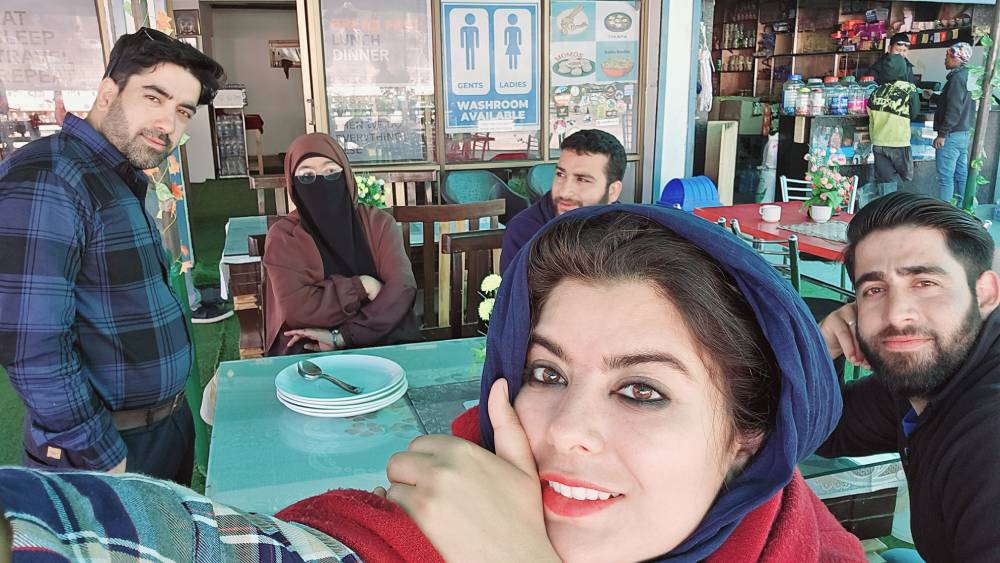
Further exploration revealed the active role women play in Kargil’s economy. Women worked alongside men, contributing to daily life as tailors, labourers, and vendors. Vegetable stalls and dairy counters were often managed by women, selling fresh produce and milk in small pouches. Their presence infused the streets with energy and resilience.
Kargil also stood out for its strict traffic management. A one-way system kept the congested streets remarkably orderly. Fayaz, accustomed to Kashmir’s more relaxed traffic norms, learned a memorable lesson when he was fined Rs 500 for not wearing a seatbelt. The enforcement was no laughing matter, and the experience left an impression. For the remainder of the trip, he did not forget his seatbelt.
In Kargil, rules were clear, and discipline was evident. The town’s unique blend of history, culture, and order left us with lasting impressions of its vibrant character.
Into Leh
On the third day, we departed early for Leh. Umar insisted on breakfast beforehand, cautioning us that restaurants would be scarce along the route. While we packed, Fayaz drove around the town in search of tea. Despite his efforts, no suitable spot was open. The only option was the restaurant we had visited the previous day, but reaching it required navigating a restricted lane. Unwilling to risk another traffic fine, Fayaz abandoned the plan.
Thus, on empty stomachs, we began our journey. Crossing the mighty Suru River, the road ascended sharply, and the morning air turned crisp. The landscape revealed its magnificence, with every turn offering a new spectacle.
Our first destination was the Aryan Valley, which filled us with anticipation. Umar, having travelled to Ladakh several times, naturally assumed the role of guide. Shahzad, seated in the front, responded to Iqra’s frequent requests to capture shots of the scenery. I turned to my tablet, quickly downloading as much information about the area as possible before losing connectivity, as Umar had forewarned. Mudasir ensured Fayaz stayed alert, keeping him entertained with constant banter.
An hour later, we reached Humbuting-La, perched at an altitude of 13,338 feet. The cold was intense, prompting us to don our jackets quickly. The wind was so forceful it felt as though it could carry us away. Fortunately, aside from Fayaz, we were all heavy enough to stay grounded. Umar’s presence beside Fayaz provided some reassurance, and our playful humour helped ease Fayaz’s fatigue. Driving through such harsh conditions was a challenging task, but good-natured teasing and camaraderie lightened the load.
The long drive culminated in our arrival at the Aryan Valley, a secluded region that felt as extraordinary as it had sounded. Encircled by towering Batalik mountains, this hidden enclave has historically remained off the major trade routes. The valley’s residents trace their lineage to ancient Aryans, with oral histories linking their origins to Gilgit.
Devoid of bustling markets, the valley’s cultural heartbeat has endured. Travellers along the Silk Route were once greeted by the sounds of local musicians, offering respite amid the harsh terrain. The villagers speak Brokpa, a language closely tied to the dialect of Gilgit, and their customs remain remarkably preserved.
Historically referred to as the Dah Hanu region, the valley encompasses four village clusters: Dah and Hanu in Leh district, and Garkon and Darchik in Kargil district. Each village held its distinct character. The Indus River, a lifeline for the area, carves through the rugged landscape, sustaining the settlements as it winds through the valley.
Apricot trees, abundant throughout the region, greeted us as we arrived. Hungry from the journey, we indulged in the sweet fruit. Fayaz, ever thoughtful, had procured packed food from a shop in Darchik, ensuring we were well-supplied.
Entering Darchik, the distinctive scent of juniper filled the air—a fragrance that seemed to permeate the entire region. The people, particularly the elders, were adorned with heavy ornaments. Their traditional caps, decorated with lantern flowers, were a striking feature, reflecting their enduring cultural heritage.
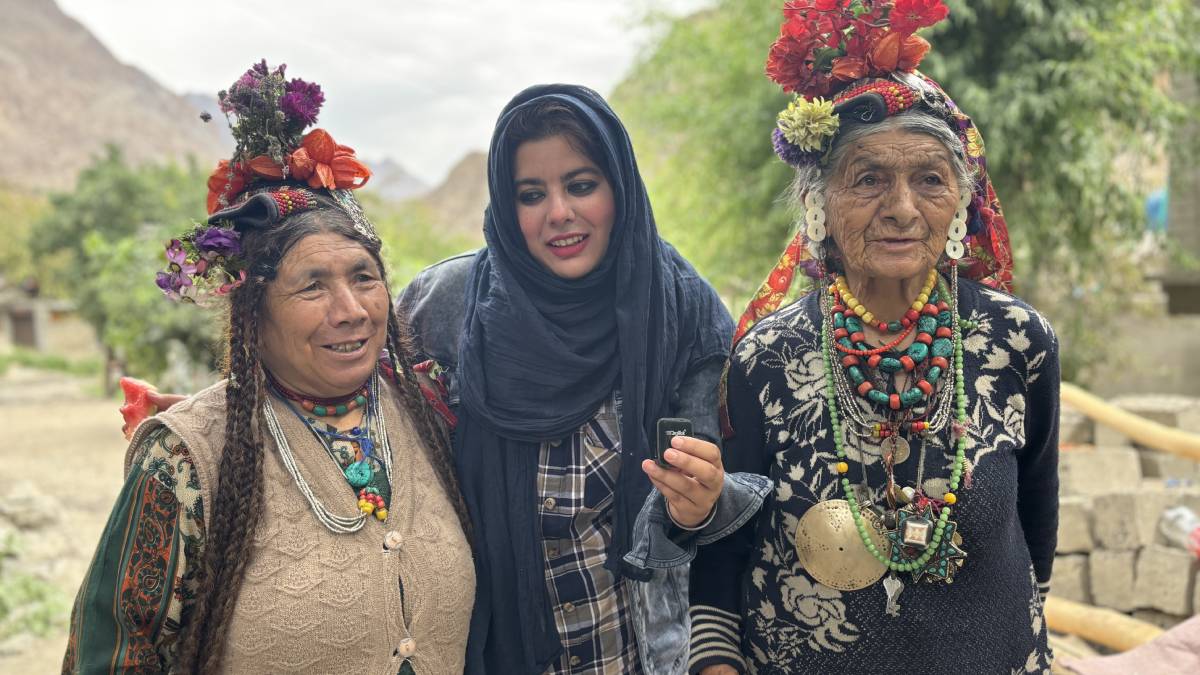
In the Aryan Valley, we encountered several foreign tourists, particularly from North America and Israel, drawn by the region’s allure. Stories have contributed to this fascination, including a sensational account from the 1980s of three German neo-Nazi women attending a Brokpa festival, reportedly seeking to be impregnated by “pure Aryans.” Such tales have shaped the region’s portrayal in the media.
Over the years, the Brokpas have embraced a narrative linking them to Alexander the Great’s army. Locals hold differing views on the claim. Some dismissed it as folklore, while others confidently pointed to supposed evidence that supported the myth. The debate over their ancestry remains unresolved, but their distinct physical features undeniably set them apart.
With no internet or GPS available, navigation depended on native knowledge. Asking for directions offered an opportunity to connect with the people.
By late evening, we left the valley and drove towards Chiktan, a stretch imbued with an uncanny atmosphere. The Chiktan Palace, an imposing structure on our itinerary, stood as a shadowy silhouette against the darkening sky. However, it was the fort that piqued our curiosity. Natives warned us of its haunted reputation, sharing stories of ghostly encounters and firmly advising against visiting it at night. We decided to defer our exploration to daylight.
Shahzad, visibly unnerved, made sure the vehicle doors were securely locked, his vigilance heightened as we navigated the desolate roads of Chiktan.
We reached Budhkarbu around midnight and managed to find a small hotel to rest and have dinner. However, the night took an unexpected turn when Iqra fell ill. Her fever spiked, and a sudden nosebleed added to our alarm. With no hospital nearby and travel at night considered unsafe, the situation was fraught with uncertainty. I rummaged through my medicine pouch and administered an antibiotic and an analgesic. By morning, her condition had improved, much to our relief. In the newsroom, we had been forewarned of the high altitude sickness.
After breakfast, we resumed our journey towards Leh. En route, we made a stop at Alchi to visit the region’s oldest monastery. Believed to have been constructed by Kashmiri craftsmen, the monastery retains intricate Kashmiri woodwork, a testament to its historical and cultural links.
The final stretch covered 210 kilometres before we arrived in Leh, the heart of Ladakh. Nestled in the arid expanse of the desert, Leh felt like a treasure waiting to be rediscovered. Known in ancient times as Maryul, its history is cloaked in mystery. Once a pivotal trading hub, the area bore witness to the rise and fall of various regimes.
Capital of Ladakh, Leh held strategic significance as it linked the Silk Road and fostered commerce across continents. Over centuries, neighbouring powers, including Tibet and Kashmir, sought to exert influence over it. Tibet pursued religious dominance, while Kashmir vied for control of its trade routes. Despite these competing interests, Leh’s stature as a crossroads of culture and commerce endured.
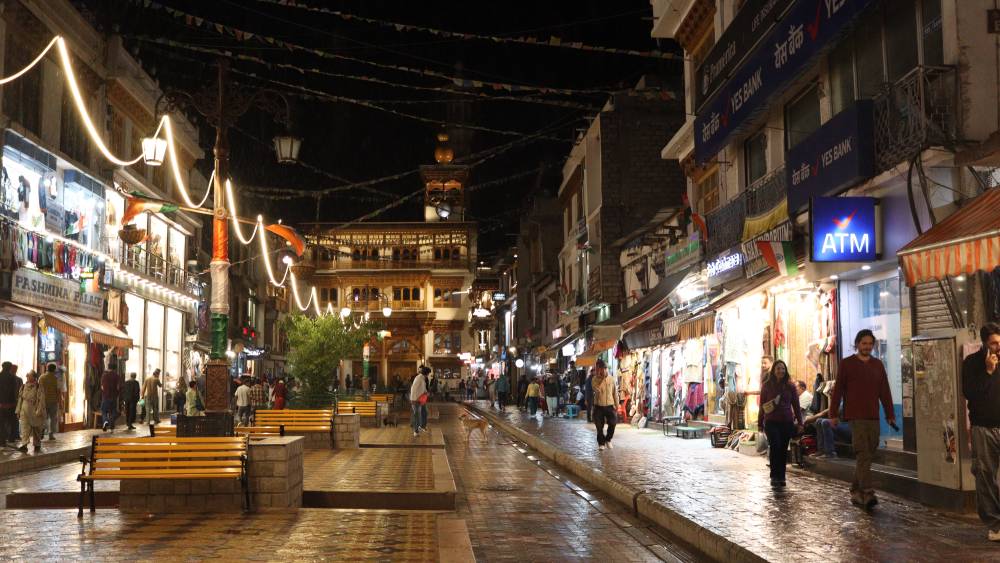
Arriving in Leh felt like stepping into a different world. The town exuded a European charm, with streets lined with vibrant shops and bustling cafés. Foreign tourists mingled with locals, many of whom wore a blend of traditional and Western attire. Over the next five days, we explored every corner of this desert metropolis. The contrast between Leh and Kargil was striking: Leh was cleaner, more developed, and brimming with energy.
Our days were spent filming and taking in the sights, while evenings were reserved for market explorations. The Tibetan Refugee Market, run by long-term Tibetan residents, was a hive of activity. Stalls offered Tibetan handicrafts, traditional jewellery, prayer beads, hand-woven carpets, Buddhist artefacts, thangka paintings, and an assortment of local spices and dried fruits.
Leh’s nightlife was equally captivating, with concerts and events lending it the vibrancy of a modern city. Each day, we returned with no less than 250 GB of data, which Shahzad diligently transferred to hard drives late into the night.
We also visited the Central Asian Museum, an institution dedicated to Ladakh’s historical ties with Central Asia. Situated near the Leh Jama Masjid, the museum highlighted the region’s role in Silk Route trade and cultural exchanges with Tibet, Baltistan, and Central Asia. Its collection included ancient manuscripts, coins, maps, and traditional costumes, offering a glimpse into the lives of traders and pilgrims who once traversed these lands. The museum also showcased Ladakhi history, art, and Buddhist culture, enriching our understanding of the region.
Into The Nubra Valley
After five memorable days in Leh, we set out early for Nubra Valley. At 6:30 in the morning, Khardung La loomed ahead, its formidable road and biting cold a sharp contrast to the 30-degree warmth of Srinagar. At just 4 degrees Celsius, the mountain pass reminded us of its strategic importance. Historically, it connected Ladakh’s Sindh Valley with the Shyok Valley and served as a gateway to Siachen, the strategic glacier where, as it is being said, two bald men are fighting over the comb.
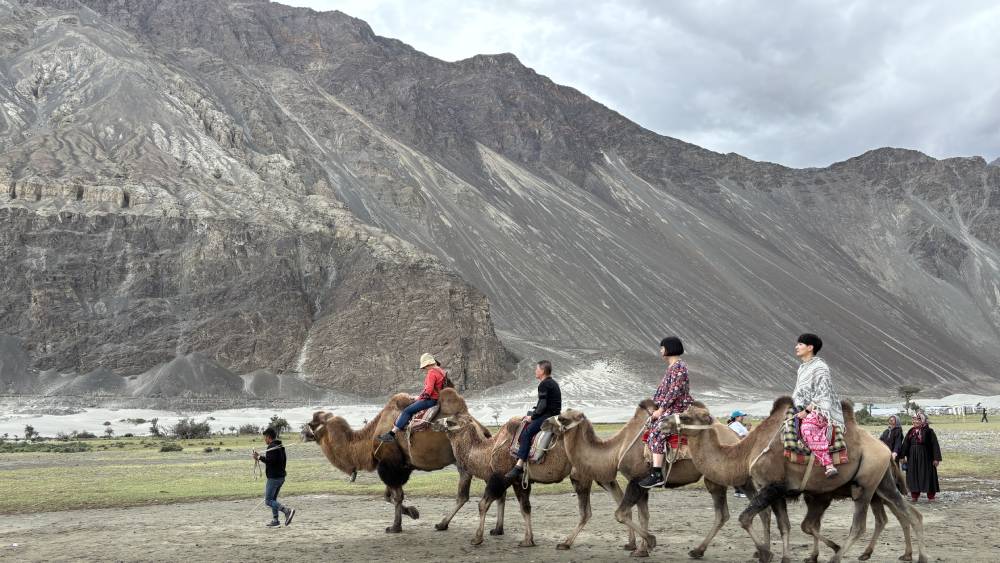
The Silk Road travellers once passed through this route, pausing in the valley to rest and tend to their animals. Our first stop was Hundar, famed for its double-humped Bactrian camels. These camels, remnants of the Silk Road era, trace their origins to Mongolia. When the trade route ceased to exist in a new political geography, the camels were left behind, eventually becoming integral to the local culture. Today, their population exceeds 300, concentrated in Hundar and Diskit.
While these camels once transported goods across vast distances, they are now central to the region’s tourism, attracting visitors eager for selfies and rides across the dunes. Hundar, teeming with foreign and Indian tourists, felt almost cinematic as we captured the dunes and camels in our frames.
As we filmed, a sudden downpour interrupted the serene landscape. Locals, unfazed, explained that such weather shifts were typical. Seeking shelter, we hurried to our vehicle and set off towards Turtuk, ready to embrace the next leg of our journey.
The Borders
During the 1971 war, several villages were wrested from Pakistan in a surprise operation in the erstwhile Baltistan. Turtuk and Thang were the two villages that were supposed to be the final destinations of our journey. Initially, we were supposed to go to Changthang, the original exit to Chinese Turkistan but the tensions (now apparently settled) on the Line of Actual Control (LoAC), prevented us. This cluster of villages, maintains their cultural identity, with most residents still speaking Balti, a language that underscores their shared history.
We arrived in Turtuk late in the evening, exhausted and struggling to find accommodation. With no mobile network, we eventually located a small hotel, connected to Wi-Fi, and informed our families and office of our safety.
Having travelled in darkness, we were unaware of the surrounding beauty. But as we drew back the curtains the next morning, the view was breathtaking. Nestled in the Karakoram range and flanking the Shyok River, Turtuk revealed itself as a hidden gem—a serene hamlet exuding natural charm.
A Storied Past
Turtuk’s history is as compelling as its landscape. Claimed by Pakistan following the partition in 1947, it remained under Pakistani control until India reclaimed it during the 1971 war. For 24 years, its people endured separation from their roots, families, and cultural identity. Even after its reintegration into India, the village remained closed to outsiders until 2010.
Today, with a population of over 4,000, Turtuk has become a haven for travellers seeking respite from urban chaos. The village framed by the towering Karakoram peaks—including a distant glimpse of K2—features stone houses and mustard-yellow barley fields glowing under the sun. Every household seemed to contribute to tourism, offering homestays or heritage house tours. Some locals charged visitors to explore private museums, creating sustainable livelihoods, especially for women.
One of Turtuk’s most ingenious features is its natural cold storage system. Villagers have carved small hollows that remain cool year-round due to an underground glacial watercourse, preserving perishables without modern refrigeration—a remarkable testament to their resourcefulness.
Among all the places we visited, Turtuk left the most profound impression. Despite its growing popularity and the influx of tourists, the village retained a tranquil air. The crisp, cold breeze carried an unmatched serenity, making Turtuk the most enchanting stop on our journey.
Onward to Thang
The following day, we continued to Thang, the northernmost village, located a few kilometres beyond Turtuk. Accessing Thang required passing through Tyakashi and obtaining permission from the Army. Situated just 2.5 kilometres from the Line of Control (LoC), it offered a stark, unfiltered view of the border with Pakistan.
Known historically as Dhothang or Thanga Chathang, Thang is part of Baltistan’s Chorbat region, which the 1972 Line of Control divided between India and Pakistan. The population, predominantly Balti Muslims, bears the emotional scars of separation.
While Thang lacks iconic landmarks, its stories are unforgettable. Villagers speak of families torn apart by conflict, with loved ones stranded on the other side of the border. Standing at the edge, residents pointed across the LoC with tearful eyes, recounting tales of longing and loss.
The poignancy of Thang lies not in its physical beauty but in the resilience of its people, who have endured decades of separation while maintaining their cultural heritage and unwavering hope for unity.
Tourism has brought new opportunities to Thang, infusing the area with resilience amidst sorrow. Women from the village have set up small stalls near the border, selling apricots, sea buckthorn, and nuts. Some have taken an innovative approach, renting out binoculars to visitors keen on glimpsing the other side of the border for a modest fee. This juxtaposition of grief and enterprise epitomises life in Thang, where perseverance endures in the face of profound loss.
The journey reached its emotional zenith at the border. An elderly man stood weeping, his family a mere kilometre away yet unreachable. The raw poignancy of the moment left an indelible impression on all of us.
Homecoming
On the return trip, I invited the team to reflect on the experience, each member rating it in their own way. Iqra, who worked with unwavering dedication throughout, seemed less enthused and rated the journey two stars. Fayaz, on the other hand, was effusive, awarding it five stars. Umar, in his characteristic style, refrained from numerical ratings and simply called it a “Bomb!” Shahzad offered a balanced perspective with three-and-a-half stars, while Mudasir settled on three. For me, it was unquestionably a five-star experience for the depth of understanding and perspective it provided.
However, the day was not without its difficulties. Mudasir fell ill on the return journey, prompting a visit to Leh Hospital. Doctors diagnosed an allergic reaction, likely caused by the buckwheat bread we had consumed in Turtuk. Thankfully, the condition was not serious and was promptly treated.
As the project concluded, the immense effort that brought it to fruition became clear. Iqra’s tireless dedication to editing ensured each episode was crafted with care and precision. Her meticulous work transformed our journey into a compelling series, capturing not only the stunning landscapes but also the stories, struggles, and indomitable spirit of the people we encountered along the way.
In the newsroom, we are told the tale-telling of the Silk Route has just begun. Is another ‘sabbatical’ for us on its way!
(The author researched and directed the 16-fim show).