A young Kashmiri PhD scholar is turning Srinagar’s fading traditions into vibrant street murals, one brushstroke, one wall, one story at a time, reports Afreen Ashraf
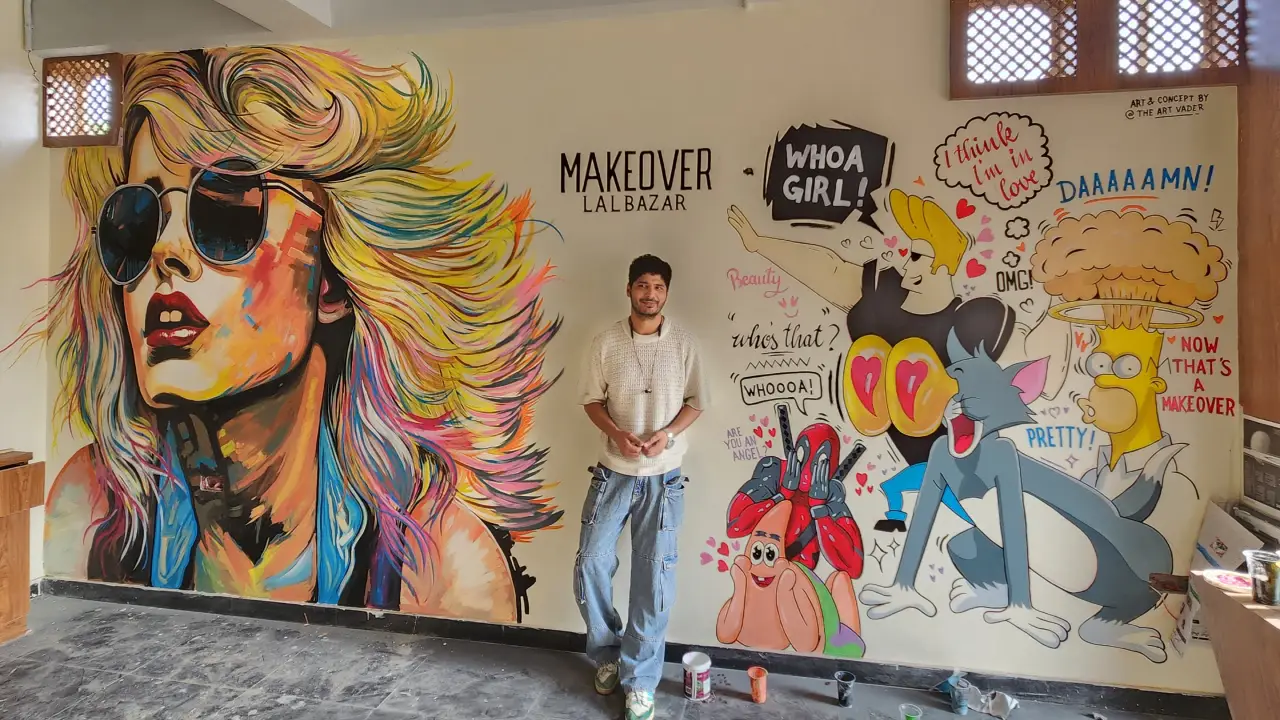
On a weathered wall along the Rajbagh bund in Srinagar, a Kashmiri woman rendered in vivid colour stands grinding spices in a mortar, her pheran draped around her, and hands carrying the weight of generations. Passers-by slow down. Some stop entirely. A group of French tourists once did more than that; they documented the process, asked questions, and lingered long enough to understand that what they were witnessing was not decoration. It was preservation.
Behind the image stands Shahran Fayaz, 27 years old, PhD scholar, and one of Kashmir’s most compelling street artists. Quietly and deliberately, he is redefining how the valley sees itself.
Early Strokes
Art announced itself to Shahran early. While classmates were learning to colour within lines, he was already experimenting with shades and shadows, teaching himself advanced techniques through practice alone. By the time he finished his board examinations, what had started as curiosity had sharpened into craft.
High school became his first real canvas. He painted names and numbers onto football jerseys, then moved to portraits of family and friends. Each piece was deliberate, a way of keeping his hand in motion and his eye in training. The turning point arrived in 2017, during his first year of college, when he was commissioned to paint a 10-foot depiction of wrestler Muhammad Ali at Gold Gym, Rajbagh. Standing before that finished wall, something shifted.
“Everyone paints on canvas,” he said. “I chose walls because they reach a wider audience. I wanted my work to be seen, and to linger in people’s minds as they pass by.”
A Threatened Culture
Shahran’s subject matter is not accidental. He paints Kashmiri heritage with the urgency of someone who fears it is disappearing. Weavers bent over looms, old domestic objects like the daan and samavar, women in traditional dress, each image is a fragment of a world he worries younger generations are losing contact with.
“Our Gen Z and Gen Alpha only know what is shown on media, mostly by outsiders,” he said. “I want to remind them of our roots, our stories, our history.”
That conviction has driven some of his largest works. At Srinagar Airport, he completed a 36-by-10-foot mural, his largest yet, depicting wood carving, shawl weaving, and traditional Kashmiri objects. The placement was deliberate: thousands of visitors pass through those doors each year, and Shahran wanted Kashmir’s culture to be the first thing they encounter. For Shahran, these are not decorative pieces. They are cultural arguments painted in acrylic.
The Scholar Painter
Balancing a PhD with large-scale public art projects is not straightforward, and Shahran does not pretend otherwise. He takes leave from university only for projects outside Srinagar, committing the rest of his time to research and academic work. “I have always been academically inclined,” he explained, “but art is my profession. It is what I want to pursue fully.”
What has made the balance possible, he said, is his family. Unlike many artists who navigate pressure to choose a more conventional path, Shahran has had consistent support from home. “Family support has been a cornerstone of my journey,” he admitted. His family accepted days-long absences for projects without objection. “They want me to excel, like any other parent, but they never objected to my choice.”
Criticism and Growth
No artist’s path is without friction. Shahran has faced criticism, sometimes from the very people who later became admirers. “I have seen people who first criticised my work and then appreciated it later,” he noted. That evolution in perception, he said, taught him to trust his own vision and keep moving.
Today, he leads a team. He mentors younger artists, introduces them to street painting, and watches the community around his work grow year on year. His ambitions extend further still: he is planning to establish an art school in Kashmir, one that would train the next generation of street painters and create employment in a field he has built almost from scratch.
Rooted in the Valley
Despite interest from beyond Kashmir, Shahran has no intention of leaving. He chooses crowded locations deliberately, walls where every passer-by becomes an unplanned audience, where someone who has forgotten their heritage might suddenly remember it, and where a visitor unfamiliar with Kashmir might begin to understand it.
“Kashmir is my inspiration,” he asserts. “Nothing is worth leaving Kashmir. This is home. I want to excel here, and if I can, I want to live and die here.”
Each mural is, in his telling, a chapter in an ongoing story, one that honours the past, speaks to the present, and reaches toward a future where Kashmir’s culture is not just remembered but alive. In every stroke of paint on every public wall, Shahran Fayaz leaves something of himself: his heritage, his conviction, and his quiet, colourful insistence that the valley will not be forgotten.