In the shadow of lofty peaks and ever-shifting terrains, the anxiety of travelling through scary stretches of NH-44 remains despite different interventions. With the uncertainty of the road and rumours around, a man laced only with a mobile phone has emerged as a reliable resource to facilitate safe navigation. Ibtisam Fayaz Khan writes about Tahir Banihali.

On a cold morning in Banihal, where mist clings to the mountains and the scent of damp earth lingers in the air, Tahir Ahmad Giri wakes before sunrise. The town remains in slumber, but he is already checking his phone. Somewhere along NH44—the arterial highway linking Kashmir to the rest of India—travellers await his updates for making an informed decision.
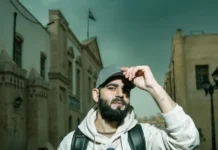
Standing on the bustling highway, the road stretching endlessly behind him, Tahir exudes quiet confidence. His posture is firm, his neatly trimmed beard and moustache lending him an air of composure. Amid the relentless flow of traffic, he remains unwavering. His peculiar Urdu delivered interestingly commands attention. Whether offering updates or reassuring the stranded, he does more than provide information—he instils trust.
For thousands, he is simply Tahir Banihali—the man who ensures the road never falls silent.
A Camera and a Voice
Born in Bankoot, a quiet village in Banihal, Tahir grew up in the shadow of the Pir Panchal mountains. His father, a farmer, led a simple life, instilling in him the values of hard work. As the eldest son, Tahir felt a deep sense of duty—not just to his family but to the land that shaped him.
His formal education ended after the 12th grade, but his instincts, sharpened by his rugged surroundings, proved more valuable than any classroom lesson. He found work as a supervisor for a construction company, a job that brought him into close contact with NH44. There, he witnessed the highway’s unpredictability—landslides, roadblocks, stranded passengers, accidents.
At first, he was just an observer, watching the chaos unfold. Then, something about the road and its stories drew him in. He began recording brief clips of landslides and road closures, uploading them online without commentary. Just raw footage, stripped of context. Few noticed. Fewer cared.
Encouraged by friends who recognised his impactful oratory skills, he decided to add narration. That changed everything. His calm, measured voice became the missing piece. Travelers started paying attention. His updates were no longer mere clips; they became essential bulletins, packed with crucial details about road conditions, alternative routes, and safety warnings. Slowly, his following grew. Truck drivers, taxi operators, and tourists began relying on his real-time reports.
Over time, his presence on social media expanded. Yet, for him, it was never about numbers. On Facebook, his page, National Highway Updates (Tahir Banihali), amassed more than 703,000 followers. Across India, from truckers to tourists, people checked his updates before setting out. On Instagram, his account gained around 91,000 followers—all drawn not by spectacle but by the reliability of his work.
The Roadkeeper
Each morning, before stepping outside, he sifted through messages—drivers stuck in traffic, tourists asking about safe travel times, and families in distress after losing belongings on the highway. Understanding their struggles, he answers them all.
One day, a family from Uttar Pradesh lost a wallet near the Nashri tunnel. It held money, identification documents, and a fragile sense of security in an unfamiliar place. Two brothers from Handwara contacted Tahir in desperation. He did not hesitate. A video went up on his page, detailing the loss and appealing for help. With the assistance of a local police officer and security footage, the wallet was traced. Tahir ensured its safe return by post, without seeking recognition or reward.
Stories like these made him more than an information source; he became a figure of trust. Even those who had never met him believed in his integrity.
When he said the road was closed, people stayed home. When he announced the highway was clear, travellers moved forward with confidence.
Yet, despite his growing influence, Tahir rejected any labels. “I am not a journalist,” he often said. “I just provide updates for the welfare of people—nothing more, nothing less.”
Surviving Storms
Neither rain nor snow nor landslides deterred him. When a storm-battered NH44 or the snow thickened to the point of zero visibility, he stood at the roadside, documenting conditions for those who could not afford to take risks.
Warnings came often. “Tahir, be careful. Do not put yourself in danger.” He always nodded, always smiled. But his actions never changed. “If Allah wills for me not to reach there, then so be it,” he would say, tightening his grip on his camera and moving forward.
His work was not without obstacles. Initially, officials questioned his presence, wary of an independent voice commanding public attention. But over time, they too recognised what the people already knew—Tahir was not chasing headlines or personal fame. His updates reduced panic, managed traffic, and saved lives. Eventually, the Banihal administration came to respect his work, seeing it as an unofficial but essential service.
Beyond Barriers
His words became part of the region’s lexicon. From children in Kashmir to truck drivers across India, his signature phrases— “Katayi zehar mausam hai” and “Agar hum traffic ki baatkarein, dhyaan naal, pyaar naal, bade maza naal chal rahahai”—echoed in homes, on highways, even in everyday humour.
One evening, a Kashmiri father sat for dinner with his daughter. The seven-year-old took a bite of her mother’s cooking, paused, and then declared, “Papa, katayi zehar banaiyuv!”
Her father laughed, shaking his head. Even the children had picked up Tahir’s lines.
Yet, beyond the humour and recognition, he remained focused. He had seen the highway’s darker side—fatal crashes, lives lost in seconds, families shattered. Those images stayed with him, haunting his quiet moments.
And still, he never turned away.
Guardian of NH44
Unlike many social media influencers, Tahir remains behind the camera, not out of anonymity, but because he believes his work should speak for itself. He rejects the viral culture that thrives on controversy, refusing to chase likes at the cost of integrity. Sensationalism, he believes, should not be amplified. The more negativity spreads, the deeper it takes root in people’s minds.
In a digital landscape where visibility equates to influence, Tahir chose a different path. He would not upload anything immoral or disrespectful. Videos of accidents? Only if they served a purpose. Sensational stories? Not his style. Some events, he believed, needed to be handled privately, not broadcast for views.
When asked to cover incidents beyond his reach, his response was firm: “Jab maiwahatha hi nahi, tohmaikaise upload karun? Jab mainekuchdekha hi nahi.”(When I was not there, how can I upload? When I have not seen it myself?).
He distanced himself from hearsay, knowing that every piece of information he shared made him answerable to the public.
Many times, people sent him compromising videos, hoping he would expose others. Instead, he contacted those involved, warning them of the consequences. “Some mistakes do not need public trials,” he believed. “People deserve a chance to correct themselves.”
Even requests to promote charity cases were met with caution. A past mistake—unknowingly amplifying a fraudulent fundraiser—had taught him a hard lesson. Since then, he refused such appeals, even if it meant disappointing people. “I cannot break the trust people have in me,” he said. “I have to stay true to my work.”
Fixed Focus
Tahir is clear about his boundaries. He refuses to dilute his impact by venturing beyond his purpose. Social media is saturated with those who post indiscriminately—from political debates to viral trends—but he will not be one of them.
His work is specific, and that specificity is what makes him reliable. If he begins covering politics, protests, or entertainment gossip, he knows he will lose what sets him apart. “Agar har cheez daalni hoti, toh fir sab log ek jaise hote,” he said. (If everyone posted everything, then all content creators would be the same.)
His discipline is his distinction. He is neither a journalist chasing headlines nor an influencer seeking attention. He is simply Tahir Banihali—a man with a phone, a purpose, and a responsibility to those who trust him.
Responsible Reporter
Despite studying only up to the 12th grade, Tahir possesses an instinctive grasp of ethics—something many social media influencers lack. He is meticulous about what he uploads, ensuring his content is appropriate for all audiences.
Privacy, especially for women, is non-negotiable. Whether tourists or locals, their faces are never shown without consent. He understands the responsibility that comes with wielding a camera.
His sense of duty extends to the truck drivers he calls his “brothers.” When a truck carrying goods is stranded due to a roadblock, he records a video, mentioning the company’s name and details, ensuring those affected are informed.
Unlike many who chase virality, Tahir considers the broader impact of his content. Social media, he believes, should be user-friendly and suitable for all, including children. “A simple joke or chutkula is fine,” he said, “but there must be a limit.”
Tahir is careful with language, avoiding inflammatory remarks or content that could spark unnecessary disputes. “I learn by observing others,” he said. Studying the negative responses influencers receive has helped him keep his work rooted in decency and responsibility.
He even took a stand against content theft, calling out pages that re-uploaded his videos without credit. “It is not just about a video,” he said. “It is about the effort behind it.”
The Road Ahead
Tahir never sought fame, but it found him. Invitations to events, felicitation ceremonies, and messages of appreciation poured in. Yet, his greatest reward remained the pride in his parents’ eyes.
His work brought him a sense of purpose. Once vulnerable to distractions and negativity, his mind was now focused on something meaningful—something that benefitted not just him but thousands who relied on his updates.
And so, the man from Bankoot continues his journey. No office, no newsroom, no grand setup—just a phone, a road, and an unwavering commitment to truth.
NH44 will always be unpredictable. The storms will come, landslides will block the way, and snow will sometimes erase the road altogether. But as long as Tahir Banihali stands with his camera, travellers will always have a guide.