A hearing-impaired care leaver, Hajira Bano, transforms personal loss into literature and social advocacy, reports Afreen Ashraf
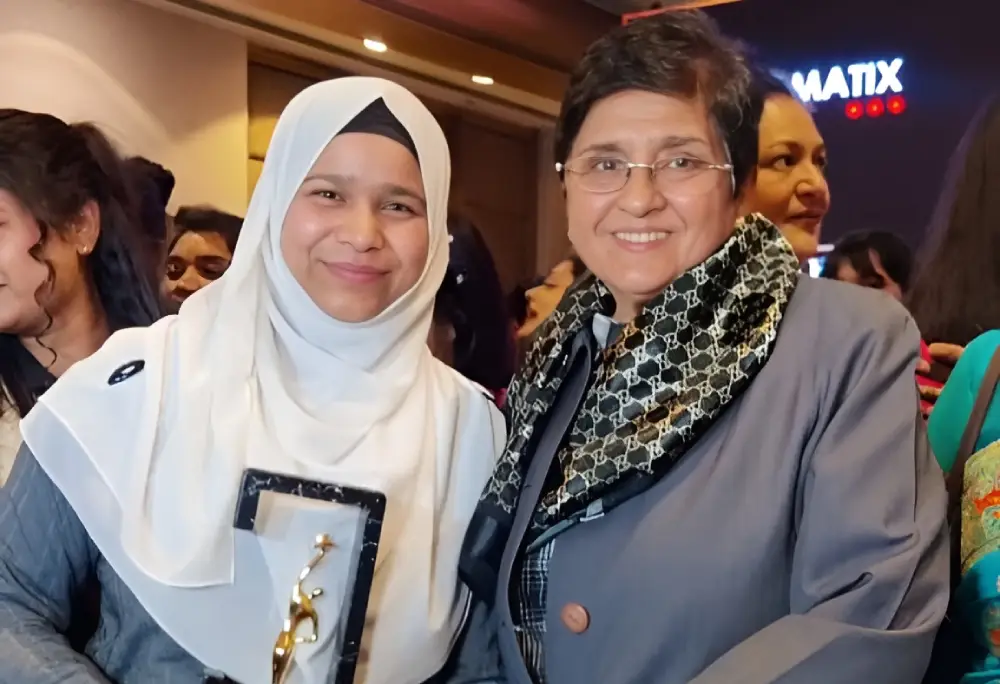
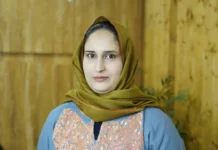
Hajira Bano listens to the world through pen and paper. For a woman who grew up with hearing impairment, words became her way of understanding people and pain. A passionate writer from the Gogji Patri (Budgam), Hajira is a published author and a care leaver from a marginalised society, and is gradually emerging as the voice for those who often speak but are not heard.
Hajira insists that writing has helped her find her identity. Currently working on her third book, her autobiography is aimed at emerging as a role model for all those who are told, “you are impaired, and you cannot do this work”.
“I used to read stories from a very early age,” Hajira said, and whenever she didn’t like an ending, she would write her own. This gave her hope. “Maybe because of this habit, I took a pen and wrote down my own story, even though everyone had already written a care leaver’s destiny.”
Initially, Hajira used to write in Urdu for herself. After realising her Urdu was not polished enough, she began writing in English.
= Writing for her was a catharsis. Much later, she was encouraged to share it with her orphanage patron, Papa Ji, whom she defines as the only reason she could move forward in this field.
Hajira describes her time at the orphanage as her inspiration rather than a limitation. For her, she could never have been Hajira without it.
“If I had been brought up in my village, I would have been confined to the kitchen and family restrictions. But Papa Ji and the CCI made me a writer and an inspiration for several care leavers indeed.”
= In her early life, Hajira faced many problems, including a language barrier. She was admitted to a CCI at the age of five, coming from the Gujjar community and knowing only Gojri.
She had to fight on two fronts: she could not hear properly, and whatever she heard, she often could not understand. “Almost daily, all the girls used to gather and perform specific activities like singing, discussions and several other activities,” Hjira remembers. “But I used to stay in my room as I feared I wouldn’t understand, and asking several times for translation can make conversation awkward for others too.”
This restrained her from many fields in which she believes she could have excelled, otherwise. Gradually, she learned Urdu and Kashmiri. “Now, I speak four languages”, a proud Hajira said.
= Hajira was born deaf. “We have a genetic disease; my uncle also has a hearing problem,” she explained.
Hajira’s hearing deteriorated gradually. When she got a hearing aid, she was already in twelfth grade. She never felt the need for a hearing aid, as people around her never made her feel different.
After leaving the CCI, she felt uncertain and realised she needed support. At the same time, however, she understood that her impairment had made her a keen observer and had given her another sense beyond the usual ones. “I now try to remove my hearing aid from time to time, so that I can cope with complete hearing loss and prepare myself for a future without sound.”
Hajira was five years old when her father died of pneumonia, leaving behind his wife, a son, and Hajira. Family financial crisis landed her in an orphanage, where she spent the next 19 years.
During this time, her family had no permanent shelter and remained separated and scattered. This, Hajira asserted, made her realise the importance of family. “When vacations came, and children packed their bags to go home to their near relatives, I, along with some other children who had nowhere to go, stayed back in the hostel.”
Though her mother visited her on Sundays, Hajira always felt the urge to live under one roof with her family. Yet she believes that all this suffering was better for her, as it built her strength and prepared her to endure anything life brings.
After completing her tenth standard, Hajira wanted to opt for the humanities stream to pursue her career in writing. However, due to limited opportunities and budget constraints, she had to choose the medical stream as the orphanage offered only medical and non-medical options. “So, I accepted it and thought I would decide after 12th.”
Later, she opted for nursing to secure her livelihood.
In the third year of nursing, Hajira fell into deep depression. It was after this phase that she returned to writing, and out of that darkness her first book, Journey from Darkness to Light, was born. It was a compilation of poems and essays which she wrote during her depression.
This writing reflects the lived moments of specially-abled individuals and care leavers. One of the stories is about a visually impaired boy who expresses his feeling that how he sees colours when mentioned in front of him. Being a hearing-impaired child, Hajira believes that writing is a way of listening when words fail.
Hajira started writing her second book during her LIFT Fellowship. She was assigned to highlight the struggles of specially-abled individuals and care leavers in Jammu and Kashmir.
She worked on this assignment for an entire year and lived with these children for six months.
“That is where I got the idea to write a book and highlight their courage-how they still see the world despite their impairment,” she remembers. With the fellowship support and a government scheme, she was able to build her own home. “Only after that was I able to live with my mamma and brother,” a happy Hajira said.
Not to give up the cause, she, along with some of her seniors, initiated the Jammu and Kashmir Care Leavers Network after witnessing the lack of aftercare support in the region. But the idea fell flat for lack of financial support.
She believes an aftercare system must exist in Kashmir, one that teaches skills and provides financial stability to care leavers.
Now, a content Hajira lives with her family, earns, and supports them. Though her deteriorating hearing loss remains a concern, she believes she is prepared to face it.