Three Budgam youths quietly repair Kashmir’s deadly potholes, reducing accidents through volunteer effort amid neglect, reports Shoaib Nazir
Some of Kashmir’s roads are so pothole-ridden that they trigger frequent road accidents. With the government too preoccupied with adding big roads to the network, a group of men is addressing that concern. The group comprising three young men operates in silence, without any media attention or government assistance. They fix patches that have been broken for years.
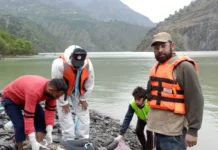
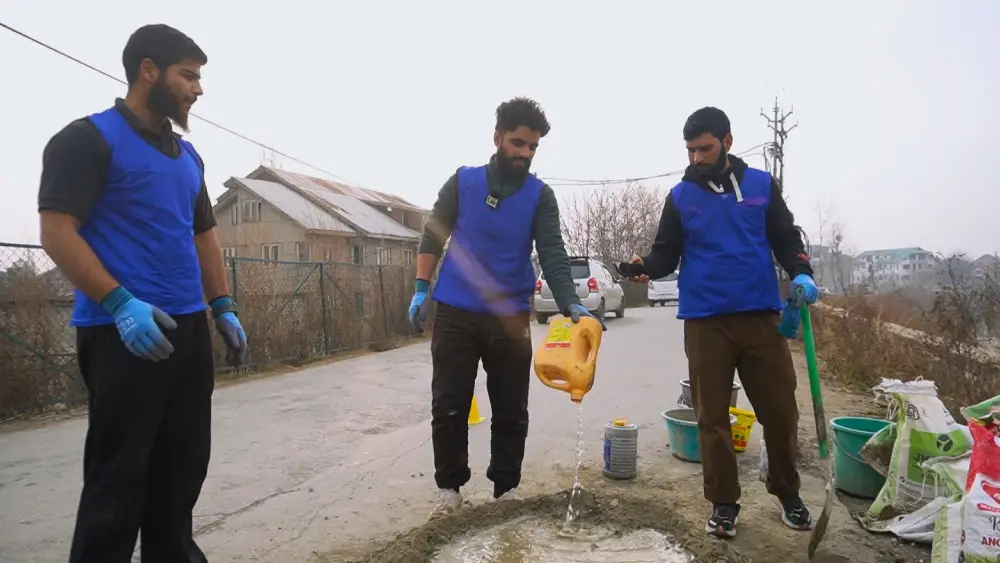
The volunteers are from Budgam’s Narkara village. Leading the group is Younis Ahmad, a delivery worker supported by two friends, one a college student, Shahid, in his second semester and Ishfaq, an apparel seller’s salesman. They call themselves Road Makers. They do not have an office or equipment beyond shovels and broken buckets.
The thought for the initiative was born out of a tragedy. One of the members said they had another friend, who fell into a pothole and survived crippled, and that gave them the idea that somebody must work on this key deficit, neglected by all.
Commuters getting into potholes and surviving with injuries is not so uncommon.
“In 2021, my cousin died because of a disfigured road,” said Owais Ashraf, a resident of Nowgam. “He was riding a bike when he hit a pothole near Kenihama, BK Pora. The bike skidded and struck an embankment. This was fatal. The government repaired and macadamised the road, but only after a life was lost.”
For too many middle-class Kashmiris, two-wheelers are the means of transport. These vehicles offer little protection. Roads expose riders to danger. The region’s climate causes roads to deteriorate even after coating. Residents attribute damage to repair delays, quality control issues, and traffic flow. Trucks carry loads that the sub-grade cannot support.
“We do not oppose the government or the administration,” Younis explained. “This is a mission to reduce accidents and save lives.” He spoke while pouring gravel into a hole. His hands were covered in dust. He and his friends seek no remuneration from what they do. They do it in the public interest.
The initiative has had an impact on residents. A driver from Barzulla thanked the group after they fixed a road that had caused damage to his vehicle. “We are thankful to these boys,” he said. “They fixed a street where my car had broken down.” The driver drove to the spot where the trio was working and offered water to them.
Road Makers have no funding, sponsors, or organisational support. The group does not accept donations. Instead, they ask for materials: cement, sand, gravel, and stone dust. These are provided by people as donations. A shopkeeper might provide a bag of cement. A contractor might drop a load of sand.
“Our vision is that Road Makers should not be limited to Budgam or Srinagar. It should be a name throughout Jammu and Kashmir,” Younis said, envisioning a network of youth in every district. Each group would monitor their own streets. They would patch holes before they expand.
The trio aspires to use macadamisation in the future. Their slogan concerns accountability. “In some countries, roads receive maintenance because citizens take care of resources,” Younis asserted. “The principle should apply here. Roads worsen because people do not care for them. The cost of repair rises if damage is not attended to.”
Kashmir has a huge network of roads. Officials said there are 8264 roads running a cumulative length of 13612 km. There are six different owners and stakeholders to manage these roads. While hundreds of crores of rupees are being spent on additional road networks, there is not much resource available for maintaining them.
Rash driving and other factors, the bad road condition is a key factor in road accidents. Official data suggest that 28,510 road accidents occurred in Jammu and Kashmir from 2020 to 2024. These mishaps killed 4,031 people. Over-speeding was cited as the cause of 27,195 accidents and 3,956 deaths in these five years.
The data indicate that while driver behaviour is a factor, the condition of the road surface contributes to the loss of control. A pothole forces a driver to swerve. This swerve leads to head-on collisions. In the winter months, the moisture on the broken roads turns to ice. This creates a surface without friction.
Younis and his associates feel that the reason to act is personal. “Just like other humans and Muslims, it is our responsibility to take care of the community,” he stated. He cites the tradition of removing obstacles from the path of travellers as a good deed, a service required on the ground.
The group works during their off-hours. Younis finishes his deliveries and then meets his friends. They use a rented vehicle to transport tools. They manage potholes, about which they get most complaints. They clear the debris first, and then pour the mixture. They level it with wood. They wait for it to dry before allowing traffic to pass.
Residents observe these actions. Some stop to help. Others provide food. The Road Makers do not wait for tenders. They do not wait for the department to verify the damage. They see a hole, and they fill it.