What began as a teenage obsession with driving has grown into a full-scale transport enterprise. From Rajwar, Aijaz Wadder now commands a fleet of more than two dozen buses and trucks. Tahira Rafiq reports on an exceptional story of mobility, ambition, and self-made success.
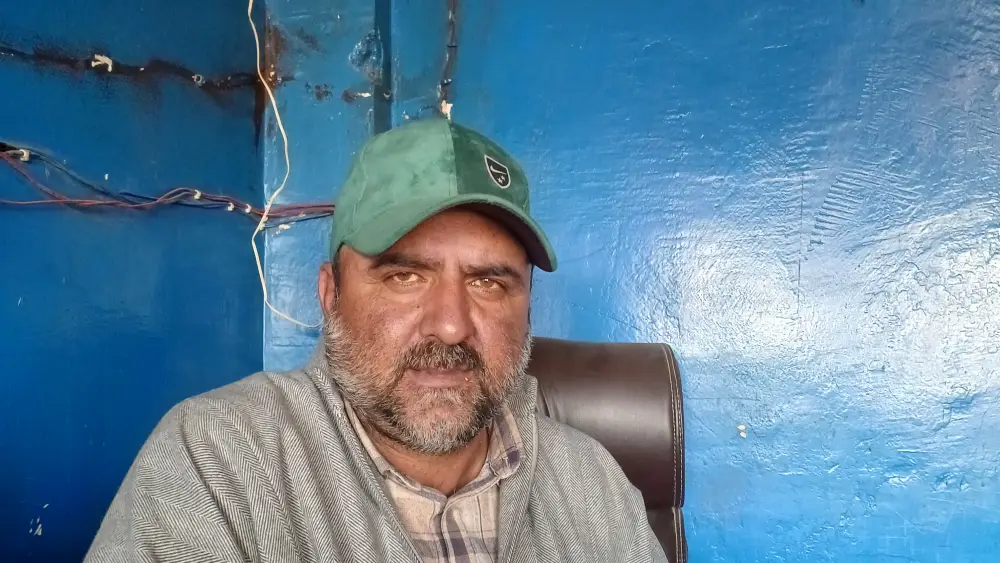
On a dusty road in north Kashmir’s Rajwar in the early 1990s, a teenage boy would slip behind the wheel of any vehicle that slowed down long enough. The vehicles were not his, and he was never meant to be driving them. Yet, whenever a driver relented, even for a few fleeting moments, he would take the wheel, inching forward in short bursts, learning the grammar of engines, brakes, and roads the only way he could.
He had no way of knowing then that this rough, improvised classroom would one day return his name, and that the very field he was trespassing into would eventually recognise him. That boy was Aijaz Ahmad Mir, now known as Aijaz Wadder.
Decades later, his name travels farther than his buses. In the transport circles of the region and beyond, Wadder has become synonymous with reliability so much so that many other owners willingly run their vehicles under his trademark: Mir and Sons.
Mapping the Road
Aijaz passed Class 9 before dropping out in 1992. Vehicles had always surrounded him, both those running in his area and those owned by his family, but ownership did not translate into control. In fact, his family hesitated to trust him with responsibility.
“I learned driving on platform trucks,” he recalled. Platforms were common then, and drivers would allow him to take the wheel for short stretches. It was informal, risky, and entirely practical.
For nearly two years, he travelled with a family-owned truck. In 1995, when the family acquired a taxi, Aijaz drove it briefly before being asked to become a conductor instead. He accepted without protest. Learning, for him, was never about status.
Despite being from a transporter family, he was desperate for this break. It came when a Mawar transporter hired him for his bus. Aijaz grabbed the opportunity. The three-year stint of driving the bus (JKC-7635) gave him the identity of a passionate and profitable driver. He then started driving another bus (JKD-5133), owned by a man from Budkoot, for two more years. Only in 2000 did he finally drive a new bus bought by his own family for him.
A Family Business
The Wadder family was in the transport sector much earlier. The family would acquire a bus and, as it aged, would sell it off and get a new one. The family’s first bus and taxi came in 1984, followed by another bus and a truck in 1987, and then the bus was sold off in 1992. These vehicles were driven by hired drivers; the family did not initially involve Aijaz directly.
“There was fear, and the family was apprehensive,” Aijaz admitted to the crisis his parents were caught in. “They thought if they handed me a vehicle, something might happen and I was not even of age to be talking about transport.” That was why he preferred to work for others instead of driving his family’s possessions.
Times have changed quite fast. By 2001, family circumstances had changed. Like many Kashmiri households, the family is split. Aijaz was handed the bus and a debt of Rs 2.7 lakh. He took it reluctantly. Within a year, the debt was cleared.
The Risk and Trust
In 2003, Aijaz bought another bus worth Rs 6.53 lakh, financing Rs 5 lakh by mortgaging the older vehicle. Initially, the financer was hesitant. When he cleared the debts in six months, the same financer offered him another bus for Rs 7 lakh.
Now, Aijaz had three buses.
“And after that,” he says, “I didn’t look back.”
An Ethic Forged
For Aijaz, transport is not just a business; it is moral work. “In transport,” he believes, “the more honest a person is, the more he progresses. The more dishonesty grows, the further they fall.”
That belief was tested repeatedly.
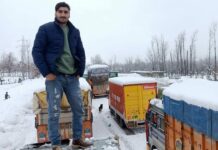
Now, Aijaz owns over two dozen buses, along with sumos, trucks, tippers, and heavy machinery. His fleet runs across North and Central Kashmir, from Handwara to Srinagar, Baramulla, Sopore, Kupwara, and the interior district routes. In winter, buses are booked for long-distance journeys, including trips to Ajmer.
During picnic seasons, demand peaks. His vehicles are also hired to transport police, army personnel, and pilgrims, wherever demand arises.
Collectively, his network employs 50 to 60 drivers and conductors. “Allah provides livelihood,” he said. “We are only a source.”
As Vice-President of the Handwara Bus Stand, Aijaz does not wish to expand further.
“Government policies don’t favour private owners anymore,” he said. Rising taxes, maintenance costs, and fitness regulations have drained his passion.
“The yearly expense of a vehicle has now risen to Rs 2.5 lakh per year compared to Rs 1 lakh earlier,” he said. “A new bus costs Rs 55lakh with a shelf life of 15 years only. It becomes impossible to cover the driver, conductor’s charges, maintenance and its finance in fifteen years.”
Yet leaving transport is not an option. Despite uncertainty, the road does not end with him. His younger son wants to continue in the transport business as long as it survives.