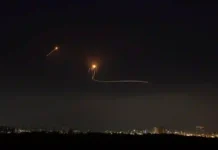
SRINAGAR: The United States launched airstrikes on Iranian missile and drone facilities as well as coastal radar sites on Friday, retaliating against what it said was an Iranian drone attack on a commercial cargo vessel in the Strait of Hormuz, marking the most serious escalation since the two countries agreed to an interim ceasefire last week.
The strikes came a day after the Singapore-flagged cargo ship M/V Ever Lovely was hit by what the US military described as a one-way attack drone while transiting the strategic waterway along the Omani coast.
The US Central Command (CENTCOM) said American aircraft targeted Iranian missile and drone storage locations and coastal radar installations in response to what it called “unwarranted aggression against commercial shipping.”
“The unwarranted aggression against commercial shipping by Iranian forces clearly violated the ceasefire. Furthermore, Iran’s dangerous behavior undermined freedom of navigation as commerce increasingly flows through the vital international trade corridor,” CENTCOM said in a statement.
US President Donald Trump defended the military action, saying Iran had violated the ceasefire understanding.
“I don’t like the fact that they took a shot yesterday, actually four of them,” Trump told reporters at the White House shortly before the strikes. Asked why military action was being taken while negotiations were continuing, Trump replied, “They’re a little bit different.”
US officials said the operation concluded within about an hour.
Iran rejected the American accusations and maintained that it had acted within its authority over the Strait of Hormuz. Ebrahim Azizi, head of the Iranian parliament’s national security commission, said on social media that “the Strait of Hormuz is governed by Iran” and described Tehran’s actions as “ceasefire management,” not a violation of the agreement.
Following the US strikes, Iran’s Islamic Revolutionary Guard Corps (IRGC) said its naval forces had targeted US military positions in the region in retaliation.
“The IRGC Navy responded to America’s aggression and breach of promise,” the force said in a statement carried by Iranian state media, adding that any further US attacks would invite “a broader response.”
The IRGC also claimed that arrangements under the ceasefire memorandum gave Iran authority over ship traffic in the Strait of Hormuz and accused Washington of attempting to undermine those provisions.
US Vice President JD Vance urged Tehran to resolve disputes through negotiations rather than military action.
“Iran signed a ceasefire agreement. We have honored it. If they have disagreements about how the MOU is being applied, they can pick up the phone. But violence will be met with violence,” Vance said in a post on X.
The renewed hostilities have raised fresh concerns over shipping through the Strait of Hormuz, a vital global energy corridor through which roughly one-fifth of the world’s oil supplies normally pass.
Earlier this week, commercial shipping had begun returning to normal after the ceasefire, with the United Nations’ maritime agency facilitating the movement of stranded vessels along an alternative route near the Omani coast. However, those operations were suspended following Thursday’s drone attack.
Shipping analysts said the latest incident had slowed the recovery in maritime traffic, although the strait remained operational.
Despite the renewed tensions, oil prices fell during Friday’s trading as more tankers resumed transiting the waterway and Saudi Arabia restarted crude loadings from its Ras Tanura export terminal after a prolonged disruption.
Meanwhile, diplomatic efforts continued elsewhere in the region, with Israel and Lebanon announcing an agreement aimed at ending months of conflict along their shared border, although questions remain over its implementation.