SRINAGAR: At the ongoing World Book Fair 2026 in New Delhi, the Abu Dhabi–based Muslim Elders Council organised a panel discussion on “AI for Humanity: Religious Perspective on Ethical AI”, bringing together journalists, academics and analysts to examine the growing influence of artificial intelligence on media, academia and society at large.
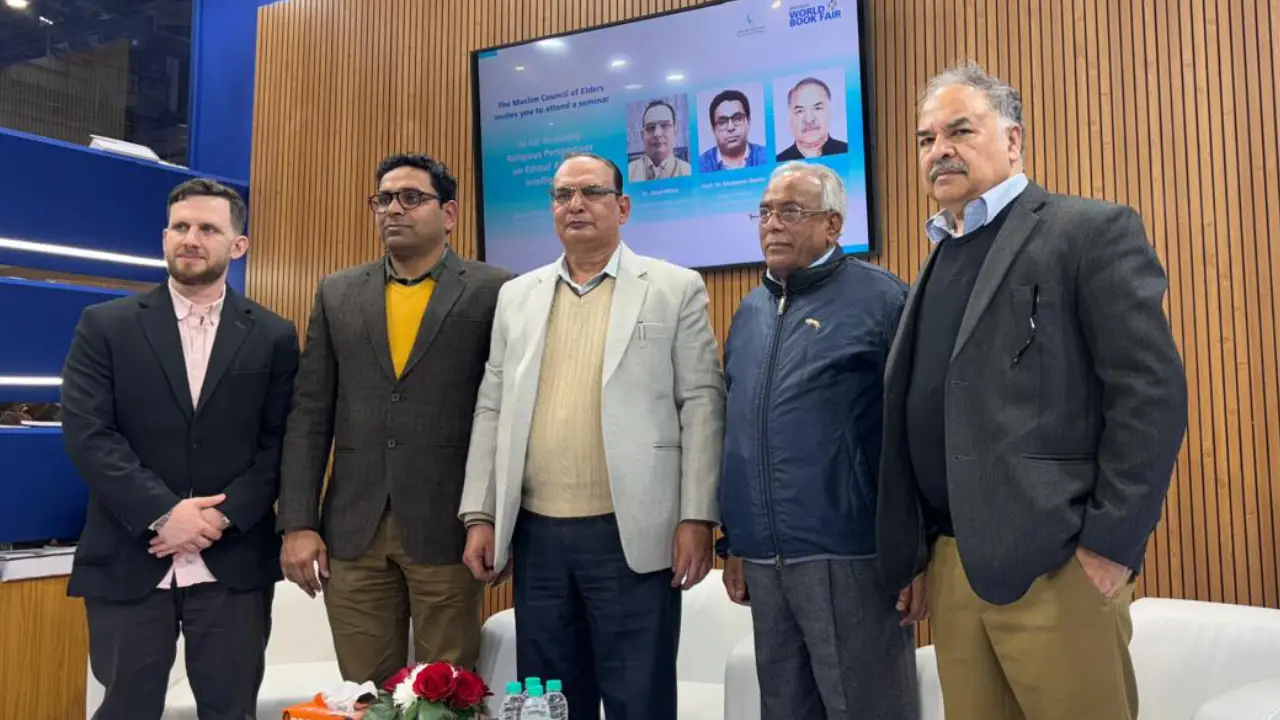
The session was chaired by former ambassador Zikrur Rehman, who previously served as India’s Ambassador to the erstwhile Palestinian Authority and as Consul General in Riyadh.
Speaking at the panel, Sanjay Kapoor, renowned journalist and President of the Editors’ Guild of India, stressed that reporting remains an occupation with a power that artificial intelligence cannot replicate. However, he warned that many news organisations are cutting back on ground reporting and increasingly relying on the internet, inadvertently strengthening AI at the cost of journalistic depth.
Referring to remarks by Elon Musk, Kapoor noted that while it is often said that trades like plumbing may remain safe in the age of AI, journalism—especially when reduced to mere question-and-answer formats—is seen as vulnerable. “In reality, when reporters limit themselves to such roles, they themselves are empowering AI,” he said.
Kapoor cautioned that the Indian media community is still not fully aware of the dangers posed by unregulated AI. He pointed out that tools like ChatGPT, despite being relatively new, can already write better than many average journalists. “If journalism loses emotional attachment, ground reporting and lived human experience, jobs will disappear—and people may not even realise when and how it happens,” he warned. He underlined the urgent need for regulation, ethical oversight and a reaffirmation of journalistic values to prevent the unchecked spread of misinformation.
Mudassar Qamar, Assistant Professor at Jawaharlal Nehru University, spoke about the impact of AI on academics, describing it as both a significant achievement and a serious cause for concern. He noted that AI tools now assist with reference lists, literature reviews, grammar checks and more. While acknowledging that overdependence on AI can dehumanise research and stifle creativity, he also highlighted its positive role in helping students overcome language barriers. He emphasised that both teachers and students must strike a careful balance between caution and informed use of AI.
Senior analyst and columnist Asad Mirza highlighted the broader implications of AI dominating various walks of life, asserting that artificial intelligence should be seen as a tool for journalism, not a replacement. He recalled that initial fears about AI eliminating jobs—particularly in writing and content creation—have partly materialised. In March last year, Italian newspaper Il Foglio published a four-page supplement produced entirely by AI, from news selection and editing to page layout.
Mirza said that when The Guardian later analysed this supplement using its own AI tools, the assessment found the content technically strong, with sharp editing and excellent layout. However, it also concluded that the human element was missing. “The news felt computer-generated—accurate and polished, but devoid of emotion,” he said.
According to Mirza, AI can undoubtedly assist in content creation, but human supervision remains indispensable. “Without a human touch, news cannot truly connect with readers or meet their expectations,” he said, adding that while AI can support journalism, it cannot fully substitute or dominate it—at least for now.
Addressing the religious dimension, Mirza cited Quranic references to argue that Islam does not oppose or prohibit artificial intelligence. On the contrary, he said, the Quran encourages the use of resources and knowledge to improve human life, as long as they do not fall within the realm of prohibition. “Islam allows the use of new technologies in all areas except worship, provided they are used ethically and responsibly,” he concluded.