Masood Hussain’s deeply personal remembrance of a Kashmiri man whose life of faith, labour, quiet sacrifice and moral certainty forged bonds beyond blood.
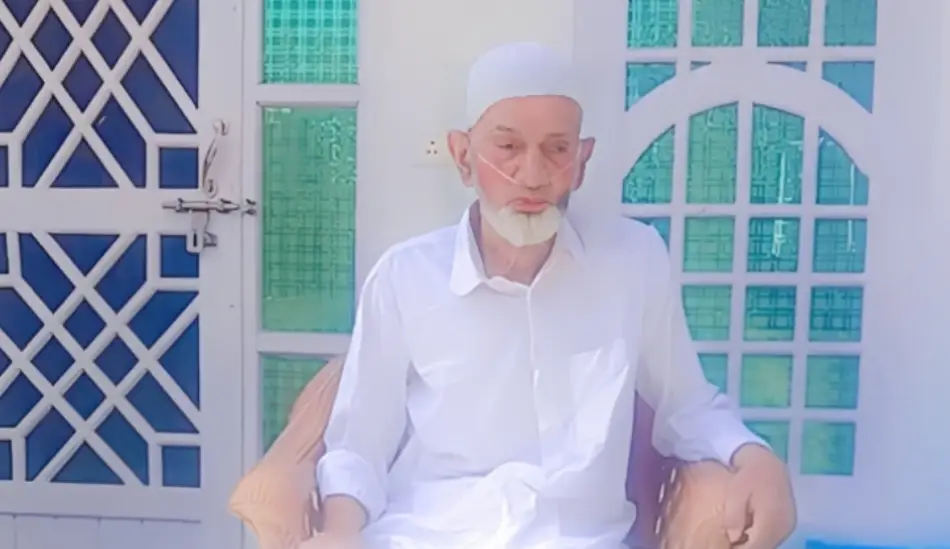
“Someone who says his name is Abbas wants to speak to you,” Kashmir Life online editor Maleeha Sofi said as she stepped into my chamber, visibly unsettled. “I think you should take the call.”
I learned later that Abbas had been trying to reach me for two days, but, as is customary in newsrooms, calls meant for senior staff are usually put through only when the caller clearly states the purpose. What finally compelled Maleeha to connect the call was a single sentence from the caller: “I need to tell him that his father has passed away.” Quickly, she put him through without knowing anything else about him.
She knew that my father had left me many years earlier. An intelligent young journalist, she understood that biology is only one of the forces that create relationships.
Momentarily confused, I picked up the call. The confusion lifted quickly when Abbas introduced himself as the son of Ghulam Hassan Sheikh, a proud resident of Dadsara in Tral. An instant sense of mourning set in. To lose someone so close and to learn of it five days later only deepened the pain.
“On Friday, December 5, at around 11:30 am, he called me into his room, made me sit comfortably, and told me that you have an elder brother,” Abbas said over the phone, his voice breaking. “He said you were his son, and also my mother’s son. He asked me to let you know that he has passed away.”
The following day, Sheikh, a chronic COPD patient, complained of minor discomfort, mostly weakness. He was taken to Khyber Hospital in Srinagar, where all tests returned normal. He passed away while speaking to his sons and daughters, three sons and three daughters. He was laid to rest the same day.
Incidental Connection
I was born and raised in a hamlet in Shopian, and my association with Sheikh was entirely incidental, formed years before guns began to rattle on the streets of Srinagar. I was perhaps in higher secondary school when, one winter day, he arrived at our home, catching both my family and me by surprise. Despite belonging to different generations, the relationship took root over time, deepening gradually as we began to visit each other regularly.
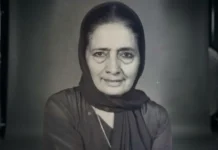
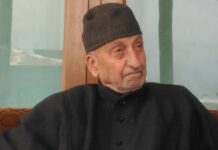
At the time, the middle-aged man was battling difficult circumstances to support his family. Born to a peasant family somewhere in 1941, he was employed with the erstwhile state’s Excise and Taxation Department since 1963 and retired in 1999 after 36 years; his work demanded long and punishing hours, sometimes at Lakhanpur and at other times at distant toll posts. His wife Zareefa Bano came from a deeply religious family in Tral and was herself an intensely spiritual person.
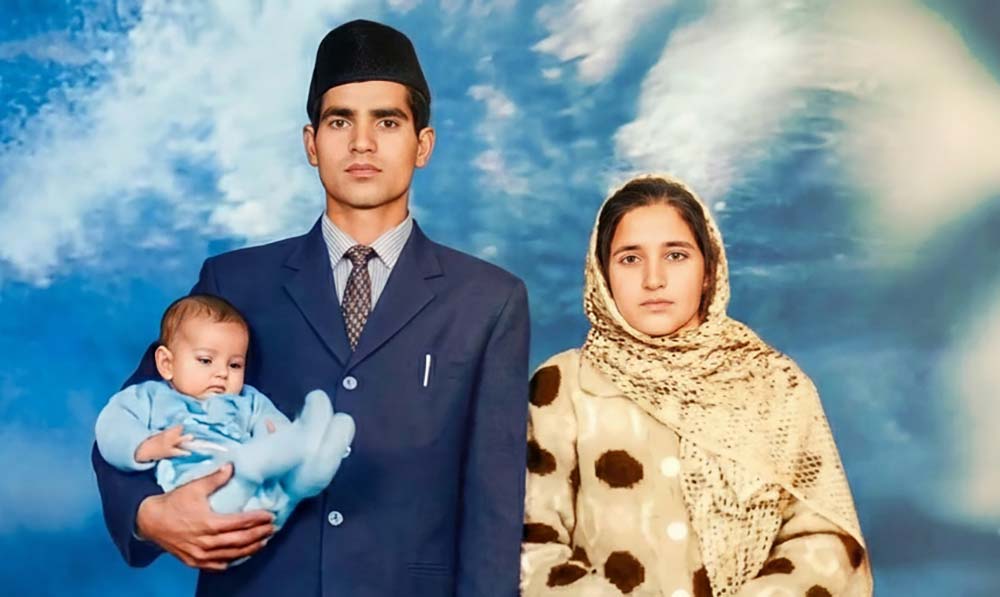
Those were the days of Kashmir’s KMD, the Kashmir Motor Drivers Association era, when travelling from Shopian to Dadsara was far from easy. One had to change at least three buses to reach what was, in effect, a town-sized village. After I enrolled at Degree College in Anantnag, the journey became somewhat easier. Even then, I made it a point to spend a few days with Sheikh’s family at least once every month.
Deeply influenced by Moulana Nooruddin Trali, the founder of Madrasa Taleem-ul-Islam, the couple also held in the highest esteem Hafiz Muhammad Charag Sahib, the founder of Jamia Anwar-ul-Uloom Dandipora. On one occasion, Sheikh took me to meet Noor Sahab, who posed a question to me; my response was mistaken, and I remember feeling acutely embarrassed.
Far removed from any strain of political Islam, the couple were immersed almost entirely in prayer, Dzikr, the Quran, and sadkaat. Technically, it was a Darvesh couple. The most demanding aspect of staying with the Sheikhs was surrendering one’s quilt nearly an hour before the muezzin called for the Fajr prayers. It was an unbending rule, from which only the seriously ill were excused. Tahajjud was compulsory as part of the household routine, followed by a visit to the mosque for prayers, and, upon return, a session of Quran recitation that continued until breakfast was served.
A Major Loss
The darkest period arrived in the summer of 1988, when Zareefa passed away at a very young age. With several small children in the house, it was the most painful blow the family had ever endured. Sheikh was suddenly left to raise six children, most of them young and school-going, while running the household and continuing with his demanding office work.
“We were always amazed at how our father managed it all,” recalled Rashid, his eldest son. “He hardly slept. His last task at night was to milk the cow and sweep the courtyard.” In the morning, Rashid said, Sheikh would clean the cowshed, carry the dung to the fields, return to prepare breakfast, cook meals, and then get the children ready for school. “Even when circumstances were far from normal, he made sure he returned home, come what may. Sometimes he would get in at ten at night and still cook for us. We would wait hungry.”
A few years later, one of his daughters grew older and began to manage the kitchen. The first major moment of happiness the family experienced came with Rashid’s marriage around 2007. For me, it felt like a family reunion. By then, I had been consumed by the blood-soaked Srinagar dateline and had become largely disconnected after militancy erupted in the aftermath of Mrs Sheikh’s death. It was not a time to probe the hardships the children had endured during those darkest years. I simply joined the long queue of baraatis, shared a hearty meal, and left for home before the dread of midnight began to dominate the highway. The next time I visited the family was in the summer of 2009, when I stopped by briefly while on an assignment.
Better Life
By 2025, when Sheikh passed away, the family had grown and found its footing. His daughters were all settled, as were his sons, now living with their families in three separate homes. More than a decade before he passed away, he had gone to the court, divided his ownership and gifted it to his three sons and three daughters after paying a fee of Rs 80,000.
The youngest chose to retain the ancestral house, not as a place to live in, but as a repository of his father’s memories and labour. “He always used to say, Please protect this home, because I used part of my leave salary and my GP fund to build it,” said Mubashir, the youngest of the three sons. “I spent good money improving it, but for living, I built a separate house.”
Rashid now wears a salt-and-pepper beard. He has never shaken off the memories of the painful years that followed his mother’s death. Yet, before she passed away, she had left behind something the children would cling to for the rest of their lives: a dream she shared with them.
“A few months before she died, she gathered us one day and told us she had seen a dream in which she was asked to prepare for death,” Rashid recalled, narrating it as though it had happened only yesterday. “She argued in the dream, asking what would happen to these children. She was told they had already been taken care of.”
She told them that in the dream, she was informed that their father would remain with them. “She asked how long and was told till he turned sixty. She refused and was asked to count,” Rashid said. “They kept adding five years, and when they reached ninety, she said no again,” Rashid remembered asking her later why she did not want their father to live till ninety and why she had settled at eighty-five. His mother, he said, replied simply, “Yeh lagge-e-dakan pateh,” meaning he would not receive proper care.
After retirement, during one of his last outings from home, Sheikh was struck by a vehicle driven by someone rushing to the airport and was seriously injured. He spent months in the hospital, as whispers and near-mourning messages began to circulate. “I dismissed all of that,” Rashid said. “I knew he was not dying.” He held on to every word his mother had spoken. “Not this time. I knew he had completed 84 years of age and that this was when he had to go, so I was prepared. In his final moments, I did waver because he was speaking normally and all his tests had returned to normal. But deep down, I knew he could not prove my mother wrong.”
There are many other stories about the couple, but it seems best not to stray too far into the metaphysical lives of people who are no longer here to tell their own stories. They were ordinary people, never in public life, and deeply private.
While I mourned the loss, chiefly of the six children I had known since their childhood, I also carried the ache of not having seen Sheikh even once before he passed away. “I did mention it to him once,” Abbas told me. “He was watching you interview someone on the phone, and I complained that while you spoke of him with such affection and respect, he never visited you. He brushed me aside and said, do not talk, he is too busy.”
I had nothing to say to the children who surrounded me for hours that Sunday, like attendants around a newlywed bride. I had no answers. I did not cry either. I remained composed, knowing that peshay ke intikhab ne ruswa kiya mujhe.
I had lunch, and then offered prayers at a mosque that was a relatively recent addition to the village’s religious landscape. The village itself had undergone a change in character over the years. From there, I went to the graveyard and offered Fateha for the couple, resting a few feet apart. I am a firm believer in logic and reason, yet I am certain that the couple now rest in the heavens. I have never heard anyone speak ill of them, nor did I ever know them to have hurt anyone deliberately. May they rest in peace forever.