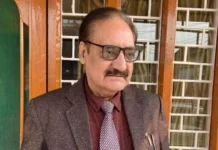
by Dr Farooq A Lone
Public respect for civil services depends not merely on authority but on humility, fairness, accountability and empathy. Democratic administration must uphold dignity while ensuring professional conduct and citizen trust.

Having spent a considerable part of my professional life in public service, I have always believed that the civil services are among the most important institutions of our democratic system. Their strength lies not merely in their constitutional position, administrative authority or decision-making powers, but also in the confidence that citizens repose in them.
It is precisely because I value this institution that I believe we must occasionally pause, reflect and ask ourselves some uncomfortable questions.
A recent incident involving allegations of inappropriate conduct by a senior officer towards a junior colleague during an online review meeting, a video of which went viral on social media, has brought administrative behaviour into public discussion. The facts of individual cases must, of course, be established through a fair inquiry. But beyond the immediate controversy lies a larger question: what kind of administrative culture are we creating, and what message does it convey to the general public?
I would like to examine this issue from three perspectives: the relationship between a superior and a subordinate, the everyday experience of citizens, and the responsibility of the civil services to preserve their own credibility.

Responsible Authority
First, authority must be accompanied by humility.
An administrative officer is expected to lead, make decisions, enforce discipline and deliver results. There will be occasions when an officer must be firm, disagree with colleagues or take difficult decisions that may not please everyone. But firmness and arrogance are two entirely different things.
A good officer can be decisive without being discourteous, demanding without being humiliating, and authoritative without being intimidating.
A subordinate is a professional colleague, not a personal attendant. The relationship is defined by the rules of service and the responsibilities of the office, not by the personal temperament of the person occupying a senior position.
Disciplinary action, where necessary, must be based on facts and established procedures. Personal hostility, intimidation and retaliation have no place in a professional administration.
Indeed, a senior officer should be secure enough in their authority to listen to disagreement. An organisation in which nobody dares to speak honestly may appear disciplined from the outside, but it is unlikely to make the best decisions.
Leadership is not demonstrated by the silence of junior colleagues or subordinates. It is demonstrated by their confidence to speak, their willingness to cooperate and their trust in the fairness of the person leading them.

Citizen Experience
Second, let us turn to the ordinary citizen.
This is perhaps the more important dimension of the issue. What does the civil service mean to an ordinary person?
For most citizens, the civil service is not represented by the senior officer they rarely encounter. It is represented by the official sitting behind a desk, the employee handling a social security pension case, the person processing a certificate, the officer dealing with a land matter or the functionary responsible for responding to a grievance.
It is through these everyday encounters that citizens form their opinions of the government. A citizen who is made to visit an office repeatedly without explanation, who is spoken to rudely, whose grievance is ignored or who is made to feel that they are asking for a personal favour is unlikely to regard that administration as citizen-friendly.
We often speak about transparency, efficiency, accountability and good governance. But these concepts acquire meaning only when citizens experience them.
Sometimes, all a citizen seeks is a patient hearing, a clear explanation or a decision within a reasonable time. These may seem like small matters to an officer accustomed to dealing with complex administrative responsibilities. To the common citizen, however, they are matters of considerable importance.
The irony is that an institution created to serve the public sometimes develops an attitude in which the public is expected to adjust to the convenience of the institution.
Civil servants must ask themselves whether this is the kind of administration they wish to represent.

Democratic Values
Third, there is a need to reconsider our understanding of the civil servant’s position in a democracy.
Our administrative system unfortunately carries a colonial inheritance. Although the Constitution transformed the relationship between the state and the citizen, certain attitudes associated with the old system have proved difficult to shed.
The exaggerated importance attached to rank, the expectation of unquestioning deference and the tendency to regard official authority as a personal privilege are incompatible with democratic public service.
A civil servant is not a ruler. A citizen is not a subject. An officer exercises authority on behalf of the state, under the Constitution and the law. That authority is entrusted, not owned.
This distinction should guide every interaction, whether it takes place between a senior officer and a junior colleague or between a public official and an ordinary citizen.
Institutional Credibility
It is important to recognise that public respect for the civil services cannot be sustained merely by recalling the institution’s past achievements. It must be renewed through the conduct of serving officers.
I would also emphasise that individual controversies should not become a basis for condemning the entire service. Thousands of officers and public employees work under difficult conditions, often with dedication and little recognition. Their contribution deserves appreciation.
But defending the institution does not mean defending every action of every member. On the contrary, a strong institution must be willing to examine its shortcomings and correct them.

Necessary Reforms
What, then, needs to be done?
We must make professional conduct an integral part of administrative performance. We need credible mechanisms to examine complaints, safeguards against retaliation, fair disciplinary processes and a workplace culture in which people can raise legitimate concerns without fear.
We must also pay greater attention to the human dimensions of leadership. While assessing an officer’s performance, the authorities must consider whether the officer has built an effective team, treated colleagues fairly and made the administration more accessible to citizens.
In Jammu and Kashmir, these considerations have particular significance. Citizens expect their administration to be responsive to their concerns and sensitive to the practical difficulties they face. Officers who combine competence with empathy can make a substantial contribution to strengthening public confidence.
Lasting Respect
Having been part of this institution, I say this with a sense of responsibility: the civil services do not need less authority. They need a more responsible exercise of authority. They do not need to abandon discipline. They need to distinguish discipline from humiliation. They do not need to surrender their professional standing. They need to understand that their standing is strengthened by humility, fairness and accountability. These are practical lessons I have learnt during my career in the civil services.
A senior officer’s greatest achievement is not that subordinates are afraid to disagree, but that they trust the officer enough to speak honestly. An administration’s greatest achievement is not that citizens fear approaching it, but that they approach it with confidence that they will be heard fairly.
Let us, therefore, return to a fundamental principle of public service: the dignity of the office is inseparable from the dignity with which others are treated. Our designations may command attention, our authority may secure compliance, and our decisions may shape people’s lives. But it is our conduct that ultimately determines whether we command their respect.
That is the standard by which the civil services must judge themselves, and that is the standard by which society will continue to judge them.
(An IAS officer, the author retired as Chairman, Jammu and Kashmir Public Service Commission. Ideas are personal.)