The Home Minister’s recent visit to Jammu and Kashmir, seen by the BJP as a routine review of development and security, drew sharp criticism from opposition parties as it coincided with the passage of the controversial Waqf Amendment Bill, Syed Shadab Ali Gillani writes
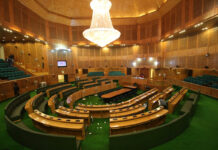
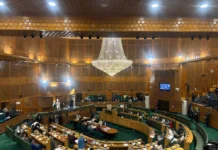
Home Minister Amit Shah’s three-day visit to Jammu and Kashmir, his first since the formation of Omar Abdullah’s government, unfolded at a politically sensitive juncture. The visit coincided with the concluding days of the budget session of the Jammu and Kashmir Assembly and the passage of the controversial Waqf Bill. In anticipation, the National Conference (NC) and its allies had created a major issue out of the administrative reshuffle by Raj Bhawan, terming it as an attempt aimed at “undermining the elected government.” It had decided to discuss it in the assembly, something that never happened.
Closed-Door BJP Meet
On April 6, Shah arrived in Jammu and chaired a closed-door meeting with BJP lawmakers and party office-bearers. The two-hour-long meeting reportedly focused on internal security, drug trafficking, and political strategy.
Leader of Opposition Sunil Sharma later said that the Shah advised them to counter the NC’s narrative around the Waqf Act, the abrogation of Article 370, and the demand for statehood. Shah also urged them to challenge what he described as “anti-people policies” of the Omar administration, both within and outside the Assembly.
According to Ravinder Raina, Shah praised the BJP workers for the party’s electoral performance in the Jammu region and encouraged them to further consolidate the party’s structure. Notably, Shah’s engagement with the party cadre coincided with the BJP’s foundation day, which was marked by internal party events.
Shah also met the family of the late BJP leader and former Nagrota legislator Devender Singh Rana at Raj Bhavan, prompting speculation that his daughter, Devyani, may be fielded by the party in the upcoming assembly by-election necessitated by Rana’s death.
On April 7, Shah visited the BSF’s Vinay forward post in Kathua, where he reviewed the security situation along the India-Pakistan border and interacted with officials. He later met the families of police personnel who had died in the line of duty and handed over appointment letters to nine nominees on compassionate grounds.
The Union Home Minister’s travel itinerary remained undisclosed, and security forces were placed on high alert throughout the visit. Officials confirmed that the visit was treated as a high-priority event from a security perspective, given recent border activity and prevailing political sensitivities.
View this post on Instagram
In Srinagar
Later that evening, accompanied by LG Sinha and leader of Opposition Sunil Sharma, Shah arrived in Srinagar, and his first stop was the residence Ghulam Hasan Baht, a former DIG in Jammu and Kashmir Police whose son, Humayun, a DySP, was among the four officers killed in an encounter with militants in Kokernag on September 13, 2023.
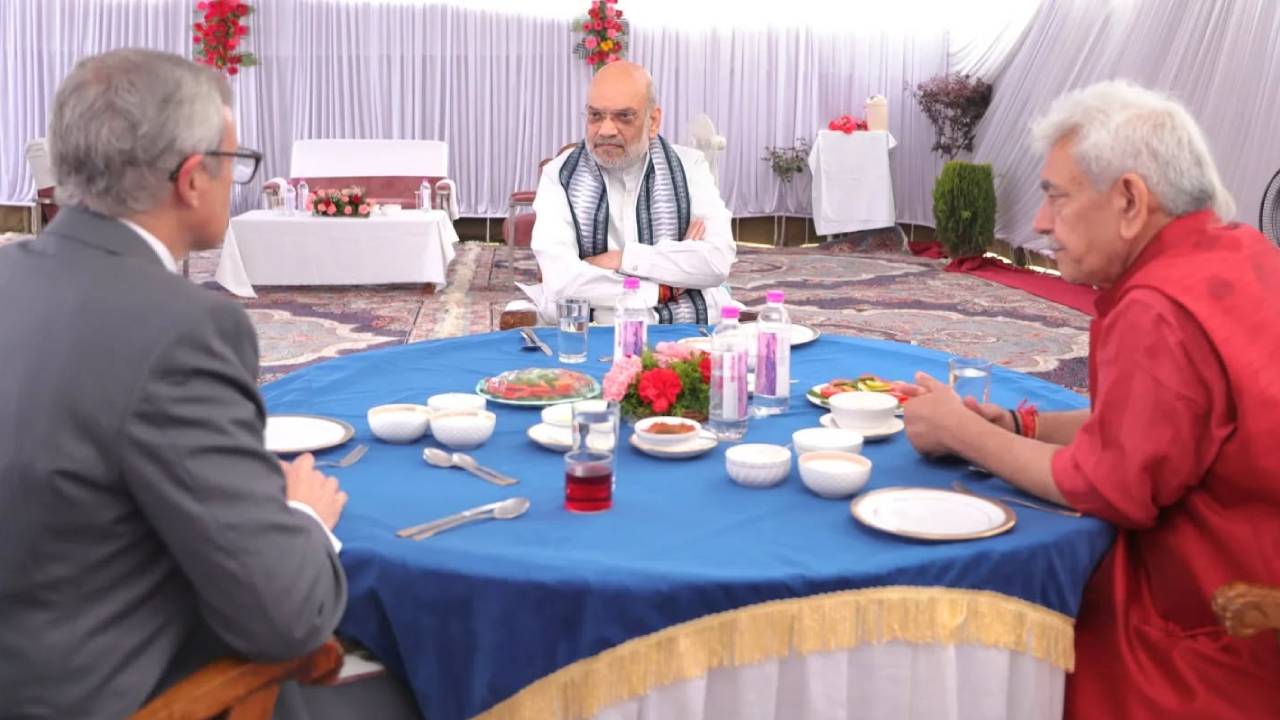
On April 8, the last day of his 3-day visit, Shah chaired a high-level meeting at the Raj Bhavan to assess security preparedness and review developmental progress. Chief Minister Omar Abdullah was notably excluded from this meeting. Although Abdullah held a separate 20-minute meeting with Shah earlier that morning, he departed before the commencement of the security review.
Sources confirmed that following the developmental review, of which Omar and LG were a part, Shah directed staff to summon senior officials waiting outside. This group included Home Secretary Govind Mohan, IB Director Tapan Deka, Army Chief General Upendra Dwivedi, and top officers from the JK Police and CAPFs. The meeting was held under the unified command mechanism now overseen by the MHA, a structure established following Jammu and Kashmir’s reorganisation in 2019.
As he exited the venue, senior bureaucrats, including Chief Secretary Atul Dulloo and DGP Nalin Prabhat, remained for the security discussions.
This was not the first instance in which the Chief Minister had been sidelined. On February 12, Abdullah was similarly excluded from a security review chaired by the LG at the Police Control Room in Srinagar, a move that drew criticism from the NC. The party has since maintained that while law and order fall under the Centre’s jurisdiction, the elected leadership should not be excluded from such critical meetings.
Development Review
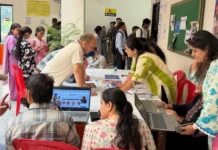
Later, Shah shifted his focus to developmental priorities, reviewing the status of ongoing projects across sectors such as road connectivity, infrastructure, and social welfare schemes. Officials briefed Shah on central financial assistance and the 2024–25 budgetary provisions for the region. He urged them to accelerate the pace of implementation to ensure delivery at the grassroots level. Emphasising the need for visible improvement across sectors, he stated that development must not remain confined to urban centres.
Shah reiterated the centre’s commitment to welfare through infrastructure expansion, financial inclusion, and employment initiatives. While he expressed satisfaction with the progress of certain centrally sponsored projects, he directed that all pending works be completed within stipulated timelines.
View this post on Instagram
Rising Threat Perceptions
On April 8, Shah chaired two consecutive high-level meetings, concluding his visit with a thorough review of Jammu and Kashmir’s dual imperatives: security and development. The security briefing assumed greater significance in light of recent militant incidents in the Jammu region.
Shah directed security agencies to enhance surveillance measures and intensify coordinated counter-insurgency operations. He stressed the need for mission-mode execution of the “Area Domination Plan” and the “Zero Terror Plan”. The meeting also assessed preparations for the annual Amarnath Yatra, scheduled to commence on July 3.
Statehood Commitment Reaffirmed
Before his visit, at a summit on March 28, 2025, Shah addressed the issue of Statehood. “We have given the assurance that Statehood will be restored. From the very beginning, we have said that Statehood would be given. But it cannot be disclosed when it will be given at a public forum,” he said in response to questions regarding a timeline for its restoration.
“Amit Shah is the country’s Home Minister, and it is his right to address and take cognisance of the security issues facing the country,” JKNC Spokesperson and Zadibal MLA Tanvir Sadiq said, acknowledging the Home Minister’s authority to address security matters. “The biggest thing is that he promised us that he would give us Statehood, and we hope it will happen soon.” BJP, however, reiterated that it will happen at an “appropriate time.”
Hurriyat Disintegration
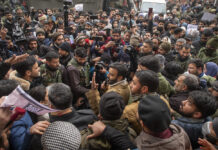
Shah’s visit coincided with a significant shift within Kashmir’s separatist landscape. As he conducted high-level meetings in Srinagar, three senior affiliates of the erstwhile Hurriyat Conference announced their formal dissociation.
Bashir Ahmad Andrabi, who heads the Kashmir Freedom Front, Mohammad Yousuf Naqash, Chairman of the Islamic Political Party Jammu and Kashmir, and Hakeem Abdul Rashid, Chairman of the Muslim Democratic League Jammu and Kashmir, declared their exit from the Hurriyat fold. The three warned of legal action against anyone who linked their names or organisations with separatist factions in future communications. Each voiced unequivocal opposition to the Hurriyat’s ideology.
Their departure raised the number of separatist groups that have distanced themselves from the Hurriyat to eight. “Separatism has become history in J&K,” an excited Shah posted on X, in response to previous resignations from the separatist conglomerate.
Reactions and Aftermath
The political class reacted to the visit. JKNC MP Aga Ruhullah Mehdi expressed scepticism, stating that he did not see any significant developments resulting from the symbolic trip aimed at generating a political narrative for the BJP in Kashmir. He suggested that the functioning of the MHA through Raj Bhawan continued unabated and that this continuity might have been the visit’s only tangible purpose.
Ruhullah asserted that the visit appeared politically motivated, particularly in the context of the recently passed Waqf Amendment Bill. He claimed the optics of the visit were intended to convey that the Home Minister had visited a Muslim-majority region. “If the visit was only to assess the security situation following the recent militant activity in Jammu, then he could have limited his trip to Jammu,” Ruhullah said. “It is correct that militant activities have increased in the Jammu region, but to review that situation, he did not need to come to Kashmir. The timing of the visit, just after the passage of the Bill, indicates it was designed for political messaging.” On the home politics, Ruhullah asserted Waqf resolution should not have been rejected in the assembly.
“Far from being routine, it signals the BJP-led Centre’s intent to tighten control over the region, which remains India’s only Muslim-majority state,” PDP spokesman Mohit Bhan said. We fiercely oppose the Waqf Amendment Bill, which we view as an attack on Muslim rights and religious autonomy. The timing of the visit, overlapping with the final days of the Assembly’s budget session, seems like a deliberate attempt to eclipse local governance.”
Taking a dig at Omar, Bhan said Abdullah’s decision to sidestep legislative duties in favour of responding to ‘summons’ from Delhi strips him of the moral authority to represent Jammu and Kashmir’s Muslims. “While claiming to resist the BJP’s overreach, his actions suggest troubling alignment with the Centre, sacrificing the region’s interests,” he claimed.
Tanvir Sadiq offered a different perspective. “I think it was a very routine meeting by the Home Minister of the country, and this visit was planned well in advance. It had nothing to do with the Waqf Amendment Bill or the security situation in Jammu and Kashmir. The Chief Minister has also clarified this,” he said. “As long as the region remains a Union Territory, such visits are entirely normal.”
With the BJP leadership highlighting what it called a “decline of the terror ecosystem” and the ruling JKNC countering with allegations of democratic deficit and institutional sidelining, the visit underscored the widening polarisation over control of the region’s political narrative.