by Iqbal Ahmad
Kashmir’s massive stone monuments, locally called Pandav Lari, display uniform design and striking Greco-Roman influence. Despite extensive studies, the technology behind lifting and assembling their immense limestone blocks remains unexplained and historically mysterious
A marvellous architectural heritage, which is of a uniform plan, material, and architectural style and distinctive in character, is encountered at several places from Shardapeth to Martand in Kashmir, but not beyond its borders. Although natural calamities and human vandalism have consecutively prevailed over centuries on these magnificent structures and have almost left these marvels in ruins, the pristine glory of this heritage is still very much evident through its grand remains.
Locally, these grand remains are known as Pandave Lari, the buildings of the Pandavas. Generally, common people have attributed these monuments to the Pandavas, and in the local dialect, they are known as Pandav Lari, meaning the buildings of the Pandavas. This curious legend is based on the perception that, since these are huge structures formed of heavy and massive limestone blocks, they must be the handiwork of the Pandavas.
The Pandavas are locally referred to as belonging to a tall and physically strong race, and since these structures are formed of massive blocks of limestone, they are attributed to this race. But this is not a historically proven fact. It is only based on the massiveness of the materials used that people have developed this belief. Otherwise, most people know that these are the remains of historical buildings, identified as ancient temples and monasteries, while a few are recognised as palaces. These are dated to the medieval and early medieval periods. Most of these remains are believed to have been built during the Karkota and Utpala periods, roughly corresponding to the seventh to tenth century AD, with some even earlier.
Advanced Architecture
In fact, I also found something interesting about these ruins. I felt the architecture was highly advanced and doubted that it could be the work of any local architect. To arrange the extraction of such massive limestones from quarries and then lift them to their designated places required not only advanced technology but also strong manpower. I keenly observed their plan, architectural styles, and the finesse adopted in these constructions. I was very much puzzled. Although I could understand the architectural design to some extent, I could not understand the technology and techniques followed in raising these wonderful structures.
The lifting of bold cuboids, rectangular, square and other geometrically designed massive stones, and placing them on each other to form large and heavy walls in such a neat and clean form is quite surprising. More curious is the formation of arched cells and the erecting of long and heavy single-stone columns. Indeed, one cannot be a master of all trades.
Although I have technical know-how in archaeology, numismatics, and epigraphy, in architecture, I am just a layman. So I studied a few papers on classical architecture. I observed that the master ruins of Martand, Awantipora, and some other places, built of massive limestone with heavy columns, were very much influenced by classical Grecian and Roman styles. I understood that this tradition may have developed here during the Indo-Greek influence on this land. But this type of architectural heritage is not found in other north-western parts of India. Who founded this distinctive architectural style and cultivated it here is beyond one’s understanding.
Alexander Cunningham’s View
Alexander Cunningham, known as the father of Indian archaeology, speaks of them. Most of the stone temples and monasteries built in ancient periods in highly finished blue limestone are almost in ruins. These are locally called Pandav Lari, meaning the houses of the Pandavas. Historically speaking, these are the remains of magnificent palaces, temples, and monasteries built here during the historic period. Some of these buildings date as far back as the end of the eighth century AD, while others must undoubtedly be much more ancient, perhaps even as old as the beginning of the Christian era.
Archaeologists have felt strong Greek and Roman architectural influences on these ancient Kashmiri stone structures. Alexander Cunningham, who made the first on-the-spot study of the ancient stone architectural remains of Kashmir, also felt this influence. He wrote a detailed article on ancient temple architecture of Kashmir titled An Essay on the Arian Order of Architecture as Exhibited in the Temples of Kashmir.
General View
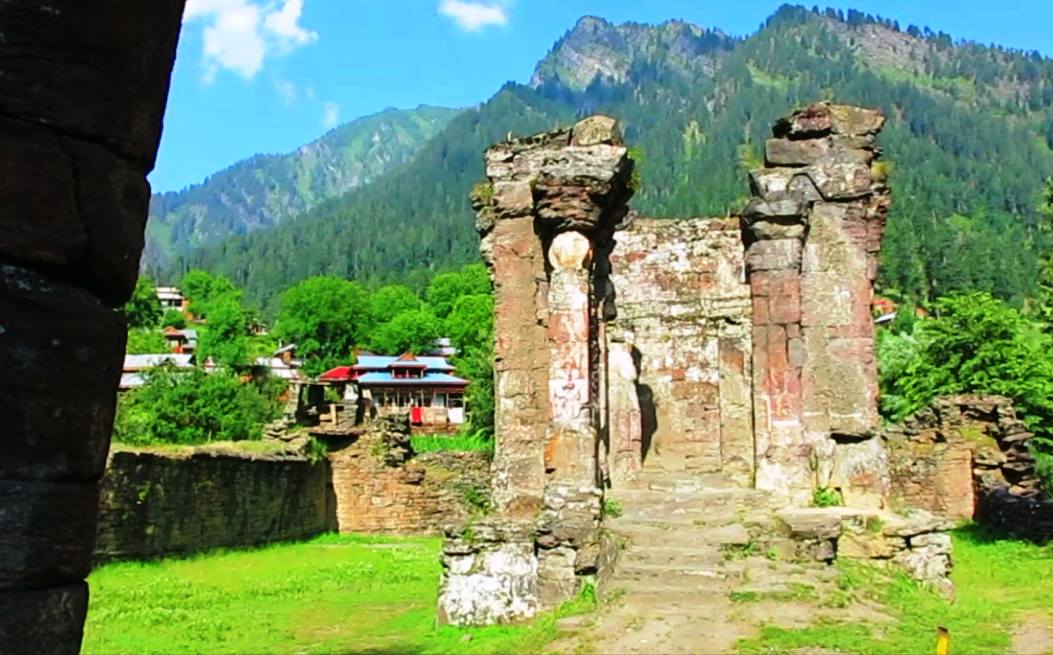
Generally speaking, within the subcontinent, these types of architecture appear quite different and indigenous, and bear no resemblance to monuments found in other parts of India and Pakistan. Although most of these ancient stone-built remains are in ruins, the grace and splendour of these wonderful constructions are still visible through their remains at their respective sites.
In fact, when one enters these ruined complexes, it feels as if one is walking through the lanes of ancient Greece and Rome. These wonderful ruins can be experienced in the lower and upper Jhelum valley of Kashmir, from Sharda Peeth in Pakistan-administered Kashmir up to Martand in Anantnag. Their strong influences are also encountered in the Babour group of temples in Udhampur. But surprisingly, this type of architecture is not found in the plains of Punjab or adjoining lands. I have made most of these observations in my recent book titled Ancient Romans and Greeks in Kashmir.
Remarkable Remains
The most remarkable remains include the stone-formed monuments at Sharda Peeth, Bunyar, Rampur Ushkar, Tappar Pattan, Prashpura, Wangith, Pandrathan, Avantipura, and Martand. Most of these structures have followed similar plans, materials, and architectural styles. Much has already been written on the history and architectural styles of these monuments, but one important question remains unanswered: the technology and techniques adopted in forming these heavy superstructures.
Keeping in mind the period of these monuments, it was not an easy task to extract massive limestone from quarries and lift it to its designated places. This required advanced technology and strong manpower. Although I understood the architectural design to some extent, I could not understand the technology and techniques used. The bold cuboids, rectangular, square and other geometrically shaped massive stones, placed neatly to form large walls, are surprising.
One wonders how, in ancient times, when no modern building equipment or technology existed, these massive stones were lifted and laid with such precision. The stones had been brilliantly carved and laid in tiers in such a way that even the joints are invisible. Despite studying almost all available literature on these monuments, I could not find satisfactory answers to these questions.
Since the purpose and plan of these structures are understandable to some extent, the technology behind their construction remains unclear. I could not find any explanation even in the notes of a master archaeologist like Alexander Cunningham. Other archaeological literature discusses the history and architectural significance of these remains, but does not mention the technology used in raising these heavy structures.

I do not know if this type of architecture is taught in any engineering institution or school of architecture. Although we have advanced engineering and architectural institutions, perhaps they focus only on modern materials, techniques and technologies, leaving no space for traditional architectural studies, particularly for these grand monumental remains.
Modern archaeologists working on Jammu and Kashmir’s ancient and medieval archaeology and architecture should focus on this architectural technology and attempt to find evidence of the methodology followed in the planning and design of these structures. The chiselling, lifting, and fixing of these heavy limestone blocks so neatly that their joints are hardly visible anywhere in these magnificent structures is something that must be studied.
(The writer is a senior archaeologist and author. Ideas are personal.)