Following a wave of Israeli airstrikes across Iran that killed senior military and nuclear officials, Kashmiri students stranded in Tehran have pleaded for evacuation. As protests flared in Kashmir and Iran vowed retaliation, fears of a broader regional conflict deepened, leaving families back home paralysed with anxiety, writes Babra Wani.

At around 3:30 AM, as the city lay asleep, a deafening thud broke the silence. Moments later, a violent tremor shook the ground, startling people from their beds. Tehran, the capital of Iran, had been hit. Israel had launched three missiles.
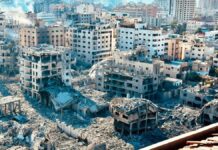
The attack followed Iran’s earlier strike on Israel and its support for Gaza amid the ongoing Israel-Palestine genocidal war. Fighting between the Gaza Strip and southern Israel began on October 7, 2023, as part of the long-running Israeli-Palestinian and Gaza-Israeli conflicts that date back to the early twentieth century. Previous wars in 2008–2009, 2012, 2014, and 2021 had already left deep scars. The ongoing genocide of Palestine by Israel has caused more than 55000 Palestinians to be killed, causing large-scale destruction and a worsening humanitarian crisis in Gaza. Iran has consistently backed Palestine.
Kashmir Concern
Soon after the news broke, social media was flooded with images and videos of the damage. Families of Kashmiri students studying in Iran were gripped by panic.
A student enrolled in a medical university said his parents had called him frantically. His mother, he said, lost consciousness when she heard about the attack. He added that the strike came just two days before Eid-e-Gadheer, and one of the missiles had landed nearby.
Once the explosions occurred, students and teachers gathered in the university compound. Despite being drowsy, they stayed awake, alert to the possibility of escalation. The student, a resident of Central Kashmir, said many others came from nearby hostels and chose to remain together through the night.
He said that while many of his friends panicked, he tried to remain calm because someone had to.
His brother back home said the family had been calling him constantly to ensure he was safe. “My mother has been sitting on the prayer mat since morning. My father is glued to the television. We are receiving calls from friends and relatives. Everyone is worried. And it is not just us, dozens of families have children there,” he said.
Another man from North Kashmir said his daughter, who is studying medicine in Iran, reassured him during a phone call: “Papa, do not be scared. Everything will be fine in a day or two.” He said he was holding onto hope that tensions would ease and normalcy would return soon.
A student from North Kashmir, also based in Tehran, said things calmed down after a few hours, but the night was terrifying. “Everything happened so suddenly. The panic was real,” she said. They had heard rumours of rising tensions in the Gulf, but no one expected a strike so soon.
Around 3 AM, students were asked to evacuate their rooms. They stood outside on the lawn until sunrise.
An Israeli strike hit Hujat Dost Ali hostel in Tehran, housing many Kashmiri students. Some sustained minor injuries.
I’ve written to EAM @DrSJaishankar urging their relocation within Iran or evacuation once the airspace opens.
Just spoke to @DrSJaishankar regarding the situation in Iran, particularly the welfare & safety of Kashmiri students in the country. The Hon Minister assured me that @MEAIndia is in close contact with their counterparts in Iran & will take all necessary steps to safeguard all…
— Omar Abdullah (@OmarAbdullah) June 15, 2025
“You Could Feel How Close Death Was”
A residential building near a university had collapsed during the strike. Students were outside, scared and confused. Their wardens stayed with them, and they remained in contact with the Indian embassy, which assured them that evacuation would be arranged if needed.
She said many Kashmiri students were studying there, and it was the first time they had experienced such intense chaos in Iran.
At one point, she feared for her life. The sense of danger, she said, was overwhelming.
For a brief period, WhatsApp worked without a VPN, allowing them to contact their families. But it was soon blocked again, leaving them anxious.
They hardly slept at night. Whenever they tried to rest during the day, another loud blast forced them to rush outside.
The students had emailed their details to the Indian embassy and joined support groups to stay connected and accounted for.
From their dormitory, they could see smoke and hear explosions. A nearby boys’ hostel at Shaheed Beheshti University was reportedly damaged, with videos circulating online.
The Indian Embassy in Iran advised students to remain prepared for evacuation. They were told to stay alert in case tensions escalated.
Too Many Students
Hundreds of students from Kashmir pursued degrees in Iran, especially in professional courses like MBBS, due to the country’s economic feasibility. Every year, after the NEET results are out, hundreds of boys and girls from Kashmir fly to distant locations to study medicine. They pay for their degrees as the seats available back home are too limited, and quite a few after the reservations. Out of more than 1100 MBBS seats available across Jammu and Kashmir, more than sixty per cent are reserved for various categories,s leaving limited scope for the meritorious.
For reasons of affordability and cultural connection, Iran is a favourite destination for aspiring medicos in Kashmir. The medical education has revived the connection that Kashmir has had with Iran for centuries.
— Office of Aga Syed Ruhullah Mehdi (@Office_ASRM) June 15, 2025
A Concerned CM
Jammu and Kashmir Chief Minister Omar Abdullah posted on X, tagging the Ministry of External Affairs and requesting urgent steps to safeguard Kashmiri students. He expressed concern for their families and called for every possible measure to ensure their safety.
Speaking to the media, he warned that further escalation could immediately impact fuel prices, stock markets, and international flights heading west. More crucially, he said, it would affect public sentiment.
He also condemned Israel’s actions, stating that Iran had not provoked the attack. Comparing it to Russia’s invasion of Ukraine, he criticised the silence of global powers. If Russia’s aggression was condemned, he said, Israel’s actions must also be seen as unjustified.
Students admitted that the embassy did issue an advisory on social media, urging Indian nationals and persons of Indian origin in Iran to remain vigilant, avoid unnecessary movement, and follow local safety protocols. Helpline numbers were also shared for emergencies.
Kashmiri students studying in Iran have had interesting situations over the years. Every time there are tensions in the region, the Indian Embassy becomes accessible. During the COVID-19 pandemic, the government of India flew several charters to evacuate the Indian citizensincluding the students from Kashmir. It was, in fact, the infection from Iran that impacted Kargil, as some pilgrims contracted the infection there. They were flown and kept separately, and then permitted to reach home. By then, however, the infection has spread far and wide.

Numerous students contacted the Indian Embassy in Tehran, seeking relocation or evacuation, but received no concrete response. They remained confused and distressed, with no clarity on evacuation plans, safety protocols, or emergency assistance, the letter stated.
Local Anger
Student concerns apart, the Iran-Kashmir emotional connect displayed itself on the roads. In Budgam, residents staged protests against the Israeli strikes, chanting slogans in support of Iran.
The strikes marked an unprecedented escalation in West Asia. In the early hours of Friday, Israeli fighter jets launched coordinated assaults across Iranian cities, killing military leaders, nuclear scientists, and civilians. Tehran denounced the action as a brazen act of war.
The bombardment targeted Tehran, Isfahan, Tabriz, Ahvaz, Kermanshah, and Qasr-e Shirin, causing significant damage to residential and non-military areas. Iranian state media confirmed the deaths of several senior commanders and scientists, sparking vows of retaliation from Tehran.
Those killed included Major General Hossein Salami of the Islamic Revolutionary Guard Corps (IRGC), Major General Gholamali Rashid of the Khatam al-Anbiya Central Headquarters, and Chief-of-Staff Major General Mohammad Bagheri. At least six nuclear scientists also died, including former nuclear chief Fereydoun Abbasi and physicist Mohammad Mehdi Tehranchi, according to the Tehran Times.

Eyewitnesses reported that several strikes hit densely populated neighbourhoods in Tehran, killing or injuring dozens, including women and children. Chamran Hospital admitted 50 injured civilians, according to state TV.
Later that day, the leader of the Islamic Revolution, Ayatollah Seyyed Ali Khamenei, issued a stern message, calling the attack a crime against the nation and promising severe retribution. He accused the Zionist regime of deliberately targeting residential areas and assassinating scientists and military leaders, vowing that Iranian forces would respond forcefully.
Preemptive Strike
Israeli leaders described the attack as a preemptive strike aimed at crippling Iran’s nuclear capabilities. Prime Minister Benjamin Netanyahu called it “an immediate operational necessity.” The assault, the most intense since Iran’s war with Iraq in the 1980s, has heightened fears of a larger conflict engulfing the region.
Israel, already a nuclear power, has been carrying out assassinations of Iranian nuclear scientists for a long time. This is aimed at preventing Iran’s nuclear capabilities. The recent attacks came against the backdrop of Tehran running a dispute with the International Atomic Energy Agency (IAEA) that accuses Iran of not being transparent, an allegation Tehran denies.
Getting frantic calls from distressed parents in Kashmir because their children pursuing studies in Iran are stuck. Request @MEAIndia @DrSJaishankar to kindly expedite their evacuation & bring them home.
— Iltija Mufti (@IltijaMufti_) June 14, 2025
Between January 2007 and January 2012, Iran officially reported five senior nuclear scientists killed: Ardeshir Hosseinpour (2007), Masoud Ali‑Mohammadi (2010), Majid Shahriari (2010), Darioush Rezaeinejad (2011), and Mostafa Ahmadi Roshan (2012). Besides, Fereydoon Abbasi, then head of Iran’s Atomic Energy Organisation, was seriously wounded in a botched attempt. Iran has always alleged these were part of a covert campaign involving Israel’s Mossad. In the latest strike described as Operation Rising Lion, Israeli aircraft targeted Iranian nuclear and military facilities and reportedly assassinated six more nuclear scientists.