Tibetan Muslim refugees, displaced by Chinese rule in 1959, carried their cuisine across the Himalayas and quietly transformed the palate of Kashmiri, reports Asrar Syeed
Walk through Eidgah on any morning, and the air tells you something before the signboards do. The scent of boiled beef and chicken rises through the windows of narrow buildings. Chefs move quickly through their morning routines behind half-open shutters. A few steps further, and the eye lands on a large hoarding painted in several bold colours: Tibetan Momo Hut.
Inside, behind the cash counter, sits Mohammed Hanif, an older man with a calm, watchful quality that comes from having spent a lifetime between two worlds. Hanif was born in Kashmir. He has never known Tibet except through stories, but those stories live in him with the vividness of personal memory.
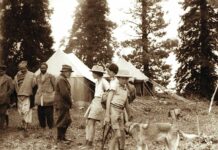
Hanief belongs to the second generation of Tibetan Muslims Khajur, of Kashmiri origin) who migrated to the Kashmir of their ancestors in the wake of the punitive 1959 occupation of Tibet by the Chinese army. Settled in tents at Eidgah in Srinagar and later rehabilitated with state support, they built communities in Eidgah and Hawal that evolved into hubs of Tibetan culture and cuisine.
“My grandfather was always happy about living in Kashmir,” Hanif said, pausing to check with his chefs whether any ingredients need restocking. “I have heard many stories from my elders about how our family travelled here.”
The story he told about his community’s migration is careful to note a distinction that is easily overlooked in broader accounts of the 1959 events. The Tibetan Muslims were not, strictly speaking, forced out at gunpoint.
“We were not forced to leave,” he explained. “But the imposition of new rules under the Chinese Red Book forced our elders to think about other places to live. They had to make a choice between their faith and their homeland. They chose their faith and came to Kashmir, the land of their ancestors.”
By 1960, Hanif’s grandparents had settled. “Our elders chose Kashmir not only because it was a Muslim-majority state,” Hanif asserted, “but also because our ancestors’ roots were from here.”

Three Dishes
Before this cuisine could become beloved, it had to be understood. Three dishes form the cornerstone of Tibetan food culture in Kashmir, each one carrying the flavours of the high plateau into the heart of the Valley.
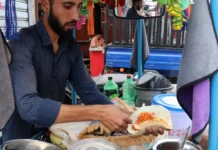
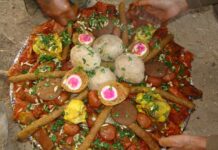
Momos, today the undisputed favourite of Srinagar’s streets, are prepared by working refined flour with water into soft, pliable dough, then rolling it into thin circular wrappers. The filling consists of finely chopped cabbage, carrot, onion, and spring onion, or minced chicken, seasoned with garlic, ginger, salt, and mild spices. The parcels are pinched shut and steamed until tender. Simple in construction, deeply satisfying in effect.
Shefali is a Tibetan-style stuffed bread of more rustic character. Wheat flour dough is rolled flat and loaded with spiced minced meat or vegetables, the edges sealed tightly before the bread is shallow-fried until golden brown and crisp on the outside, whilst remaining yielding within. It is street food in the truest sense – filling, affordable, and eaten standing up.
Thukpa rounds out the triumvirate: a soup of handmade wheat noodles swimming in a light but flavourful broth, enriched with cabbage, carrots, onions, tomatoes, and sometimes spinach, seasoned with garlic, ginger, and mild spices. Meat, chicken, beef, or mutton is added in non-vegetarian versions. In the bitter Kashmiri winter, it is close to essential.
Half Empty Pots
In those early years, selling Tibetan food in Kashmir was not a viable enterprise; it was an act of stubborn faith. A handful of elders from the Tibetan Muslim community began cooking their traditional dishes, but the valley’s food culture was built on richly spiced, layered preparations. A plain steamed dumpling required explanation, persuasion, and patience.
“People in Kashmir had never tasted such things,” Hanif recalled. “It was very difficult to sell even half the production.”
The elders adapted pragmatically, cutting operations to alternate days and opening their makeshift wooden stalls for just three hours each morning, from 8 to 11 am. By 11:30, the food was gone, and the shutters were down.
As a child, Hanif watched these early vendors work. He watched them explain to curious and often sceptical Kashmiri passers-by what these dishes were and how they were made. The patience required was extraordinary.
Momos In Vogue
By the late 1990s, something had shifted. The Tibetan Muslim dishes had found their audience, slowly, neighbourhood by neighbourhood. The problem was no longer indifference; it was the opposite. Customers who arrived after 11 am were turned away hungry.
Hanif saw the opportunity clearly. He opened his own restaurant, Momo Hut, and kept it open throughout the day. “The moment news spread about my shop, we started receiving customers,” he revealed. “The business was nice, and we were witnessing good sales.”
Over the years, the shop was renovated, expanded, and eventually renamed Tibetan Momo Hut, a name that announced, with quiet confidence, both a heritage and a claim on the city’s appetite. Hanif is not simply a restaurateur. He is a living chronicle of how a displaced people’s food became, over the course of a generation, a beloved staple of the city that sheltered them.
“These dishes were very cheap in the early stages. Throughout the day, I receive so many students because our rates are affordable.”
Above The Tight Stairs
Hawal is the second home to Tibetan Muslims. When Sheikh Mohammed Abdullah was Chief Minister, he directed that land be provided on lease to families who wished to relocate. Over the following decade, a cluster of homes and shops grew up in the shadow of Hari Parbat, and with them a new generation of Tibetan food vendors.
The most prominent is announced by a deep red signboard with white lettering in bold capitals: Hamid and Aadil Momo Wala. To reach the main dining area, you climb a staircase that is narrow and steep enough to be modest. What greets you at the top is warmth in both the literal and temperamental sense, warm bowls of soup placed before every customer as a matter of custom, and the broad, welcoming smile of Hamid Butt, who has been running this establishment for over 25 years.
Hamid was born in Kashmir, his grandfather having crossed over from Tibet, a story he inherited like many Kashmiris inherit family histories, distant yet defining. Running a restaurant was not his original plan.
“I started my first shop of embroidery where I used to do tilla-work on pherans,” Hamid explained. “But due to the violence that erupted during the early 1990s, my business suffered enormously. Those days were very scary, although our fellow Kashmiri Muslims always made us feel secure and never made us feel like we weren’t among them.”
He spent several years in Ladakh, teaching Hindi and Urdu at a primary school his uncle ran, before returning to Srinagar and taking his father’s advice to open a Tibetan food shop.
Patience Pays
The early years of the restaurant were humbling. Customers came, tasted the food, and sometimes left dissatisfied, calling the momos “half-cooked.” Hamid absorbed the criticism without retaliating. The food was still unfamiliar to many palates. Sales were poor.
In 2010, facing persistently weak returns, Hamid considered shutting the restaurant. His father urged him to hold on. “Have faith in what you have started,” he told him. Hamid waited. The tide turned.
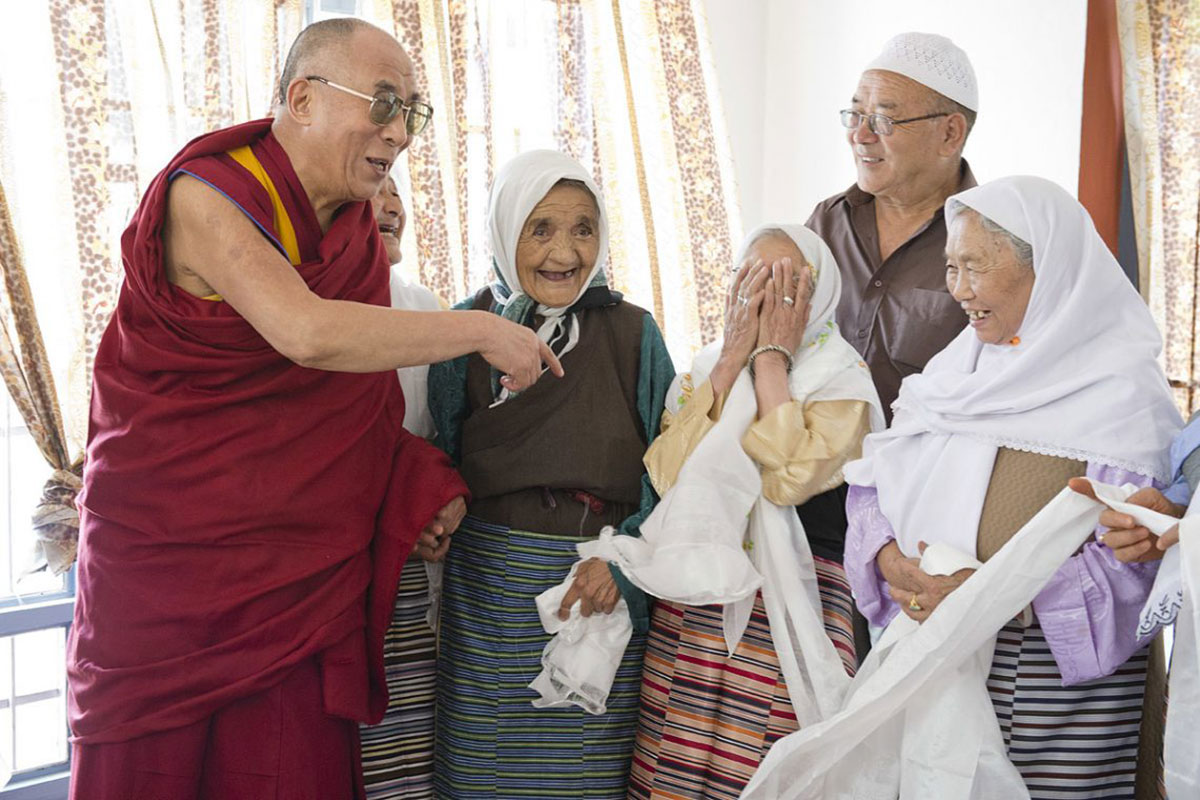
Now, Hamid and Aadil Momo Wala serve customers who have become, over years of regular visits, something closer to friends. Hamid has learnt Kashmiri, the valley’s mother tongue, well enough to converse comfortably, a gesture that has meant a great deal to the community that hosts his family. He credits his brother Aadil without hesitation. “If Aadil had not supported me, maybe I would not have been able to reach this stage where I am today.”
Among Hamid’s regulars is Aadil Shah, who first discovered the restaurant as a student at Islamia College in 2012. He now brings his wife and children. “Hamid will always be my first choice to taste the Tibetan delicacy,” he admits. “He is the sweetest and noblest person you can see, and his products speak for themselves.”
New Stalls, New Opportunities
The appetite for Tibetan food in Kashmir has outgrown the original Eidgah and Hawal shops. Across Srinagar, makeshift stalls and polished modern cafés now serve momos, thukpa, and shefali to a clientele that skews young, budget-conscious, and increasingly health-aware.
Sahil Ahmad represents this newest generation of Tibetan food vendors, though he is Kashmiri, not Tibetan. Armed with a university degree and exhausted by a long, fruitless search for employment in the private sector, Sahil watched young entrepreneurs across India find modest success with street food stalls and decided to try his hand.
“I did not have the money to rent a shop, so friends pooled in what they could and I added my savings,” he said. “In the beginning, there were long idle hours. Now, regular customers and nearby students keep the place busy. I have kept prices low and margins tight to maintain quality.”
His presence points to something significant: Tibetan food in Kashmir has crossed the invisible line from novelty to institution. It now sustains businesses run by people with no ancestral connection to Tibet. It has become, in the truest sense, a shared cuisine.

A Chef Supports
Yaseen, a Kashmiri chef with experience at both national and international levels, has given considerable thought to why the Tibetan culinary tradition found such a receptive audience in the Valley.
Historic connections between Kashmir, Ladakh and Tibet apart, Yaseen points to the health dimension. “The Tibetan cuisine has been considered healthy, and it truly is healthy if you eat it in a limited way. In recent times, a desire to eat healthily has grown, and that too has led to an increase in customers,” he said. “Easy availability, sustainability, and growing demand to eat healthy food, all these reasons have resulted in this surge.”
A Cuisine With History
The steam that rises from a plate of momos in Srinagar carries more history than the dish itself suggests. It rises from a community’s choice, made in the snowbound winter of 1960, to value faith over geography. It rises from decades of patient selling in a city that did not know what to make of these soft white dumplings. It rises from the early morning hours of elders who opened their makeshift stalls and waited for customers who were slow to come.
The Tibetan Muslims who arrived in Kashmir did not know that their food would become beloved. They were simply cooking what they knew, in a city that had given them land on lease and a cautious welcome. Over time, their food became familiar, and strangers became loving neighbours.