by Syed Ahfadul Mujtaba
A police officer reflects on how neglect, inconsistency, and eroding civic discipline gradually transform ordered societies into wastelands, drawing from literature, history, and administrative experience
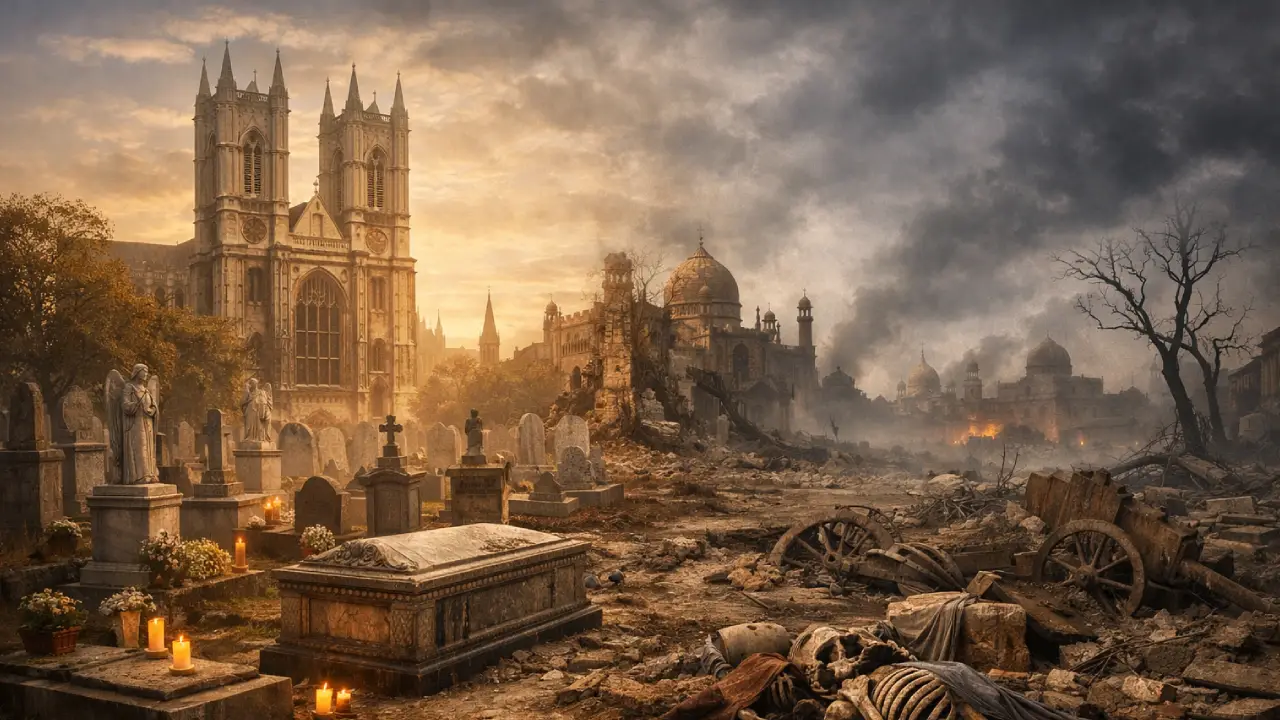
I still recall the quiet, almost meditative power of Joseph Addison, the early eighteenth-century essayist and co-founder of The Spectator, whose prose shaped much of modern English reflective writing. In one of his celebrated essays on Westminster Abbey, he reflects on that vast resting place, one of the best-kept cemeteries, where, in the end, friend and foe lie side by side. The rivalries that once animated life dissolve into a common stillness. Distinctions fade. What seemed so urgent in life becomes irrelevant in death.
There is dignity in that image; death, at least, has been given a form.
Contrast this with what William Dalrymple unfolds in The Anarchy. Across the subcontinent that the East India Company steadily dismembered, the dead piled up after each engagement; battles gave way to further battles, and the fallen were left where they lay. No Westminster Abbey awaited them, only the indifferent earth of a civilisation being stripped apart. Where Addison’s Abbey suggests that even rivalry can find its final repose, Dalrymple’s India reminds us what happens when no one remains to perform that act of closure.
That contrast stayed with me, not merely as a reflection on mortality, but as a commentary on what becomes of human endeavour when it loses its larger meaning. A burial ground, when ordered and remembered, carries dignity. But when memory weakens and continuity breaks, it risks becoming something else: a space where what once had meaning is simply deposited and forgotten. It is from this point that my understanding of the wasteland began to take shape.
The Wasteland
When I later encountered The Waste Land, TS Eliot seemed to carry forward, in a more fractured and unsettling form, what Addison had suggested in quieter prose. Where Addison offers repose and reflection, Eliot presents disturbance and dislocation. His wasteland is not a desert of sand, but a landscape of the spirit, where continuity has fractured, and life proceeds without coherence.
What struck me was not the presence of death, but the absence of meaningful burial. Fragments remain, but they do not connect. Ritual survives, but belief has drained away. Language continues, but it no longer binds. In such a condition, society comes to resemble a burial ground without order, the past neither honoured nor integrated, only scattered.
Inner Disorder
Over the years, particularly during my service in Jammu and Kashmir, I came to understand that this inner disorder does not remain confined to thought or culture. It finds its way into the physical world, into streets, neighbourhoods, and public institutions.
The transition is subtle. It does not begin with dramatic breakdowns. It begins with small signs that are easy to overlook: a public facility left unrepaired, a rule inconsistently enforced, a minor encroachment tolerated and never revisited. Each carries a quiet message that order is negotiable.
The Broken Window
A broken window left unrepaired signals that no one is responsible, that standards have loosened, that disorder carries no consequence. From that point, behaviour adjusts almost imperceptibly. What was once an exception becomes acceptable. What was once noticed becomes ignored.
In my experience, this is how decay actually begins, not with lawlessness, but with inconsistency. Not with defiance, but with permission. A city does not announce its decline. It absorbs it, one small compromise at a time.
An Accumulation of Neglect
Extended to the level of a nation, the idea of a wasteland is not about collapse but about accumulation, about what is repeatedly left unattended. Waste is not accidental. It is produced through deferred responsibility, selective enforcement, and the gradual erosion of standards.
In such an environment, the role of the young becomes critical. Energy does not remain neutral; it responds to cues. And the most powerful cues are not speeches or policies, but surroundings. The broken window becomes a lesson. It teaches what is permissible.
The Capitals
In cities such as Srinagar and Jammu, this dynamic becomes especially significant. A capital city is not simply an administrative centre. It is a statement of order and collective aspiration. What is tolerated here travels outward.

If there is one lesson that has stayed with me, it is this: order is not maintained by grand interventions alone. It is sustained by daily consistency, repairing what is broken promptly, enforcing what is prescribed uniformly, and responding to violations predictably.
For it is inconsistency, not weakness, that invites disorder.
The wasteland does not arrive suddenly. It forms quietly, in what is ignored, in what is postponed, in what is tolerated beyond reason. The broken window is never just a window. It is a signal of whether a society still attends to itself.
The choice before us is immediate and continuous: to respond, or not to respond. That choice, repeated daily, determines whether our cities remain ordered spaces of life or slowly take on the character of a wasteland.
(The author, after retiring as IGP in Jammu and Kashmir Police, was a member of the Jammu and Kashmir Public Service Commission. Ideas are personal.)