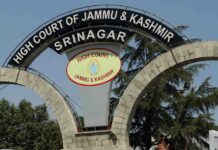
SRINAGAR: The High Court of Jammu and Kashmir and Ladakh has quashed criminal proceedings against pharmaceutical company Albert David Limited in a case arising from a drug sample declared substandard, holding that the company was deprived of its statutory right to have the sample re-tested after the sample allegedly failed to reach the Central Drugs Laboratory in Kolkata.
Justice Wasim Sadiq Nargal passed the judgment on August 18, 2026, in CRM(M) No. 618/2024 filed by Albert David Limited through its Jammu Regional Sales Manager. The judgment was reserved on August 7 and pronounced on August 18.
The court, however, ordered an administrative inquiry into what it described as serious lapses in the handling and transmission of the drug sample, including the circumstances in which a sample stated to have been sent by the trial court never reached the Central Drugs Laboratory.
The case dates back to April 27, 2011, when the Drugs Inspector, Kathua, conducted a routine inspection at M/s Hare Rama Hare Krishna, a chemist outlet in Kathua, and lifted samples of four drugs. One of them, ADIS Needles, Batch No. 4752, manufactured by Albert David, was sent for analysis.
The Government Analyst’s report dated November 30, 2011 declared the sample “not of standard quality” after it failed the sterility test. The company disputed the finding and, in a communication dated February 21, 2012, notified the authorities within the statutory 28-day period of its intention to challenge the report and sought re-testing by the Director, Central Drugs Laboratory, Kolkata.
The company told the court that its own quality-assurance testing of control samples had found them to have passed the sterility test. It therefore invoked Sections 25(3) and 25(4) of the Drugs and Cosmetics Act, 1940, which provide a mechanism for challenging a Government Analyst’s report through re-testing by the Central Drugs Laboratory.
The Drugs Inspector subsequently filed a complaint before the Chief Judicial Magistrate, Kathua, on May 14, 2012 under Section 18(a)(i) read with Section 27(d) of the Drugs and Cosmetics Act. The complaint also sought re-analysis of the sample by the Central Drugs Laboratory.
The problem was that the sample apparently never reached the Kolkata laboratory.
According to the High Court judgment, after repeated reminders, the Director-in-Charge of the Central Drugs Laboratory informed the trial court on October 25, 2016 that its records showed that “no such sample was received by this laboratory for testing from your Hon’ble Court.”
Despite this, the proceedings remained pending. The sample had an expiry date of July 2012, but the trial court eventually took cognizance of the complaint on February 18, 2020—almost eight years after the complaint had been filed—and proceeded on the basis of the original Government Analyst’s report.
The High Court found this course legally unsustainable.
The court held that once Albert David had exercised its statutory right to challenge the Government Analyst’s report within the prescribed period, the statutory mechanism for re-testing had to be completed. The earlier analyst’s report could not simply be revived as the basis of prosecution when the re-testing process had failed.
Justice Nargal observed that the sample’s expiry made the failure particularly significant. By the time cognizance was taken in 2020, the sample had expired almost eight years earlier and could no longer be meaningfully re-tested.
The court also criticised the prolonged inaction after the Central Drugs Laboratory reported in 2016 that it had never received the sample. It noted that no effective inquiry appeared to have been undertaken to establish where the sample had gone, why it had failed to reach the laboratory or who was responsible.
In particularly strong language, the court described the case as “a rare case which shocks the judicial conscience of this Court”, noting that a sample stated to have been sent by the court was not received by the Central Drugs Laboratory for almost eight years, while the trial court continued to await the report without taking effective steps to resolve the matter.
The court said the lapses required examination because the case concerned the quality and safety of a drug and failures in the statutory testing process could have “direct and serious ramifications for public health”.
The High Court accordingly quashed the February 18, 2020 order of the Chief Judicial Magistrate, Kathua, and all consequential proceedings against Albert David. It also allowed the petition filed by the company.
At the same time, the court ordered that the matter be examined administratively.
The Registrar General has been directed to place the judgment, complete paper-book and scanned trial-court record before the Chief Justice for appropriate action. The Drug Controller, Drugs and Food Control Organization, J&K, Jammu, has also been directed to constitute a committee within one week, headed by the Drug Controller, with liberty to co-opt two experts familiar with the Drugs and Cosmetics Act and the statutory procedure for testing drug samples.
The committee has been tasked with examining the lapses, fixing responsibility for any negligence by the Drug Inspector or other officials, and determining why the sample failed to reach the Central Drugs Laboratory.
Significantly, the inquiry will also examine whether there was “any mischief or role played by any official of the petitioner-Company in manipulating the record” to prevent the sample from reaching the Kolkata laboratory. The court directed that all stakeholders be given an opportunity of being heard.
The committee has been given four weeks from its constitution to complete the exercise, following which the Drug Controller is to submit its report in a sealed cover before the Registrar Judicial of the High Court.
Albert David was represented by Senior Advocate Sunil Sethi, assisted by advocates Shivam Mahajan, Sachin Shukla and Shubham Sharma. The Union Territory of Jammu and Kashmir, through the Drugs Inspector, Kathua, was represented by Additional Advocate General Raman Sharma.
The judgment was pronounced by Justice Wasim Sadiq Nargal at Jammu on August 18, 2026, and has been marked as both a speaking and reportable judgment.