SRINAGAR: Chief Minister Omar Abdullah on Thursday cautioned against the demolition of houses and mass detentions in the aftermath of the killing of a police head constable in Anantnag, saying such measures would not help eliminate terrorism and could instead alienate the public whose support is essential to defeating militancy.
His remarks came a day after Head Constable Ashiq Hussain Qureshi was shot dead in Anantnag while on Amarnath Yatra duty. In response, security forces demolished the houses of two alleged Lashkar-e-Taiba militants in south Kashmir and launched a Valley-wide crackdown, detaining more than 2,500 suspected Over Ground Workers (OGWs) for questioning.
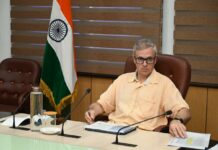
Speaking to reporters in Srinagar, Omar said he understood the anger within the police over the killing but warned against resorting to summary punitive action.
“I understand the anguish of the police. But there is an order of the Supreme Court that summary action should not be taken,” he said.
The Chief Minister said demolishing houses and detaining thousands of people would not improve the security situation.
“We will not be able to improve the situation by demolishing houses and arresting thousands of people. On the contrary, the situation will get worse,” he said.
Omar stressed that terrorism could not be defeated through force alone and required the active support of ordinary citizens.
“The police, Army and CRPF will do their work. But the real end will come only when the common people join us and fight against terrorism,” he said, recalling that during his earlier tenure as chief minister, the government had concluded that public cooperation was indispensable for ending militancy.
He also warned that excessive detentions risked diverting public anger away from militants.
“People are angry that a police head constable was brutally killed. But when the numbers become 1,000, 2,000 or 2,500 arrests, that anger gets transferred. We have to bring our people together in this fight. Only then will we achieve real success,” he said.
Referring to the demolition of houses after last year’s Pahalgam attack, Omar said he had intervened with the Centre to halt the exercise after investigations found that the attackers were not locals.
“We saw exactly this after the Pahalgam attack. I had to speak to the Central Government to stop the process. Later, the investigation found that none of the locals were involved. All the attackers had come from outside,” he said.
The Chief Minister’s remarks came amid growing criticism of the sweeping security crackdown across Kashmir.
Jammu and Kashmir Peoples Conference president and Handwara MLA Sajad Lone strongly opposed the detention of thousands of people based on their inclusion in old OGW lists.
“You cannot summon and arrest thousands of people because their names are included in the OGW list,” Lone said, arguing that many on the lists were identified decades ago and some are now elderly.
Questioning the legal basis of the detentions, Lone said the current approach undermined internationally accepted principles of reintegration in conflict situations.
“There is a concept of reintegration in conflict situations. People who have taken to arms are eventually encouraged and facilitated to reintegrate with society. But the current approach runs counter to this established principle,” he said.
“I don’t agree with the concept of mass arrests. It looks more like community punishment,” Lone added, asking the authorities to reassess the policy.
He also questioned the legality of the crackdown, saying, “Which law of our country justifies this community punishment? It is patently illegal.”
The police action followed Wednesday’s killing of Head Constable Ashiq Hussain Qureshi, who was posted with the Indian Reserve Police and attached to the Special Operations Group. He was shot dead at close range in Anantnag while deployed for Amarnath Yatra security.
Following the attack, security forces demolished the houses of two alleged local Lashkar-e-Taiba militants in Anantnag district and launched extensive searches across the Valley, detaining more than 2,500 suspected OGWs for questioning.
The crackdown has revived debate over the balance between security measures and civil liberties, with political leaders warning that collective punitive actions could prove counterproductive in the fight against militancy.