Mining in Kalakote (Rajouri) has stopped after safety orders, while Rs 71.34 crore provident fund dues and a Rs 179.04 crore claim over the defunct thermal plant intensify financial and employment pressures.
Coal mining operations in Kalakote’s historic coal belt in Rajouri have come to a standstill following regulatory action, mounting financial liabilities, and the resurfacing of a decades-old financial claim linked to the Kalakote Thermal Power Plant.
Government records placed in the assembly show that extraction at the Mehataka coal mine was halted on June 19, 2025, after the Director General of Mines Safety (DGMS), Srinagar, issued prohibitory orders under Section 22(3) of the Coal Mines Regulations, 2017. The shutdown followed inspections that found a shortage of mandatory technical personnel, including qualified mine managers, surveyors, and mining sardars, positions considered critical under statutory safety architecture. Without these designated officers, production cannot legally continue.
Officials said that recruitment has been initiated through the Government e-Marketplace portal, and communication has been sent to DGMS authorities seeking conditional clearance once appointments are made. However, regulatory restoration involves not merely staffing but documentation, safety audits, mine plan approvals, and physical inspection, suggesting that resumption may take time, they pointed out
Moughola Mine
Parallel challenges persist at the ageing Moughola coal mine, developed over nearly five decades. Engineers attribute falling output to geological depletion in certain seams, outdated extraction techniques, and ageing surface infrastructure, including haul roads, ventilation systems, and mechanical equipment. Limited capital infusion in recent years has compounded operational stress.
The government said that improved maintenance regimes and strengthened safety oversight are being planned. Exploration of a new mining block in the Moughola sector is also under consideration to offset depletion and improve grade consistency. If operationalised, officials assert, the new block could partially stabilise coal supply while creating direct and indirect employment in the region.
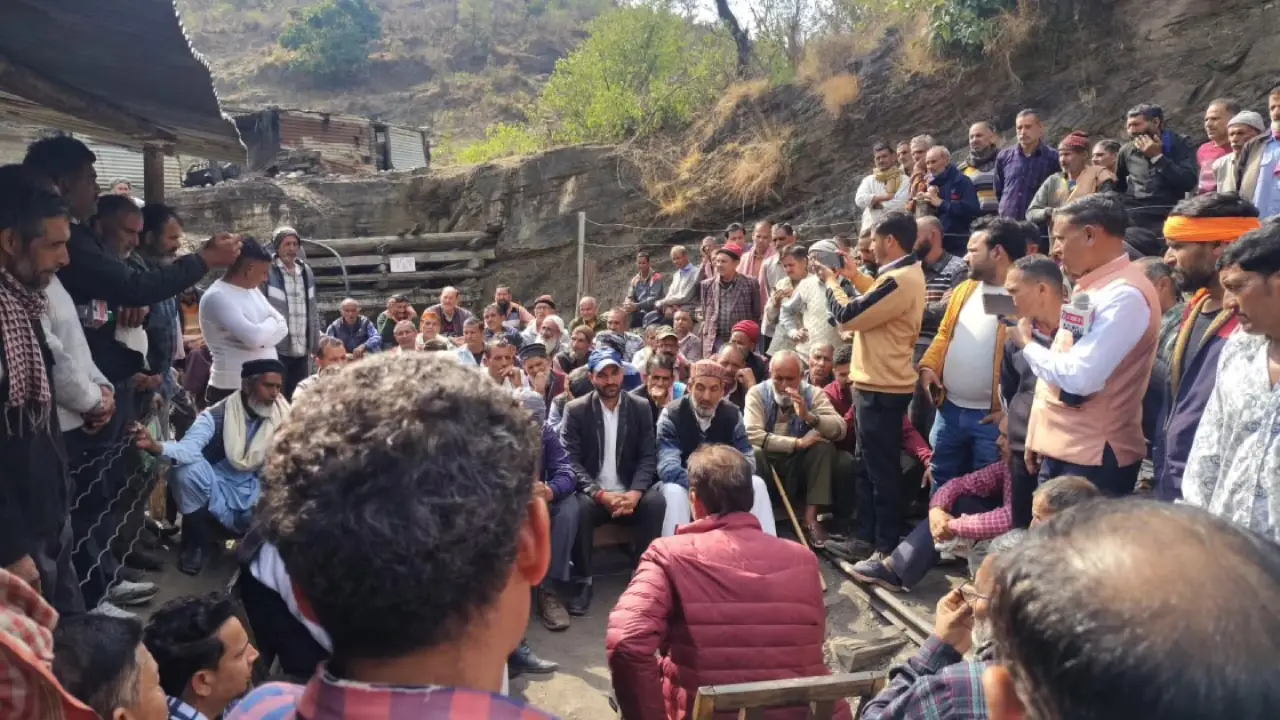
Yet uncertainty has already translated into labour unrest. On June 30, 2025, around 274 workers at the New Moughola mine staged a protest, citing the absence of work allocation and unmarked attendance. Workers expressed apprehension that prolonged inactivity could impact monthly wages and service records. The protest indicated the social cost of regulatory and financial disruptions in a mono-industrial township dependent on mining.
The Mining Department is facing a crisis on two ends. While the mines are not in operation, the costs for the operations continue. Liabilities are soaring.
Rs 71.34-Crore PF Liability
The financial position of the mining corporation remains strained. Coal Mines Provident Fund (CMPF) liabilities accumulated up to October 2025 stand at Rs 71.34 crore. These arrears represent legacy statutory obligations, while current monthly contributions are reportedly being deposited on schedule.
Officials said the pension and gratuity disbursements are being cleared in phases, subject to cash flow availability. However, they acknowledge that without the resolution of pending inter-departmental claims, liquidity stress will persist. The mines’ revival plan, therefore, is not solely technical but also financial, dependent on unlocking disputed receivables.
Jammu Kashmir Minerals is itself facing acute financial stress with total pending liabilities amounting to Rs 194.65 Cr, including over Rs 71.34 Cr of CMPF. Other liabilities include Rs 47.81 Cr in royalty payable up to December 31, 2023, Rs 19 Cr in pending 6th and 7th Pay Commission arrears, Rs 4.50 Cr in gratuity and leave encashment payable, and Rs 52 Cr in pending electricity charges related to the Kalakote thermal power project.
Thermal Power Plant
At the centre of the financial dispute lies the Kalakote Thermal Power Plant, commissioned in 1968 as North India’s first coal-fired power station. Conceived to utilise locally extracted coal, the plant symbolised industrial ambition in the region. However, persistent issues with high ash content and low calorific value of coal reduced operational efficiency. By 1989, the plant was decommissioned.
The plant’s administrative journey has been complex. It was transferred from the Minerals Department to the Works and Power Development Department in 1973 and later to the Jammu and Kashmir State Power Development Corporation Limited in 1994. Jammu and Kashmir Minerals Limited assessed its net asset value at Rs 5.33 Cr rore during transfer. Citing non-payment, the company has computed compound interest at 7 per cent annually from 1973, raising its claim to Rs 179.04 Cr.
Subsequent power sector restructuring further complicated the accounting narrative. In 1999, power projects valued at Rs 916.5448 Cr were transferred to the JKSPDC for a token consideration of Re 1. In 2018, under financial restructuring directives, these assets were recognised at original valuation as equity contribution in kind, with equivalent shares issued to the government.
Official records state that the consolidated asset value has been fully accounted for within the restructuring framework. However, JK Minerals Limited maintains that its independent claim remains unsettled, forming the basis of the Rs 179.04 crore demand. The matter illustrates the layered nature of public-sector asset transfers, where valuation, ownership, and accounting treatment may diverge over time.
Economic Footprint
The thermal plant once anchored Kalakote’s economy. Residential colonies, market clusters, and ancillary services grew around it. Even after decommissioning, the government continues to incur expenditure exceeding Rs 11 lakh annually on salaries for nearly 250 workers linked to the closed facility. Over the years, there have also been reports of theft and deterioration of plant infrastructure, reflecting the cost of maintaining idle assets.
The cumulative situation presents a threefold challenge: restoring regulatory compliance in mining operations, resolving legacy financial obligations, and rationalising defunct industrial assets. For Kalakote, revival depends not only on reopening mine shafts but also on clearing balance sheets and reconciling decades-old transfers.
Until technical staffing is restored, liabilities addressed, and the thermal plant dispute conclusively settled, Kalakote’s coalfields remain suspended between legacy burdens and the uncertain promise of industrial renewal.