As Kashmir rolls out free e-bus travel for women, the policy is hailed as a progressive step towards gender inclusivity. Yet, in the shared space of public transport, a quieter debate unfolds—one of silent frustrations, shifting social dynamics, and the fine balance between empowerment and perceived inequality, Ibtisam Fayaz Khan reports
Inside one of Srinagar’s red-coloured e-buses, the driver presses button number three, triggering a familiar announcement: “Kripya karke mahilaon ki seats se uth jaye.” (Please vacate the seats reserved for women.) The conductor moves through the aisle, gesturing towards men seated in the designated section. Most comply without hesitation, some even moving before being asked. But not everyone yields so easily.
As the Smart City bus navigates the city streets, a woman steps inside, scanning for a place to sit. Her eyes settle on a man occupying one of the reserved seats. The conductor, noticing the situation, speaks in a firm yet measured tone. “Sir, this seat is reserved for ladies. Please vacate it.”
What should have been a routine request quickly escalates. The man’s face hardens. “Are all the seats for ladies?” he retorts, his voice edged with frustration. “What is left for men then?” His words carry an unmistakable weight, articulating grievances often murmured but rarely spoken outright.
A few passengers turn their heads, some indifferent, others faintly amused, as if they have witnessed such exchanges before. The driver, accustomed to these reactions, remains composed. “Sir, these few seats are reserved,” he explains evenly.
But the man is unconvinced. “If it is like this, then make a separate bus for ladies!” he declares, his voice rising. A few women exchange glances but remain silent. Some men sitting nearby shift slightly in their seats, their expressions unreadable—whether in agreement or quiet resignation, it is difficult to tell.
Another day, another reluctant commuter. Muttering under his breath, he moves aside. “Are we not humans?” he said—not protesting, not questioning, merely stating the familiar.
Though such moments are not unprecedented, they emphasise how gender-based policies shape public spaces and commuter experiences. The majority of men comply without resistance, recognising the necessity of these measures. But with a new initiative granting women free rides, conversations about fairness and inclusivity are gaining traction. As transport policies evolve, the challenge lies in balancing women’s mobility needs with a sense of equity in shared public spaces. While the initiative aims to enhance accessibility, it also raises an uncomfortable question: does it truly foster inclusivity, or does it risk deepening existing tensions?
Policy Shift in Public Transport
Jammu and Kashmir’s public transport landscape is set for another change. In his maiden budget proposal on March 7, 2025, Chief Minister Omar Abdullah announced that from April 1, women across Jammu and Kashmir would be entitled to free rides in buses that the government owns —a policy designed to enhance mobility, provide financial relief, and encourage workforce participation. While widely regarded as a step towards gender-inclusive mobility, the policy has also raised questions about how transport privileges shape public spaces.
Owais Rana, CEO of Srinagar Smart City Ltd, said that although no official directive has been received, preparations are already in place. “As soon as we receive the formal order, we are prepared to implement the facility without delay,” he said.
While there has been no significant resistance to the proposal, some argue that alternative measures—such as gender-segregated transport or balanced fare concessions—might be more equitable. Globally, governments have adopted varied approaches, from women-only transit services in South Asia to fare subsidies in the West, all to create safer and more accessible public transport. The challenge remains in uplifting one group without disadvantaging another.
Riding the Divide
For many women in Kashmir, public transport has long been a space of negotiation—between accessibility and safety, affordability and comfort. With the introduction of Smart City e-buses in November 2023 and the subsequent free-ride initiative for women, these negotiations have shifted. Some see the changes as a long-overdue step towards gender-inclusive mobility, while others remain sceptical about their long-term impact.
Safety has been a persistent concern in public transport. Private buses and Sumos often pose challenges—overcrowding, unwanted attention, and occasional harassment—prompting many women to view e-buses as a safer alternative. “I have never felt unsafe in these buses,” noted one working woman. However, this is not a universal experience. “Whenever buses are overloaded, we have to face many unwanted vulgar issues, irrespective of whether a girl or a woman is standing or sitting,” one commuter explained. “Most of the time, when we are standing in an overcrowded bus, there are instances of inappropriate physical contact—whether intentional or not—which is deeply disturbing.”
Beyond safety, discomfort remains an issue. “I have not felt unsafe, but I have felt uncomfortable at times when some older men—not all—behave inappropriately,” said another commuter. “Some sit in ways that make others uneasy, and there is often an unsettling male gaze from all age groups. It makes travelling on public transport particularly unpleasant when the bus is overcrowded.”
The reserved seating policy, reinforced through frequent announcements, has received strong support from female commuters. Many rely on these seats for comfort, particularly during long commutes. “Very important—I use them often,” one respondent emphasised. However, some question whether the policy effectively addresses harassment. “In an overloaded bus, standing itself becomes unsafe. When the driver suddenly applies the brakes, it is difficult to maintain balance, and most of the time, you end up falling on someone,” said one commuter. “In such a scenario, how many seats can realistically be preserved, and how many women can they truly protect?”
Shifting Dynamics
The introduction of free rides for women has been widely welcomed, particularly for the economic relief it offers. “It makes travel more accessible,” said one respondent. Others, however, see it as a convenience rather than a necessity. “Somewhat helpful—I benefit, but it is not essential for me,” noted another commuter.
As these policies become embedded in daily commuting, women have observed varying reactions from male passengers. Some note an undercurrent of frustration among men who feel inconvenienced by gender-based privileges, while others report no such resentment. “Yes, often male commuters feel discomfort due to these policies,” one woman said, adding that while the frustration is rarely vocalised, it is noticeable. Another commuter, however, disagreed: “No, never—I have not noticed any discomfort.”
Towards a Fairer System
When asked how public transport could be made fairer for all, responses varied. Some advocated for increased surveillance and stricter enforcement of existing policies, while others proposed structural changes. “Segregation of transport—similar to women-only compartments in metro systems—could be an effective solution,” suggested one commuter. Others called for a redesign of the transport system itself. “Either introduce separate buses for both genders or strictly enforce a ban on overcrowding. If men and women must share a bus, ensuring all passengers are seated could significantly reduce inappropriate behaviour,” one respondent suggested. Another proposed a more visible approach: “Designate separate buses for men and women and use colour coding so that people can easily identify which bus they should board.”
As the free-ride initiative continues, women’s experiences reveal the layered nature of public transport policies. While safety and accessibility have improved for many, the broader debate over fairness, both for men and women, remains unresolved.
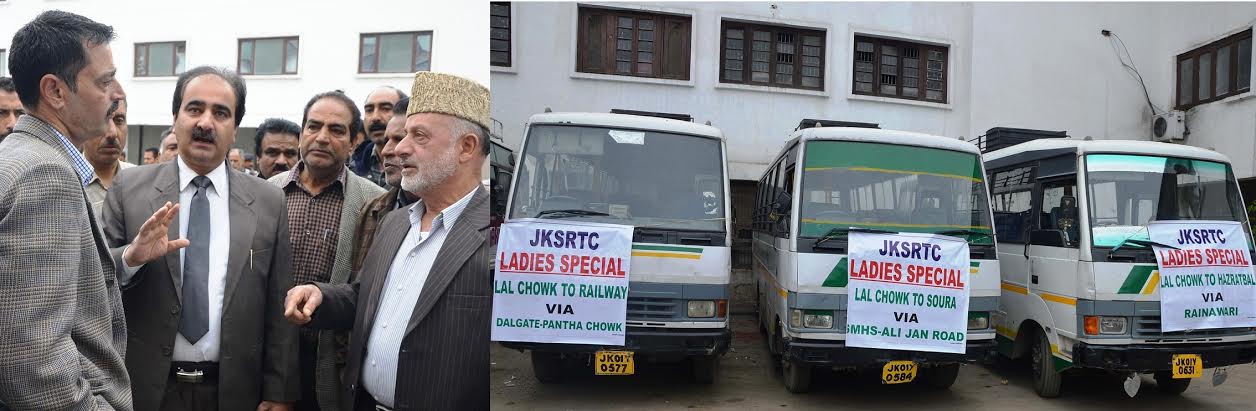
Free Ride’s Flip Side
The introduction of free e-bus travel for women has triggered a quieter sentiment among males – one of resignation, occasional resentment, and a sense of being overlooked. While most surveyed men support the initiative, perspectives vary. Some view it as a necessary measure to encourage women’s workforce participation, while others see it as an undue advantage. A smaller group questions why financial relief is distributed along gender lines when economic hardship affects all.
This debate is not new. In Delhi, a similar scheme introduced in 2019 increased female ridership but also sparked discontent among low-income men. In Kashmir, tensions already exist over reserved seating, where men are expected to vacate designated spaces. With free rides now added to the equation, the potential for friction grows.
Gendered Transit?
Dr Shazia Malik, a gender studies expert and assistant professor at University of Kashmir, explains that such initiatives acknowledge the systemic barriers women face in accessing public spaces. “Ensuring safe and easy transport for women is not just about mobility; it normalises their presence in public, reduces patriarchal resistance, and narrows the gender gap in employment and education,” she said.
However, these measures are often met with scepticism. Some men, particularly those who find themselves standing in overcrowded buses while reserved seats remain vacant, perceive the policies as unfair. “In places like Kashmir, where social and cultural norms already shape interactions in public spaces, there is an added layer of complexity,” Dr Malik noted. “The pressure on men to vacate seats—even beyond the reserved section—creates an unspoken moral expectation, leaving some with a sense of forced compliance.”
Dr Malik suggests that gender-sensitive transport policies should extend beyond free rides. “Having reserved seats is not enough if overcrowding negates their purpose. Proper surveillance, clear communication about these policies, and alternative solutions—such as separate compartments or designated buses—should be considered to strike a balance,” she said.
Ultimately, the success of these policies depends on public perception and implementation. While they aim to address real concerns, their effectiveness lies in ensuring inclusivity without deepening social divides. “For real change, policies must be accompanied by awareness campaigns, expert advice, and infrastructural improvements, so they are seen not as privileges but as necessary steps toward an equitable society,” Dr Malik concluded.