NEW DELHI: India and the European Union on Tuesday concluded negotiations on a historic Free Trade Agreement (FTA), the largest trade pact ever signed by either side, creating a free trade zone spanning nearly two billion people and close to a quarter of global GDP.
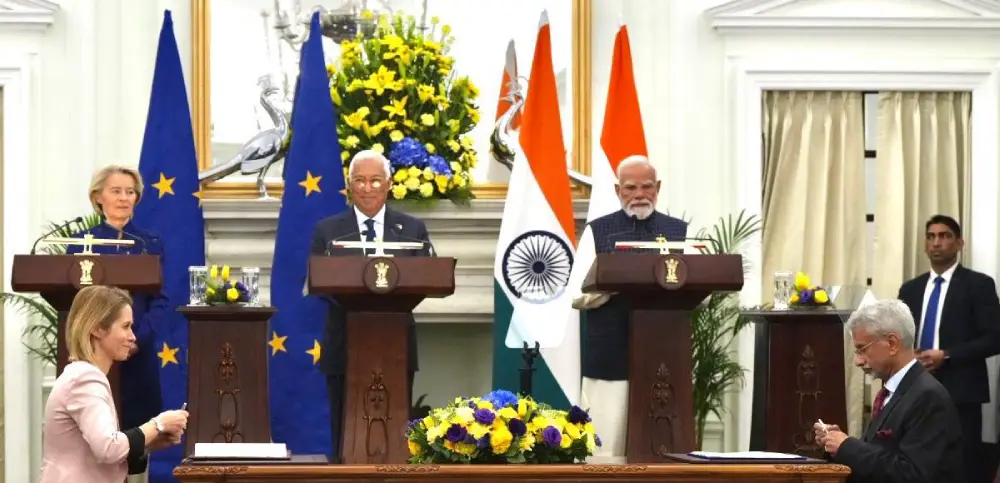
The agreement comes at a time of heightened geopolitical tensions and economic uncertainty, and is expected to significantly deepen economic, strategic and political ties between the world’s fourth-largest economy and the 27-nation European bloc.
European Commission President Ursula von der Leyen hailed the pact as a defining moment, calling it the “mother of all deals.” In a post on X, she said the EU and India had “created a free trade zone of two billion people, with both sides set to benefit,” adding that the agreement sends a powerful message that “rules-based cooperation still delivers.”
Prime Minister Narendra Modi welcomed the agreement, saying it would give a major boost to India’s growth ambitions. “The India-EU Free Trade Agreement will strengthen India’s manufacturing and services sectors, boost investor confidence and deepen our strategic partnership with Europe,” Modi said in a post on X.
India and the EU currently trade more than €180 billion worth of goods and services annually, supporting nearly 800,000 jobs in the EU. Under the FTA, tariffs on 96.6 per cent of EU goods exports to India will be eliminated or reduced, a move expected to double EU goods exports to India by 2032 and save European companies around €4 billion a year in duties.
The agreement marks the most ambitious trade opening India has ever offered to a partner. It gives European firms preferential access to India’s vast market of 1.45 billion people and one of the world’s fastest-growing major economies, with an annual GDP of €3.4 trillion.
Key tariff cuts include a gradual reduction in duties on imported cars from as high as 110 per cent to as low as 10 per cent, while tariffs on auto parts will be eliminated entirely over five to ten years. High tariffs on machinery, chemicals and pharmaceuticals will also be largely removed.
European automakers such as Volkswagen, Renault, Stellantis, BMW and Mercedes-Benz are expected to benefit, although analysts note that India’s car market remains highly competitive and dominated by domestic manufacturers.
Modi said the agreement reflects India’s commitment to reform and openness. “This agreement underlines India’s role as a trusted global economic partner and reinforces our belief in open, fair and rules-based trade,” he said.
The FTA will significantly lower barriers for European agri-food exports, cutting or eliminating tariffs that currently average more than 36 per cent. Duties on wines will fall from 150 per cent to 75 per cent at entry into force and eventually to as low as 20 per cent, while tariffs on olive oil will be reduced from 45 per cent to zero over five years. Processed food products such as bread and confectionery will also see tariffs of up to 50 per cent eliminated.
Sensitive EU agricultural products such as beef, poultry, rice and sugar have been excluded from liberalisation, and Indian exports to the EU will continue to comply with stringent European health and food safety standards.
The agreement also grants EU companies privileged access to India’s services market, including financial services and maritime transport, representing India’s most far-reaching commitments in these sectors under any trade deal so far.
A dedicated chapter for small and medium-sized enterprises (SMEs) aims to simplify customs procedures, enhance transparency and provide institutional support to help smaller businesses benefit from the agreement.
The FTA includes robust provisions on the protection and enforcement of intellectual property rights, covering trademarks, copyrights, designs, trade secrets and plant varieties, bringing Indian and EU IP regimes closer together.
It also contains a comprehensive trade and sustainable development chapter, committing both sides to high environmental and labour standards, climate action, women’s empowerment and responsible business conduct.
India and the EU will additionally establish a joint climate cooperation platform in 2026, with the EU planning up to €500 million in financial support over the next two years to assist India’s efforts to cut greenhouse gas emissions and pursue sustainable industrial growth.
The negotiated texts will now undergo legal vetting and translation before being submitted to the EU Council and the European Parliament for approval. Following ratification by both sides, the agreement can enter into force.
Negotiations on a separate Geographical Indications Agreement and an Investment Protection Agreement between India and the EU are continuing.
Calling the agreement “a milestone in India-EU relations,” Modi said the deal “opens new opportunities for businesses, workers and innovators on both sides,” while von der Leyen stressed that it marked “only the beginning of a much deeper partnership.”