Despite criticism from his political adversaries, Omar Abdullah appears to have focused on tackling low-hanging fruit during the initial 100 days of his tenure. However, many of his voters, and even some within his party, are eager for him to address the promises he made during the election campaign, reports Humaira Nabi.

On January 13, Prime Minister Narendra Modi inaugurated the Sonamarg tunnel in his signature style. Dressed in a sleek jacket and black sunglasses, he projected confidence as he stood atop a floral-adorned, open-top vehicle, driving through the newly constructed passage. A discreet bodyguard, partially visible maintained a watchful presence, ensuring the Prime Minister’s security without overshadowing the moment.
The absence of a Chief Minister to share the spotlight underscored the region’s evolving power dynamics. Omar Abdullah, though present, remained overshadowed by Modi’s presence. As the Prime Minister ceremoniously cut the ribbon to mark the opening of the 6.5 km bi-directional tunnel, Abdullah stood at a distance, a subdued figure on the periphery of the grand spectacle. He, however, had a joint photograph with the Prime Minister, LG Manoj Sinha and Highway Minister, Nitin Gadkari with the tunnel opening as an impressive backdrop.
Modi later engaged with engineers and officials, animatedly discussing technical aspects of the project. Abdullah, positioned at the margins, appeared detached—both literally and figuratively—from the core discussions. His presence, though notable, was largely inconspicuous, highlighting the carefully orchestrated optics of political events in Jammu and Kashmir.
The event unfolded just days before Omar’s Jammu Kashmir National Conference government completed its first 100 days in office. Since taking charge on October 16, the administration has come under mounting criticism for failing to meet public expectations. With the region witnessing the return of an elected government after six years, hopes for meaningful change had been high. However, the government’s performance so far has left many questioning its ability to fulfil the promises it made while seeking the vote in a highly participated election.
While some initiatives have been introduced, the administration remains constrained by the structural realities of governing a Union Territory, where substantial authority is vested in Lt Governor Manoj Sinha. Political observers believe these limitations have hindered the government’s ability to operate independently, posing significant challenges to its governance.
The 100-Day Target
On November 22, a month after assuming office, Omar’s cabinet reviewed the administration’s 100-day target. The agenda prioritised tackling unemployment and fast-tracking recruitment processes, with Abdullah instructing ministers to expedite hiring within their respective departments.
Earlier in the month, Abdullah had convened a high-level review meeting at the civil secretariat to assess the performance of various government departments. During the session, he established clear benchmarks for completing developmental projects within 100 days and one year. Administrative secretaries presented detailed vision documents, outlining specific deliverables within these timelines. These encompassed major policy decisions, the completion of ongoing projects, and the initiation of new developmental schemes.
The targets were low-hanging fruit that were about to be ready. It included a huge list of formal inaugurations and laying of foundation stones.
With the 100 days now concluded, voters and opposition leaders scrutinise the government’s performance. Asserting that development is a routine exercise, they are seeking “tangible evidence” of progress viz a vis the mandate he had chosen for himself.
Key Reforms
In its first hundred days, the Omar Abdullah-led Jammu and Kashmir National Conference (JKNC) government undertook a series of bold measures, with the most significant being restoring the region’s academic calendar—a transformative shift in the education system.
“For now, we will restore the academic session to November-December up to the 9th standard. For students in the 10th to 12th, the academic session will be restored from next year,” Education Minister, Sakina Masood, announced. This decision marked a departure from the academic calendar introduced by the Lt Governor’s administration in 2022, which had aligned the session with the national schedule, commencing in March. The government’s move reinstates the traditional November start in Kashmir’s winter zones.
Among the administration’s initial measures was the sanctioning of 575 lecturer posts in the education department, addressing a longstanding demand to strengthen academic infrastructure. In a decision welcomed by young aspirants, the upper age limit for candidates appearing in the Public Service Commission’s Combined Competitive Exam was also raised.
The government further approved key reforms across various sectors. In the field of medical education, a three-tier faculty structure was introduced for dental colleges. Economic measures included amendments to the Jammu and Kashmir Goods and Services Tax Act, aimed at streamlining financial operations. Employment reforms saw the elimination of oral tests for specific government posts, a step intended to enhance transparency in recruitment processes.
Additionally, steps were taken to address the financial concerns of government employees and pensioners, with the announcement of measures to clear pending dearness allowance arrears.
In its first month in office, the Omar government secured an additional 300 MW power supply for the region following successful negotiations with Power Minister Manohar Lal. This crucial agreement, achieved at standard rates rather than higher emergency tariffs, aims to provide relief to both Kashmir and Jammu, which experience severe power shortages during the winter and summer months, respectively.
Since assuming office, Omar Abdullah has been actively advocating for the restoration of Jammu and Kashmir’s statehood—a key promise outlined in the party’s election manifesto. Speaking at a public event following the inauguration of the Z-Morh tunnel, he called on Prime Minister Narendra Modi to fulfil this commitment and reinstate statehood to the region.
In October, during meetings with central leadership, including Prime Minister Narendra Modi and Home Minister Amit Shah, Omar pressed for greater support for the Union Territory. A significant request included an additional Rs 6,000 crore in central assistance to address budgetary shortfalls for 2024-25. In discussions with Finance Minister Nirmala Sitharaman, he stressed the importance of boosting local revenue generation and reducing dependence on central funds by focusing on investments in tourism, agriculture, and horticulture. Whether or not any of these requests have been approved will be known in the coming days.
Challenges Remain
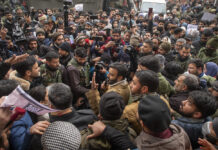
Just over a month into its tenure, the Omar government faced one of its most formidable challenges: fulfilling its election promise to revisit Jammu and Kashmir’s reservation policy. The issue reached a boiling point when job seekers gathered outside the Chief Minister’s residence, voicing their opposition to the new reservation rules. The revised policy, which expanded quotas for various groups beyond 60 per cent, has triggered a wave of discontent among open-merit candidates, many of whom sought legal intervention and demanded its immediate rollback.
The situation took an unexpected turn when dissent surfaced within the National Conference (NC) itself. Syed Agha Ruhullah Mehdi, the NC MP from Srinagar, joined the protesters, aligning himself with opposition leaders in a demonstration outside Abdullah’s residence. Mehdi, a vocal critic of his party’s government, has repeatedly condemned its approach to critical issues, particularly the restoration of Article 370 and statehood—matters that have remained contentious since Omar Abdullah assumed office.
Further complicating the political landscape, the government’s alliance with Congress has shown visible signs of strain. Congress leaders, once silent partners, are now openly criticising the administration’s perceived shortcomings. Political analysts believe the marginalisation of Congress within the coalition could be a strategic move aimed at placating the BJP-led central government, reflecting the complex political calculations at play.
Vikar Rasool, the erstwhile president of the Jammu and Kashmir Congress Committee, has strongly criticised the “inefficiency” of the Omar government. In a recent interview, he expressed frustration over what he described as a lack of reciprocity from the National Conference (NC). “The Congress helped the NC shed its image as a proxy for the BJP, particularly after Farooq Abdullah received relief from the High Court, which quashed the Enforcement Directorate’s charge sheet against him in the JK Cricket Association case. But this is not how coalitions work,” he said.
Rasool accused the JKNC of crediting the BJP for projects initiated by the Congress. “The initiatives launched by the Congress are now being attributed to the BJP and the Prime Minister by the National Conference and its leaders,” he remarked. He also dismissed the government’s accomplishments, describing them as insubstantial. “So far, this government has been a total failure. The only notable decision has been the change in the academic session—a routine administrative task that was previously handled by a director but is now being portrayed as a major achievement by the Chief Minister and the Education Minister.”
Mohit Bhan, spokesperson for the People’s Democratic Party (PDP), echoed similar sentiments, labelling the administration a “complete failure.” He acknowledged the government’s authority but criticised its inability to deliver on promises. “We understand the power this government wields, just as the National Conference did. However, they should have been mindful of their limitations when making ambitious promises to the people. The current administration has not only failed to fulfil them but has also ceased discussing these issues altogether.”
Bhan further questioned the government’s inaction on key matters. “What is stopping them from addressing the issue of shifting prisoners from outside the region to local jails? Why is there no dialogue about the ousted employees?” he asked. He alleged that the administration’s priorities lay elsewhere. “Their primary focus seems to be appeasing the central government. That is why they are seen flying to Delhi so frequently,” he claimed.
It is not opposition alone. Even clergy has joined in. A popular Shia cleric has a scathing critique of Omar’s Aaap Aayay Bahar Aayee speech and it was a huge hit on social media. People in Jammu and Kashmir are seeking answers for promises made about undoing things that have happened in the last few years. They talk about Sheikh Abdullah’s holiday restoration, durbar Move restoration, clearance of payments stuck in the governance maze for years, and a formal closure to the massive land appetite that the developmental front is reporting.
Omar Focus
In most cases, a decision would require too many cushions and a lot of authority. Regardless of the criticism and the crisis he is facing on governance issues – he is facing problems even in posting the officers, Omar sees the malady in the dual system of the bipolar governments in Jammu and Kashmir. He has talked about it so have his colleagues and friends. Right now, his focus is to have statehood restored. He has been silently but aggressively campaigning for it and there are rumours that something is happening.
Political observers believe that restoration of full statehood is too distant a dream right now but indications suggest something is cooking up. If that somehow helps him get a fair share in governance issues, there is a possibility of Omar’s government becoming more visible in the coming days. In politics, however, there are no free lunches. If there is a quid pro quo, it remains to be seen how desperation for seeking legitimate authority upsets the political landscape of a space that is in perpetual crisis.