SRINAGAR: In the remote Himalayan skies of Ladakh, the auroras of May 2024 were more than just a breathtaking spectacle; they were harbingers of one of the most complex solar storms Earth has seen in decades. Over a year later, Indian scientists have decoded the dramatic chain of solar eruptions that caused this rare display, marking a milestone in heliophysics and space weather prediction.
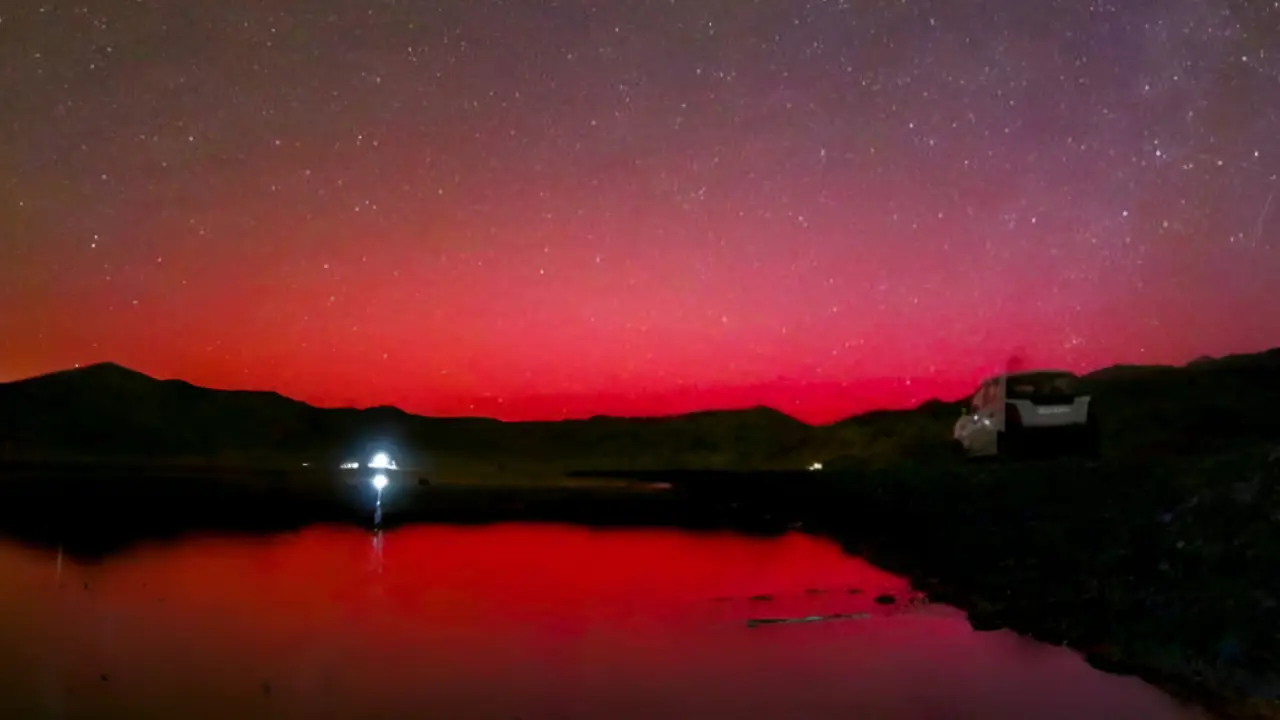
The story begins on May 10, 2024, when a sequence of six massive Coronal Mass Ejections (CMEs), giant bursts of magnetised plasma from the Sun’s corona, hurtled toward Earth. What made the event historic was not only the number of CMEs but their interaction. All six originated from a hyperactive region on the Sun, linked to solar flares and filament eruptions. As they collided and merged en route to Earth, they triggered a geomagnetic storm unmatched in over 20 years.
The result: on May 11, the skies over Ladakh were lit with rare red and green auroras, typically visible only in far northern latitudes like Canada or Scandinavia. The spectacle was captured by the Indian Institute of Astrophysics (IIA) through its all-sky cameras at Hanle and Merak.
“This was a unique sequence of six interacting CMEs,” Dr Wageesh Mishra, faculty at IIA told reporters. “It gave us an unprecedented opportunity to trace how solar plasma evolves thermodynamically across space.”
Using data from NASA and ESA space missions, the IIA team modelled the journey of these solar clouds using an analytical framework called the Flux Rope Internal State (FRIS) model. Lead author and IIA doctoral scholar Soumyaranjan Khuntia explained that the CMEs initially released heat but, surprisingly, transitioned into a state of heat absorption as they travelled farther from the Sun.
By the time the solar storm reached Earth, instruments like NASA’s Wind spacecraft detected something stranger still, a “double flux rope” structure, a twisted braid of magnetic fields with unusual heating and cooling patterns between ions and electrons.
Published in the Astronomy and Astrophysics journal, the study is the first of its kind to offer a continuous thermodynamic profile of multiple interacting CMEs across interplanetary space. “This work lays the foundation for a new frontier in space weather forecasting,” said Anjali Agarwal, a co-author and doctoral scholar at IIA.
The Ladakh auroras did not end there.
On the night of October 10–11, 2024, another red-hued aurora painted the sky over Hanle, Leh, and Merak, again visible to the naked eye. According to IIA’s official statement, bright red streamers appeared around 10:45 pm and continued until dawn. It marked the fourth major aurora sighting in Ladakh during the current solar cycle, after those on May 10, 2023; November 5, 2023; and May 11, 2024.
These auroras were predicted 48–72 hours in advance by the Center of Excellence in Space Sciences India (CESSI), based at IISER Kolkata, using machine learning models that had flagged the flare-prone solar activity days earlier. “Our predictions were validated. This boosts our confidence in forecasting extreme solar weather,” Dr Dibyendu Nandi, head of CESSI, was quoted as having said.
Dr Nandi pointed out that these events are linked to the peak of Solar Cycle 25, which began in December 2019 and was predicted by CESSI in a 2018 Nature Communications paper to peak in 2024. Whether the cycle has already peaked remains under watch.
“A severe solar storm can enhance orbital decay of satellites. An extreme storm could disable satellites, trip power grids, and cripple communications and banking,” Nandi warned.
The research teams from IIA and CESSI now look forward to integrating data from India’s Aditya-L1 mission, including the VELC and ASPEX instruments, to refine their forecasts and better understand how CMEs interact with Earth’s magnetic shield.
“India is well on its way to becoming a global powerhouse in heliophysics,” said Dr Mishra, “helping us prepare for future space weather threats that could disrupt the backbone of modern society.”