SRINAGAR: A new anthology has brought together, for the first time in such comprehensive form, a sweeping selection of Kashmiri literature translated into English, taking readers from fourteenth-century verse and folk traditions to modern stories, radio plays and experimental writing.
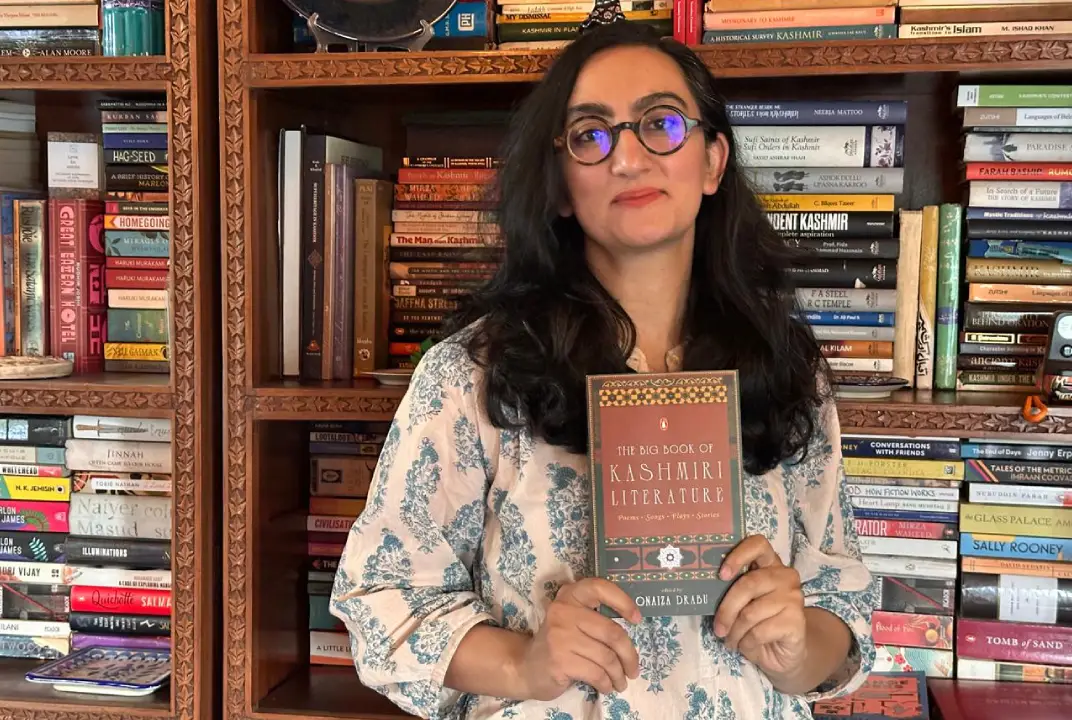
The Big Book of Kashmiri Literature: Poems, Songs, Plays, Stories, compiled and translated by anthropologist and writer Onaiza Drabu, has been published by Penguin India in August 2026. Running to 664 pages, the volume seeks to introduce readers not merely to Kashmiri literature but also to the historical, cultural and emotional landscape that shaped it.
The anthology brings together the work of scholars, saints, dramatists, storytellers and poets, including voices from Kashmir’s rich oral tradition as well as its later print culture. Pre-modern verse, folk chants, metaphysical ghazals, plays, flash fiction and excerpts from novels appear alongside other forms of literary expression.
According to the book’s description, the anthology traces a literary culture that evolved through Kashmir’s oral traditions, borrowed influences from the East and subsequently engaged with the West through print. Together, these strands offer what the publisher describes as an immersion into the “emotional topography” of Kashmir, its language and its people.
For Drabu, the project grew out of a long-standing desire to spend several years reading Kashmiri literature and assembling a representative selection in translation.
“Many years ago, I found myself wishing I had a few years to read Kashmiri literature and put together a selection in translation,” she wrote while announcing the book. “For the past three years that is all I have done.”
Drabu, an anthropologist, writer and translator rooted in Kashmir, has long worked at the intersection of language, literature and culture. Her first book, a retelling of Kashmiri folklore, was published in 2019.
The making of the anthology also unfolded against a deeply eventful personal period in Drabu’s life. She became a mother while working on the book.
Her husband Ali Khan Mahmudabad, a professor at the Ashoka University, reflecting on the completion of the anthology, described the book as the product of three years of work and praised the effort involved in editing and assembling such a diverse body of literature.
He noted that the birth of their child and the publication of the anthology had occurred almost exactly a year apart, calling the book a “first birthday present”. He also described the anthology as a painstaking process in which different literary “strings, strands, and threads” had to be woven together.
“Lliterature offers a glimpse into how a language informs the mindscapes of people and societies,” Mahmudabad wrote, describing the anthology as a portal that could encourage readers inside and outside Kashmir to reconsider their assumptions about the region and understand the ways in which literature shapes the past, present and future.
The anthology has also drawn appreciation from Drabu’s uncle and former Jammu and Kashmir finance minister Haseeb Drabu, who likened the book to chanchabeel, a Kashmiri expression associated with a spread offering different flavours and textures.
Describing it as a literary tasting menu, Haseeb Drabu praised the anthology for curating the diversity of Kashmiri literature in a form that allows readers to sample its many traditions and return to them repeatedly.
At its core, The Big Book of Kashmiri Literature attempts to address a longstanding gap in the accessibility of Kashmiri literary traditions to readers who do not read Kashmiri. By bringing works across centuries, genres and literary traditions into English translation, it presents Kashmir through the voices of those who have imagined, remembered, questioned and narrated the land in its own language.
The book is published in paperback by Penguin India.
The book is also an exercise in representation, not only in the authors and works it brings together, but in the range of translators who have shaped it. Unlike conventional anthologies that rely largely on professional translators, this project includes hobby translators whose engagement with translation extends well beyond their regular professions. Among them are a civil servant, a successful poet, an academic working in a village in Kashmir, an economist, a professional musician and a neuroscientist. For each, translation has been a project of passion, driven by a different personal or intellectual impulse.
Together, the translators have redrawn the literary map of Kashmir, bringing shifts in emphasis and perspective. Some have recovered works that had previously been overlooked in translation, while others have experimented with form, producing transductions and transcreations alongside more literal renderings that seek to preserve the original meaning as closely as possible.
The selection also deliberately moves beyond established literary names. Some contributors are musicians, mystics or mothers whose writing was never undertaken with serious literary ambitions. In some cases, it was their children who, having watched them write, encouraged their work to find a place in the anthology. They represent a much larger community of people who continue to write and recite in Kashmir despite the absence of a thriving publishing ecosystem and largely outside the structures of state patronage.
The works chosen, therefore, are not necessarily the most representative pieces by each author. Rather, the editors and translators have often selected the work that contributes most meaningfully to the larger narrative the book seeks to construct.
At the heart of the project is this broader idea of representation. The diversity extends to the translators themselves. Alongside academics are people for whom translation lies well outside their professional lives. For some, it is a form of service; for others, a way of returning home or an act of self-care. For some, it has become a means of connecting with family: three translators have involved their mothers in the project, while another has worked with an uncle and another with an aunt.
The result is an anthology that brings together not only different generations and literary traditions, but also markedly different approaches to translation. Some translators remain close to the original text, while others take greater creative liberties. The book consequently accommodates both the accessible and the experimental, the seasoned translator and the first-time practitioner, reflecting the many ways in which Kashmir’s literary traditions continue to be carried, interpreted and reinvented.