by Asad Mirza
Mamdani’s Indian heritage and his stance on Gaza have further fuelled accusations of being anti-Israel, drawing Islamophobic abuse and unfounded allegations of antisemitism.
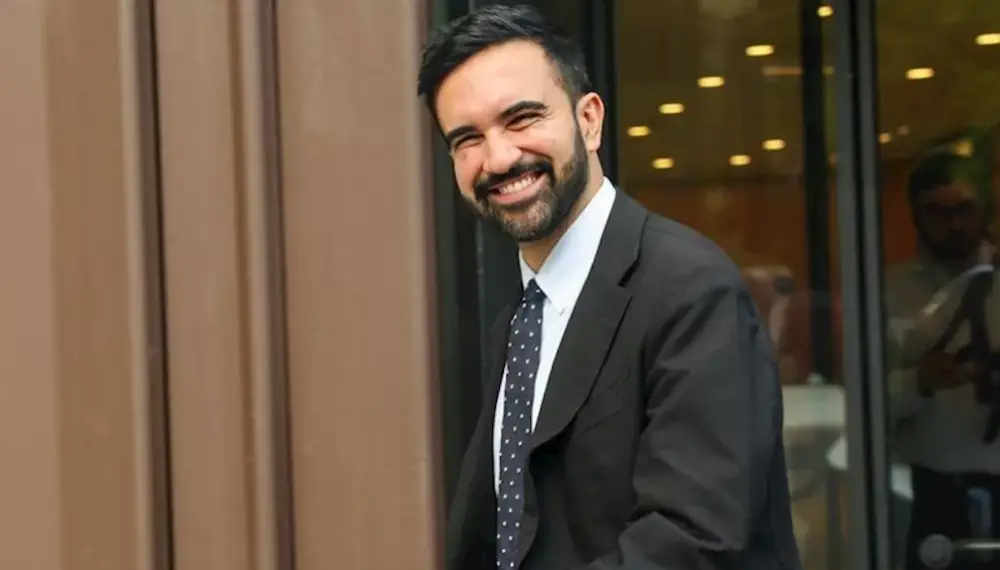
Zohran Mamdani’s unexpected victory in the Democratic primary for New York City’s mayoral race has unsettled the city’s elite and exposed deeper undercurrents of Islamophobia and capitalist anxiety within the establishment. His rise has disrupted the usual political order and triggered a reaction that reveals the structural fault lines of American society and those who wield influence over it.
At thirty-three, Mamdani, a democratic socialist and Queens assemblyman, has emerged as the frontrunner after defeating former Governor Andrew Cuomo. With unions, grassroots Democratic groups, and key elected officials rallying behind him, his path to City Hall now appears clear. His candidacy, however, has provoked a coordinated backlash from the city’s most powerful and affluent figures. Their opposition has not centred on the feasibility of his proposals, but rather on who he is and what he represents.
Although Mamdani campaigned on a platform of economic reform and public welfare, many of his policy suggestions are not novel. They echo past initiatives in New York and across the United States. For instance, former Mayor Bill de Blasio attempted to freeze rents on stabilised units in 2015, 2016, and again in 2020. Minimum wage increases have been gradually implemented over the past decade, reaching \$16.50 in the city this year. Mamdani’s call for free public buses closely resembles the Metropolitan Transportation Authority’s Fair Fares programme, which provides half-price rides to low-income residents.
Other proposals, such as state-subsidised groceries, are minor expansions of existing welfare structures. The idea of opening one government-run grocery store in each borough complements the federal Supplemental Nutrition Assistance Programme, which already supplies 1.6 million meals daily to around three million New Yorkers. Similarly, his plan to tax the wealthy reflects long-standing efforts in Albany, where such bills have routinely been introduced but consistently stalled in committee. In 2021, then-candidate Eric Adams proposed a tax on New Yorkers earning over \$5 million to support the city’s recovery, though he abandoned the idea once in office.
Despite the modesty and precedent of Mamdani’s agenda, business leaders have labelled it a danger to the city’s economic future. The Wall Street Journal has reported that powerful financial and political figures are funding independent campaigns to prevent his general election win. They fear his proposals, such as rent freezes and municipal grocery stores, might undermine the city’s market-driven foundation.
What has unfolded is not a critique of policy but a resistance to disruption. Mamdani’s campaign has become a litmus test for how far the establishment is willing to go to preserve its interests. The language of economic concern conceals an unease with a candidate whose background, politics, and popularity challenge the status quo.
At least one newly formed group, New Yorkers for a Better Future Mayor 25, has amassed a campaign fund of $20 million, according to sources close to the effort. This is only one of several initiatives aimed at defeating Zohran Mamdani, with figures such as Pershing Square CEO Bill Ackman and former mayor Rudy Giuliani involved in parallel efforts. Another campaign, led by Giuliani and former NYPD detective Bo Dietl, is reportedly attempting to raise an additional \$10 million. Despite their shared opposition to Mamdani, these financiers have yet to consolidate behind a single alternative candidate.
JPMorgan Chase CEO Jamie Dimon dismissed Mamdani’s politics as “more Marxist than socialist” and characterised his policy proposals as “ideological mush.” Yet, while donors prepare to flood the election with funding, political strategists fear that such external financial intervention could reinforce Mamdani’s anti-establishment appeal and alienate voters wary of billionaire-backed politics.
The central question remains: how did Mamdani manage to secure such a landmark victory? He achieved what national Democrats have long claimed they must do in the wake of repeated electoral defeats, but have consistently failed to execute. According to Senator Bernie Sanders, the independent senator from Vermont and two-time presidential candidate, “Zohran Mamdani talked about issues of relevance to working-class people. The city responded to him, and he won the primary.”
Mamdani, a democratic socialist like Sanders and US Representative Alexandria Ocasio-Cortez, has taken decisive positions on economic reform and the protection of human rights, both internationally and domestically. The primary results indicate that these positions have broad popular support in New York City, where he now stands as one of the most visible Democratic nominees in the country.
Despite this, Democratic leaders from New York City, including Senate minority leader Chuck Schumer and House minority leader Hakeem Jeffries, have not endorsed Mamdani. Governor Kathy Hochul and Senator Kirsten Gillibrand have also withheld their support. Gillibrand, in particular, made Islamophobic remarks about Mamdani, for which she later issued a public apology. Meanwhile, suburban Democrats such as Representative Laura Gillen have openly criticised Mamdani, opposing his positions on taxation and his criticism of the United States’ support for Israel’s assault on Gaza.
This hesitation has drawn sharp criticism from progressive circles. Jasmine Gripper, codirector of the New York Working Families Party, stated, “It is time for every Democratic leader to get on board.”
The unease voiced by business leaders and the city’s elite reveals deeper contradictions in the American political order. While the country’s leadership often speaks of democracy, inclusion, and equality, the backlash against Mamdani’s success suggests a resistance to change when it challenges entrenched power.
Some critics have equated Mamdani’s policy proposals with Soviet-era governance. Even the Democratic Party’s socialist wing has largely withheld support, exposing an unwillingness to dismantle the status quo or invest in the needs of marginalised communities. Mamdani’s Indian heritage and his stance on Gaza have further fuelled accusations of being anti-Israel, drawing Islamophobic abuse and unfounded allegations of antisemitism.
What this episode reveals is a society still grappling with its democratic ideals. Merit and a commitment to reform remain insufficient when pitted against political inertia and financial power. The opposition to Mamdani exposes a discomfort with any attempt to shift resources away from the privileged and towards those who have long been excluded.
(The writer is a New Delhi-based senior commentator on national and international affairs, defence and strategy, environmental issues, and interfaith matters, and also works as a media consultant. Views are personal.)