by Munazah Fayaz
In Kashmir’s grade-driven education culture, parental pressure sidelines moral guidance, weakening character formation and creating social imbalance despite academic success and professional achievement.
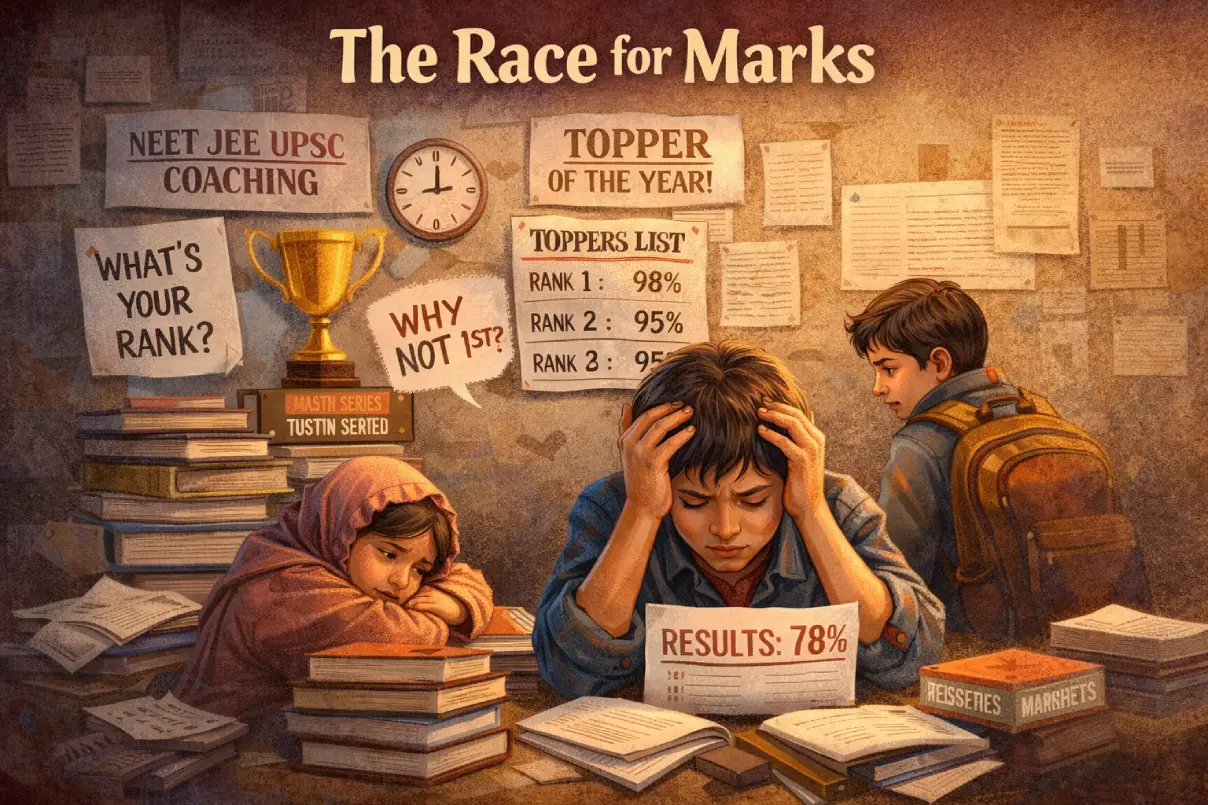
In today’s Kashmir, education has become a race, fast, competitive, and unforgiving. Mark sheets are celebrated, ranks are announced with pride, and careers are planned before childhood even ends. In the obsession with academic results, we are forgetting what truly matters: guidance, moral values, and character. Kashmiri parents, like parents everywhere, want the best for their children. Today, most dreams revolve around NEET, JEE, and UPSC, producing doctors, engineers, and civil servants. Chasing these dreams and changing them into reality is in no way wrong. Rather, it is beneficial for society. However, in this intense race, an important part that is being overlooked is honesty, humility, moral values, sincerity, and other related aspects of one’s life. Such features, if incorporated in our younger generations who chase their beautiful dreams for the betterment of society, will surely add a feather to the cap of this society.
Children begin to study not to understand, but to score; not to grow, but to compete; not to serve society, but to accumulate wealth. This mindset creates stress, anxiety, and emotional exhaustion. This pressure does not remain limited to individuals alone or to certain homes; it follows individuals throughout their lives and gets inculcated into our society. Academic coaching classes multiply in every neighbourhood, while moral coaching quietly disappears. Time that was once spent with family, reflection, and remembering the Creator is now taken up by tuition schedules and test series.
Conversations about honesty, empathy, patience, faith, and responsibility are slowly replaced by questions like: How much did you score? Who got more marks than you? Why weren’t you topping the class? Chasing grades makes children feel that love and care are conditional. A child is forced to think that he will get respect only when he achieves a certain set of criteria of marks. However, religious philosophies, for example, Islamic teachings, place emphasis on nurturing children with mercy, guidance, and character, not pressure to obtain material things.
Very few parents now encourage their children in the development of moral values. When worldly success is valued more than sincerity and humility, education loses its balance, and the soul begins to fade. This, in turn, leads to a variety of societal issues, including corruption and nepotism. Therefore, we must focus on moral education side by side. For instance, religious philosophy, including Islamic philosophy, does not reject worldly knowledge, but it strongly emphasises that knowledge without moral values and sincerity can become more harmful and less beneficial. Without religious philosophy, a person remains ignorant of his or her moral responsibilities and roles, no matter how many degrees he or she has achieved. Thus, our focus should be to work on both worldly and religious aspects of our wards.
If we look at religious philosophy, for example, Islamic philosophy, character (Akhlaq) and sincerity are developed from the mother’s lap, from home, through the behaviour of parents, daily conversations, honesty in dealings, kindness in speech, and trust in relationships. Children learn far more from what they observe than from what they are instructed. If parents lie, children learn dishonesty; if parents show patience, children learn restraint; if parents pray sincerely, children learn love for Salah.

Unfortunately, in the race for marks and results, many parents forget that education without moral education can create success without integrity. Character is caught, not taught. A brilliant mind without a guided heart can become dangerous to society. Therefore, we need to develop such an atmosphere in our homes so that we produce sincere and well-charactered individuals for society at large.
Let our homes once again become places of mercy and understanding, not pressure and fear. Let conversations begin with prayer and purpose, not comparison and competition. Build homes where Imaan grows alongside education, and character matters more than ranks. Let us raise children not only for their careers, but for their Imaan, Akhlaq, and fear of Allah, so they succeed not only in this world, but in the Hereafter as well.
“Grades may build careers, but only Imaan and Akhlaq build real human beings.”
Let us conclude this discussion with a beautiful saying of the Prophet Muhammad: “A father gives his child nothing better than good character.”
(The author studies Zoology at the Central University, Kashmir. Ideas are personal.)