by Rayees Ahmad Kumar
Dr Nazir Mushtaq’s Tinkey, a collection of a hundred Urdu micro-fictions, explores social evils, fading values and everyday human experiences, offering readers and aspiring writers a compact literary study.
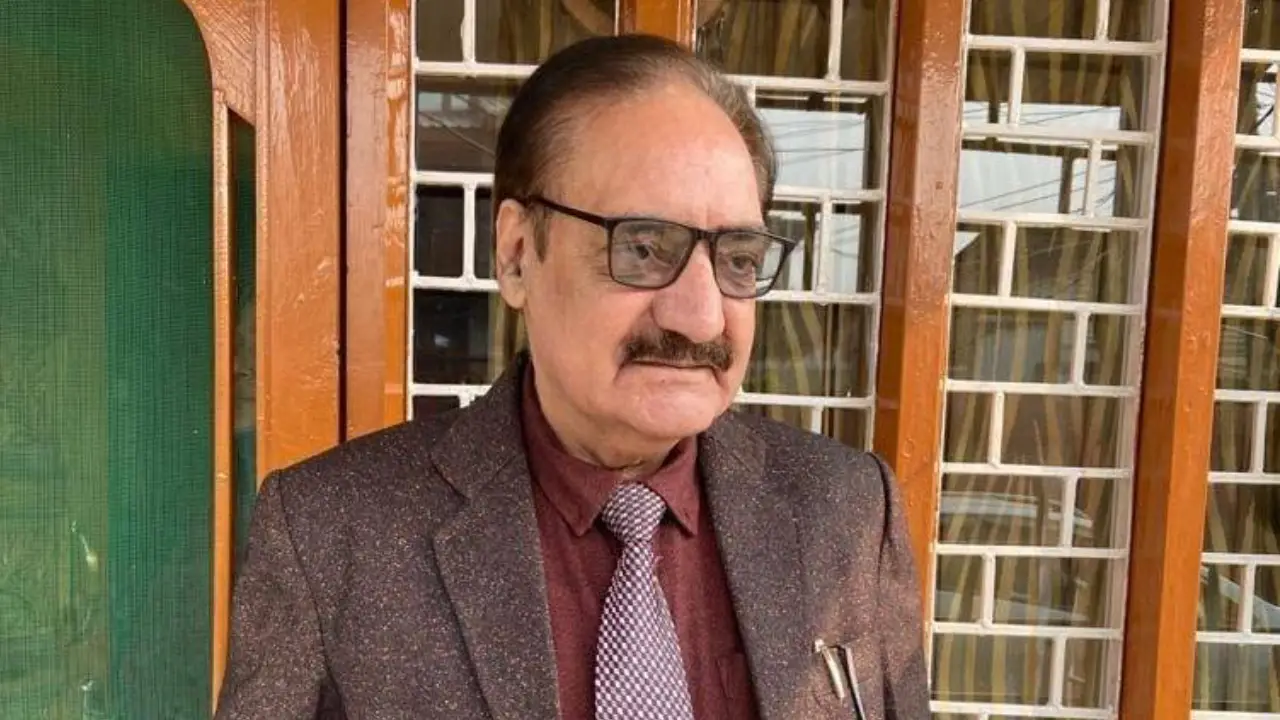
Dr Nazir Mushtaq is a renowned physician and a distinguished writer of the Valley, known for his enduring love for the Urdu language and literature. Despite a demanding clinical schedule, he finds time to express his ideas through micro-fiction and afsanchas, often sharing his work on Facebook, where his stories attract thousands of readers. His writings frequently explore social injustices, expose the contradictions of everyday life and, directly or indirectly, suggest ways to address the evils that afflict society.
I have followed Dr Mushtaq’s writings since the days when he wrote a health column, Sahati Kamil, for the daily Kashmir Uzma. I was pursuing my graduation at the time. His continued commitment to Urdu literature, even in his seventies, reflects a literary passion that has earned him a prominent place among the Valley’s Urdu readers.
I have long read his fiction and micro-fiction with interest. His stories are often engaging and thought-provoking, inviting readers to reflect on familiar social realities. A few months ago, he posted a micro-fiction titled Khoon (Blood) on his Facebook wall. When I read it and shared it with my wife, she developed such an admiration for his writing that she began following his stories with even greater enthusiasm than I did.
Unfortunately, I have not been able to see his Facebook writings for the past few weeks. I do not know whether I have inadvertently been blocked or whether a technical issue is preventing his posts from appearing in my feed. I hope the matter is resolved soon and that I can resume reading his work regularly.
My interest in his writing acquired a new dimension when Dr Mushtaq announced on Facebook that he had compiled a book titled Tinkey, containing a hundred of his micro-fictions. My wife insisted that I procure a copy. Her enthusiasm prompted me to travel from Qazigund to Srinagar twice in search of the book. I could not find it during my first visit, so I messaged Dr Mushtaq to inform him of the difficulty. Fortunately, on my second visit, I succeeded in obtaining a copy from KBD Book Shop.
Published by GNK Publications, Charar-i-Sharief, Budgam, Tinkey contains a hundred micro-fictions spread over 198 pages. The book is attractively designed, and the quality of its paper deserves appreciation. For Urdu readers, it is a welcome addition to the growing body of contemporary literary writing in the Valley.
The book’s literary significance is reflected in the contributions of several established writers who have commented on Dr Mushtaq’s work. Its preface has been written by Noor Shah, the Valley’s celebrated fiction writer. Observing that Jammu and Kashmir has a galaxy of accomplished fiction writers, Shah places Dr Mushtaq in a distinctive position among practitioners of microfiction. The collection, he suggests, reflects the writer’s sustained commitment to a literary form that demands both imagination and precision.
In his own introductory note, titled Mere Afsaanche (My Micro-fictions), Dr Mushtaq describes the collection as a hundred stories now placed in the hands of readers. He calls micro-fiction his hobby, explaining that whenever he steps away from his busy clinical schedule, he enters the literary world and begins writing. He regards his micro-fictions as his children and considers himself their mother. The observation offers a glimpse into the personal attachment he feels towards his creations and the care with which he approaches his literary pursuits.
The writer, poet and translator Parvez Manoos also contributes an appreciation of the collection. He notes that although Dr Mushtaq is a medical doctor by profession, his affection for Urdu language and literature is profound. His microfictions draw on the different colours and shades of life encountered in everyday experience. Manoos emphasises that expressing substantial ideas in a few words or lines requires considerable literary skill, a quality he believes Dr Mushtaq possesses in abundance. This ability to convey meaning concisely, he suggests, helps explain the writer’s popularity.
Wehshi Syed, chief editor of Nigeena International, similarly highlights the craft involved in compressing a significant thought into a page or two. He regards this capacity for literary condensation as one of Dr Mushtaq’s notable strengths. Microfiction demands more than brevity: it requires the writer to select a telling detail, establish a situation and leave the reader with an idea or emotion that extends beyond the words on the page. The appreciations in Tinkey draw attention to this central challenge of the genre.
Towards the end of the book, Dr Riyaz Tawheedi Kashmiri provides a four-page overview and analysis of the collection. He observes that Jammu and Kashmir has produced a number of prominent writers who were not formally trained in language and literature. Among those he mentions are Noor Shah, Wehshi Syed, Mushtaq Mehdi, Deepak Budki, Parvez Manoos, Raja Yousuf, Nasir Zameer and Zubair Qureshi. Dr Mushtaq, too, has established himself as a recognised literary voice despite his professional background in medicine. His work demonstrates how sustained reading, observation and creative engagement can enable a writer to develop a distinctive place in the literary world.
Dr Mushtaq has dedicated Tinkey to his beloved sister, Tahira Bano; his wife, Dr Raas Masood; Waseem and Yawar; and all his Facebook friends. The dedication reflects the personal relationships and readership that have accompanied his literary journey.
The collection’s wider appeal lies in its engagement with society and its shortcomings. Tinkey draws attention to the erosion of cultural values, the weakening of social bonds and the contradictions that often characterise human behaviour. Its stories address different aspects of social life, with a substantial number drawing on the author’s experiences as a medical professional. His clinical encounters provide a vantage point from which to observe human vulnerability, suffering, fear, prejudice and the complex relationships between individuals and society.
Among the microfictions that particularly appealed to me are Nimazi, Bhikari, Zaroorat, Online, Taweez, Alaaj, Darr, Masla, Mazdoor, Dandha, Qatil, Paap, Peshgoyi, Maatam, Loug, Doori, Imtihaan, Robert, Saboot, Zaat, Raaz, Samaaj, Madam, Kafan, Fikr, Chour, Namumkin, Baraf, Baap-Beta, Baroosa, Gunah and Naseeb. Their titles suggest the breadth of themes explored in the collection, from faith, poverty and labour to identity, morality, family relationships and the uncertainties of human existence.
Microfiction is a demanding literary form because it leaves little room for digression. Unlike the conventional short story, which can develop characters and situations at greater length, a microfiction must often rely on a single incident, a striking observation or an unexpected turn to convey its message. The writer must know not only what to include but also what to leave unsaid. In this respect, Tinkey offers an opportunity to observe how a writer uses brevity to draw attention to larger social and human questions.
For readers, the appeal of such stories lies partly in their accessibility. They can be read quickly, yet their implications may linger long after the final line. For aspiring Urdu writers, they can also serve as exercises in narrative economy, demonstrating how an idea can be shaped into a compact literary expression without necessarily sacrificing its emotional or social significance.
The physical presentation of Tinkey complements its literary purpose. Its attractive design and production quality make it a pleasing addition to a personal collection, but its greater value lies in the writing it brings together. The book deserves to be read not merely as a compilation of short pieces but as a sustained engagement with the social realities that Dr Mushtaq has observed and interpreted through his own literary sensibility.
I hope Urdu readers will approach the collection with the attention it deserves. Those interested in short fiction, particularly students and aspiring writers of afsanchas, may find it useful to study how Dr Mushtaq develops an idea within a limited space and invites readers to look beyond the immediate narrative.
The collection reflects his enduring commitment to Urdu literature alongside his demanding medical profession. It is a welcome contribution to contemporary Urdu writing in Kashmir and deserves the attention of readers who value concise storytelling, social observation and the enduring power of the written word.
(Author is a teacher. Ideas are personal.)