by Sri Varshith Kumar Reddy E
Jammu and Kashmir’s development scorecard has begun to command attention in 2026. The harder question is whether the state apparatus is learning to measure delivery as closely as it measures announcements.

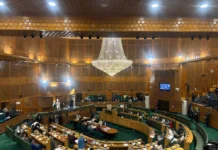
There is something almost incongruous about a chief minister standing up in the Jammu and Kashmir Assembly, in the same speech that acknowledges a year of near-continuous strain, to claim that his government now ranks among the fastest improving administrations in the country on the Sustainable Development Goals.
On February 6, Omar Abdullah did precisely that, telling the House that NITI Aayog’s latest index places the Union Territory among the country’s most improved performers, even as he conceded that “2025 had been nothing but challenging for Jammu and Kashmir”. The claim holds up on its own terms, yet it conceals the distance between an index number and the texture of a household’s actual life, and that distance deserves scrutiny now, eight months into a year otherwise consumed by border tension and budgetary anxiety.
Consider what the numbers, read patiently rather than as talking points, actually show. The Union Territory’s composite SDG score rose from 66 in the 2020-21 assessment to 74 in the most recent full edition, a climb that carried it into the “Front Runner” category and left it trailing only Puducherry among Union Territories. Health outcomes moved with unusual force over the same window. Neonatal mortality fell by 13.3 points, and the sex ratio at birth improved from 923 to 976, a shift researchers have described as among the sharper gender-outcome gains recorded anywhere in the country in recent years. These figures track actual births and survivals recorded on the ground, in a place where both have historically been harder to secure than the country’s statistical apparatus liked to admit.
The Grammar of a Budget
If the index score tells you where Jammu and Kashmir has arrived, the 2026-27 budget tells you rather more about where its government intends to spend its political capital. At Rs 1.13 lakh crore, with capital outlay of Rs 33,127 crore, the budget projects GSDP growth of 9.5 per cent for the year ahead, a figure offered almost defiantly given the preceding sentence’s admission of hardship. There is a certain candour, or perhaps a certain political calculation dressed as candour, in pairing an admission of difficulty with a forecast of acceleration.
The document also carries a quieter, more consequential commitment for Goal 2, pledging 127 new Anganwadi centres, one per CDPO block, aimed at the kind of early childhood nutrition deficit that no index score fully captures but which shapes a generation’s cognitive and physical development long before anyone thinks to measure it. Meanwhile the Union government’s transfers to the Union Territory rose to Rs 43,290 crore, a 4.72 per cent increase meant to bridge a resource gap that remains, whatever the growth figures suggest, structurally unresolved.
Education offers a similar lesson in reading past the summary statistic. The Performance Grading Index 2.0 results, released in July, showed the Union Territory’s score rising from 500.2 to 547.0, enough to lift it a full grade band. Equity and teacher training both scored well, which is no small achievement in a system that spent much of the last decade managing disruption rather than pedagogy. Infrastructure and facilities remained the weakest link by a wide margin, at just 80.28 out of 190, a gap the current budget tries to address with Rs 1,513 crore earmarked for upgrading 2,000 schools into what officials are calling Smart Schools. Whether that money reaches classrooms on schedule is a separate matter from whether it was allocated, and Jammu and Kashmir’s own fiscal history counsels caution before treating the two as equivalent.
 A Growth Story
The most uncomfortable fact in the entire dossier is also the one least likely to appear in a budget speech. Real GSDP grew 5.82 per cent in the previous fiscal year, services now account for 61 per cent of gross value added, and fresh investment of Rs 5,260 crore arrived within three quarters of 2025-26, a rise of nearly 27 per cent over the year before. Set against this is an unemployment rate that stood at 6.7 per cent when the government answered a question in the Assembly in February, still nearly double the national figure, with more than 4.73 lakh people between 18 and 50 registered as willing and unable to find work. Youth unemployment, for those between 15 and 29, has hovered above 17 per cent for years without meaningful movement. A polity can, evidently, grow its output while leaving its largest cohort of working-age citizens outside the economy it is growing, and Jammu and Kashmir’s 2026 figures illustrate that possibility as cleanly as any state in the country.
This ought to trouble the government more than it appears to. The Sustainable Development Goals were designed precisely to prevent aggregate success from becoming an alibi for particular failure, and the eighth goal ties growth and decent work together as a single target rather than two adjacent ones. A young graduate in Anantnag or a job seeker in the districts of Jammu division furthest from Srinagar and Jammu city measures the government’s performance by whether someone will hire him, an experience the composite index and the growth rate cannot register. Until that experience changes at scale, the language of front-running risks becoming a genteel way of describing a government that has learned to measure its successes more precisely than it has learned to distribute them.
Institutions and Announcements
The single development this year that deserves more attention than it has received is procedural rather than statistical. On August 19, Chief Secretary Atal Dulloo chaired a review of a UNDP-supported plan to tag every rupee of departmental spending against a specific SDG target, folding that classification into the Union Territory’s existing financial management architecture across all twenty departments. Should this survive contact with routine bureaucratic practice, it would let an auditor, or for that matter a citizen, trace a line item to a claimed outcome instead of inferring impact from a year-end press note, long the default mode of accountability in Indian public finance. UNDP’s own officials, in reviewing the plan, reportedly praised the distance already travelled while still pressing for tighter fiscal integration, an implicit admission from an external partner that the current scores, however respectable, remain necessary rather than sufficient evidence of durable change.
Few state governments in India have attempted budget tagging with this degree of specificity, and fewer have tried it while simultaneously building the underlying financial digitisation from a comparatively recent baseline. The Union Territory’s Centrally Sponsored Schemes have already migrated from the old Treasury mode to the SPARSH system for payments and accounts, a groundwork step the Chief Minister cited as evidence that the administration is ready for something more demanding than compliance reporting. Whether that readiness translates into a public dashboard that ordinary researchers and journalists can actually interrogate, or remains an internal tool circulated among department secretaries, will determine whether this reform belongs to the citizens it claims to serve or merely to the government that commissioned it.
What Ought to Follow?
Jammu and Kashmir’s next stretch of progress on the Sustainable Development Goals will be decided less by where its index score lands than by a handful of executive choices over the coming eighteen months.
The SDG budget-tagging system, once operational, should be published openly and disaggregated to the district level, so that its claims can be tested by people outside the government rather than taken on faith.
Industrial incentives tied to the current wave of investment ought to carry minimum local hiring conditions, so that the Rs 5,260 crore already committed begins to draw down the 4.73 lakh people registered as unemployed rather than accumulating as capital formation divorced from local livelihoods.

Capital expenditure on school infrastructure needs to move at the pace the budget promises rather than the pace the Union Territory’s disbursement record suggests, given that facilities remain the weakest link in an otherwise improving education system.
Youth unemployment deserves a place in the government’s own quarterly communication, presented beside growth figures rather than left to surface only in answers to legislative questions.
The gains in neonatal mortality and sex ratio at birth need to be extended deliberately into Pir Panjal, the Chenab valley, and the border districts, where Union Territory averages can conceal what remains unfinished.
Jammu and Kashmir’s development trajectory remains, for now, a wager still open on whether an administration that has grown skilled at measuring its own progress can grow equally skilled at distributing it, and on whether the institutional plumbing being built through 2026 will still be checked upon once the political incentive to announce it has passed.
(The author is a pracademic working on government policy and public institutions. Ideas are personal.)