by Dr Farooq A Lone
As Kashmiri homes embrace eating out, technology and individualised lifestyles, the decline of shared kitchens and meals risks weakening family interaction, social learning, hospitality, traditions and intergenerational bonds.
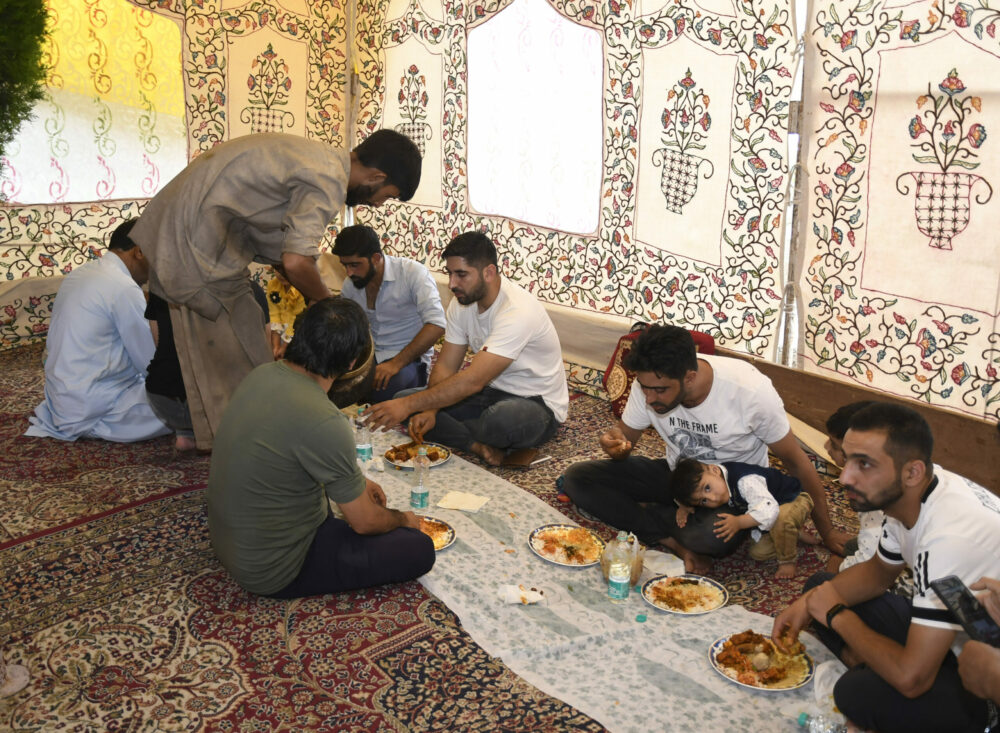
There is a quiet change taking place in Kashmir, particularly over the last decade or so. There has been a mushrooming growth of eateries and restaurant chains, proudly managed and run by our educated youth, some of whom have even studied abroad. Perhaps, for a tourist place like ours, good restaurants and eating places are required. Besides, entrepreneurship per se is a very good development idea which provides employment to many others, helping them to run their kitchens back home. So far, so good.
But this quiet change has also started to affect many Kashmiri homes. The traditional, functional kitchen, an active centre of family life, is gradually losing its place in our daily routine. Eating out, ordering food, packaged meals and increasingly individualised lifestyles are becoming more common, particularly among our younger generations. Resultantly, the spread of Dastarkhaan sheets around which families sat for Koj and Kaal (lunch and dinner) is decreasing in frequency.
The issue, as a matter of fact, is not really about the kitchen. It is about what happens around the kitchen. For generations, the Kashmiri household kitchen has been much more than a place where food is prepared. It is a space where family members meet, conversations happen, children observe and learn, elders share stories, and relationships get quietly strengthened. Much of our social education takes place there, around the Dastarkhaan or dining table, without being formally taught.
A child learns the value of sharing when a meal is served to everyone. He or she learns hospitality when a guest or relative is welcomed with tea and food. Respect for elders is learnt through everyday interaction. Family histories, local traditions, recipes, humour and even the small stories of everyday life are passed naturally from one generation to another.
The kitchen is thus, in many ways, an informal school of social life.
Modern life in Western style, towards which we are increasingly and consciously heading, is undoubtedly different. Nuclear families, demanding careers, smaller homes, changing aspirations and new technologies have altered the way we live.
There is nothing inherently wrong with these changes. A modern kitchen can be more efficient, and eating outside occasionally can be enjoyable and convenient. But convenience should not come at the cost of companionship. The larger concern is that we may be gradually losing spaces where people simply sit together without a specific purpose. The family meal is replaced by individual schedules. Conversation is replaced by screens. Children may know how to order food through an app but have fewer opportunities to watch a parent prepare it, sit with grandparents, or participate in the simple rituals of family life.
This raises a deeper question: Are we failing to teach our younger generation the importance of social life? Education is often understood in terms of examinations, degrees, careers and employability. But human beings also need to learn how to live with one another. They need empathy, patience, sharing, hospitality, respect for elders and responsibility towards family and community. These qualities cannot be acquired entirely from classrooms or social media. They are largely learnt through lived experience.
And that is why the everyday family kitchen matters.
We should not romanticise the past or resist every change. Nor should every household be expected to follow an old-fashioned way of living. But as we modernise our homes, we should consciously preserve the spaces and practices that keep families connected.
Perhaps the answer is simple: keep the kitchen alive, even if the kitchen itself changes. Cook together more occasionally. Eat together whenever possible. Let children participate. Invite grandparents into the conversation. Make room for guests. Try to make it possible to put away the phones for a while.

Because when we lose a functional kitchen, we may not merely lose a place where food is cooked. We may lose one of the everyday institutions through which a society reproduces its values, memories and relationships. A society is held together not only by its great institutions, but also by millions of small daily interactions. Sometimes, the future of our social fabric may depend on something as ordinary as a family sitting together around a meal.
While we evolve, let’s try to change the concept of the kitchen being an exclusively women’s affair. Men should feel happy to assist the ladies-folk of the home in kitchen chores. There is absolutely nothing bad in it. We have to slightly change our mindset and ways of parenting. Let’s encourage our sons to work for a while in the kitchen. Our generation is guilty of not training our own kids in kitchen work but expecting our daughters-in-law to do all the kitchen chores efficiently. This hypocrisy has to go.
In our families, where both the parents are working, male members not assisting the female folk is sheer hypocrisy. When we change this mindset, only then can we expect that the live-in kitchen does not disappear from our homes and that we, as a society, are not deprived of the associated social advantages of this time-tested institution in our family life.
This year’s Nobel Prize winner in Physiology or Medicine Prof Karl Deisseroth of Stanford University, can serve as a role model. He did not miss preparing school lunch for his kids on the biggest day of his life when he had just received a call from the Nobel Secretariat and was busy receiving congratulatory messages on his Big day.
(An IAS officer, the author retired as Chairman, Jammu and Kashmir Public Service Commission. Ideas are personal.)