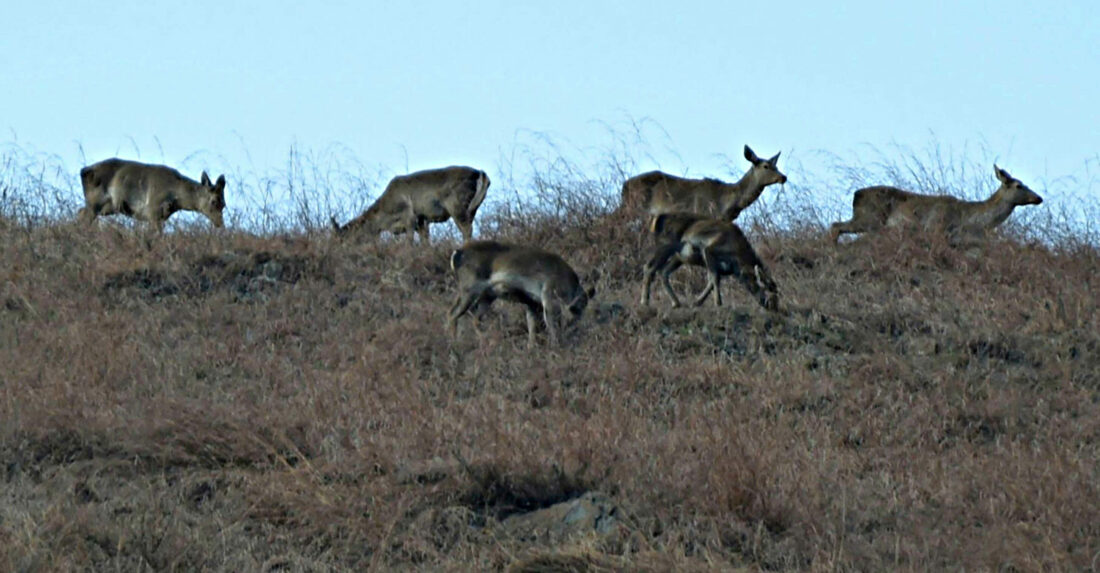
SRINAGAR: Female Hangul, the critically endangered Kashmir red deer, have a widely dispersed mating season. While males show a much more synchronised rut between October and December, females apparently giving birth mainly in April, a new study has found.
The study has also detected a sharp rise in physiological stress in both sexes in May, which researchers say may be associated with the movement of migratory livestock herders, their animals and guard dogs into the Hangul’s summer habitat, although they caution that this link needs further investigation.
The findings, published in Scientific Reports, provide what the researchers describe as the first reproductive and stress hormone profiles of wild Hangul and establish a baseline that could be used for future conservation-breeding programmes. The researchers say the results also point to the need to minimise human disturbance around the periods of mating and parturition, both of which are critical to the growth of the small remaining population.
The paper, Establishing reproductive seasons for the conservation of the critically endangered Kashmir red deer Cervus hanglu, was authored by Tanushree Srivastava, Javaid Hameed, Vinod Kumar, Harika Segu, Sneha Narayan, Moomin John, Karthikeyan Vasudevan and Govindhaswamy Umapathy.
Srivastava is affiliated with the Laboratory for the Conservation of Endangered Species (LaCONES), Centre for Cellular and Molecular Biology (CCMB), Hyderabad, and the Wildlife Trust of India, Uttar Pradesh. The other researchers are affiliated with LaCONES, CCMB. Vasudevan and Umapathy are the corresponding authors.
The paper was published in Scientific Reports (volume 15, article 4955) in 2025, by Springer Nature.
The researchers set out to establish the reproductive seasons of male and female Hangul by analysing hormone metabolites contained in faecal samples collected from free-ranging animals in the Kashmir Himalaya. The approach allowed them to study reproduction without capturing or otherwise physically handling the endangered deer.
The study was conducted in Dachigam National Park between September 2019 and August 2020. Researchers monitored 11 permanent trails in the lower Dachigam every month and collected 1,172 fresh faecal samples. Of these, 539 were identified as female and 333 as male samples, while 300 could not be assigned a sex and were excluded from the analysis.
Female Cycle
The hormone profiles indicate that female Hangul do not follow the tightly synchronized breeding pattern seen in some red deer populations at higher northern latitudes.
Estrogen metabolites in females increased to peak levels around December and January. From January or February onwards, the population appeared to divide into pregnant females, which showed low estrogen levels, and non-pregnant females that continued to show signs of estrus for considerably longer periods, in some cases through March or April and even later.
The researchers therefore concluded that female Hangul have a highly dispersed estrous season.
This finding is significant because Hangul lives at a relatively lower latitude than many of the red deer populations with which its reproductive biology has traditionally been compared. According to the researchers, longer periods of food availability in subtropical environments, combined with the Hangul’s mixed-feeding diet, may allow females to maintain an extended mating season.
“Both FEM and FPM profiles in females show that estrus is highly dispersed,” the researchers write.
Male Rut
The pattern was markedly different among males.
Testosterone metabolites in male Hangul rose above the study’s threshold between October and January and reached their peak in November. The increase was accompanied by a rise in glucocorticoid metabolites, the hormonal indicators the researchers used to assess physiological stress.
The study consequently identifies October to December as the principal period of male reproductive activity, with November emerging as the peak month.
The researchers associate the increased stress during this period with mating activity and competition among males. Hangul has a highly polygynous mating system in which males compete for access to females during the rut.
The study found a significant positive relationship between testosterone and glucocorticoid levels in males, consistent with the physiological demands of reproductive competition.
April Births
While mating appears to be spread over a relatively long period among females, the researchers found evidence that births are considerably more synchronized.
Progesterone metabolite concentrations increased from January through March and then dropped sharply in April. The researchers interpret the increase as evidence of pregnancy and the April decline as an indication of parturition.
The paper therefore suggests that April is the principal birthing period for female Hangul, despite the more dispersed timing of mating.
The timing appears closely connected with the seasonal availability of vegetation. Satellite-derived vegetation data showed that plant availability began increasing from February and reached its peak in June. The researchers found a significant relationship between female progesterone levels and vegetation availability, supporting the broader ecological principle that seasonal ungulates time reproduction to coincide with favourable food conditions for parturition and lactation.
May Stress
One of the study’s more important conservation findings concerns May.
Female glucocorticoid levels began rising from March and peaked in May. Males also experienced a second major stress peak in May, even though they were reproductively inactive at that time.
The researchers note that May coincides with the movement of migratory livestock herders and their animals into the higher-elevation summer habitats used by Hangul. Guard dogs accompanying livestock are also present in these areas.
“Higher FGM levels in the population in May could also be attributed to the human disturbance in the area,” the researchers write. But they immediately qualify the observation, saying that their study design did not explicitly measure these disturbances and that the relationship requires further investigation.
The finding is particularly relevant because previous research cited in the paper has documented a shift by Hangul towards comparatively lower elevations in summer, apparently in response to disturbances in its traditional summer habitats. The species is already exposed to competition for resources and disease transmission from livestock, as well as the risk of predation of newborns by guard dogs belonging to nomadic herders.
Food Connection
The study also examined the relationship between reproduction and environmental variables including vegetation availability, day length and temperature.
The researchers found that female progesterone was negatively related to NDVI, a satellite-based measure of vegetation, while day length had a significant positive relationship with progesterone. In males, testosterone was negatively related to day length and positively related to glucocorticoid levels.
The authors interpret these relationships as evidence that Hangul’s reproductive cycle is closely attuned to the seasonal environment.
Because Hangul is a mixed feeder, relying substantially on browse and forbs rather than exclusively on grasses, the researchers argue that it can exploit food resources over a longer period. This may help explain why its breeding cycle is less tightly synchronized than that of some grazing ungulates living at higher latitudes.
Conservation Window
The researchers say the findings have immediate implications for conservation planning, particularly for the proposed or existing efforts to establish viable captive-breeding populations.
Hangul was included in India’s recovery programme for critically endangered species in 2007, while a breeding centre was established in 2008 by the Central Zoo Authority and the Ministry of Environment, Forest and Climate Change. The paper notes, however, that the breeding centre has had only five females to date, underlining the importance of understanding the species’ reproductive physiology.
The study’s hormone profiles could provide the baseline required to determine the appropriate timing for breeding interventions.
The researchers nevertheless recommend that the timing and duration of mating and birthing identified through hormone analysis should be further confirmed through camera-trapping surveys.
Once those periods are established more precisely, they argue, measures should be taken to keep Dachigam free from anthropogenic disturbance during these critical reproductive windows.
Population Pressure
The findings assume added importance against the precarious status of the Hangul population.
The paper says the species’ population has declined drastically over the past five decades and that the Dachigam population represents the only viable population of about 400 animals. The study also notes the existence of smaller, isolated populations whose connectivity with the main population remains limited.
In the study-site description, the researchers give the Dachigam viable population as 394, with smaller populations reported from Shikargah in Tral Wildlife Sanctuary, Wangat-Naranag, Chandaji-Diver-Lolab and Overa-Aru.
The paper stresses that the reproductive findings should be viewed as a baseline rather than a complete account of Hangul breeding biology.
The authors acknowledge that the enzyme immunoassays used in the study could not be biologically validated because Hangul is critically endangered and no animals were available in captivity for such validation at the time of the research. They recommend physiological or biological validation in future studies.
The researchers conclude that the study provides the first non-invasive physiological assessment of reproductive seasonality and stress in wild Hangul and that its results should inform longer-term management of the species.
“Effective measures should be taken to keep the Park free from various anthropogenic disturbances” during mating and parturition, the authors state, while calling for further fine-scale studies to understand how Hangul responds to both human-induced and climate-related changes in its seasonal environment.