A new study warns that Kashmir’s threatened wildlife faces mounting pressures beyond protected areas, urging habitat connectivity, wetland protection, community participation and landscape-wide conservation to safeguard biodiversity amid expanding infrastructure and human activity.
SRINAGAR: A new study of the Kashmir Valley’s biodiversity warns that large areas of habitat used by threatened wildlife remain outside formal protection, leaving them exposed to expanding settlements, infrastructure development, unregulated grazing, poaching and human–wildlife conflict. It calls for conservation planning that connects protected areas with unprotected forests, alpine meadows and wetlands, rather than relying on protected-area boundaries alone.
The study, Regional ecological and biodiversity context of the Kashmir Valley, northwestern Himalaya, India, presents a regional assessment of the Valley’s ecology, habitats, wildlife, protected areas and conservation challenges. Published in the Journal of Threatened Taxa in July 2026, it synthesises published research, government records, and field-based ecological observations to establish a shared regional context for future biodiversity studies and conservation planning.
The paper was authored by Mohsin Javid, Khursheed Ahmad, Orus Ilyas, Junid N Shah and Affifullah Khan. Mohsin Javid, Orus Ilyas and Affifullah Khan are affiliated with the Department of Wildlife Sciences, Aligarh Muslim University, Aligarh, Uttar Pradesh. Khursheed Ahmad is affiliated with the Division of Wildlife Sciences, Sher-e-Kashmir University of Agricultural Sciences and Technology of Kashmir (SKUAST-Kashmir). Junid N Shah is affiliated with Ajaz Environment Consultants (AJEC), Sharjah, United Arab Emirates.
Ecological Diversity
The Kashmir Valley covers approximately 16,000 square kilometres and ranges in elevation from around 1,100 metres in the Uri sector to more than 5,000 metres in the surrounding mountain ranges. The study describes it as a transition zone between the Palearctic and Oriental biogeographic regions, with habitats ranging from temperate forests and subalpine scrub to alpine meadows, glaciers and wetlands.

These variations in elevation and climate support a diverse range of plants and animals within a relatively compact landscape. The Jhelum River runs through the Valley, linking several important wetlands, including Wular, Dal, Anchar, Hokersar and Shallabugh. Several of these wetlands are internationally important for migratory waterbirds and form part of the Central Asian Flyway.
The paper notes that the Valley’s biodiversity extends well beyond forests and formally protected areas. Traditional grazing landscapes, river corridors, high-altitude grasslands, and areas surrounding wetlands also provide wildlife habitat.
Threatened Species
The study focuses on several threatened species, including the Hangul or Kashmir stag (Cervus hanglu hanglu), Kashmir musk deer (Moschus cupreus) and Kashmir markhor (Capra falconeri). It also documents the ecological importance of species such as the Himalayan ibex, Himalayan brown bear, Asiatic black bear, leopard and Western tragopan.
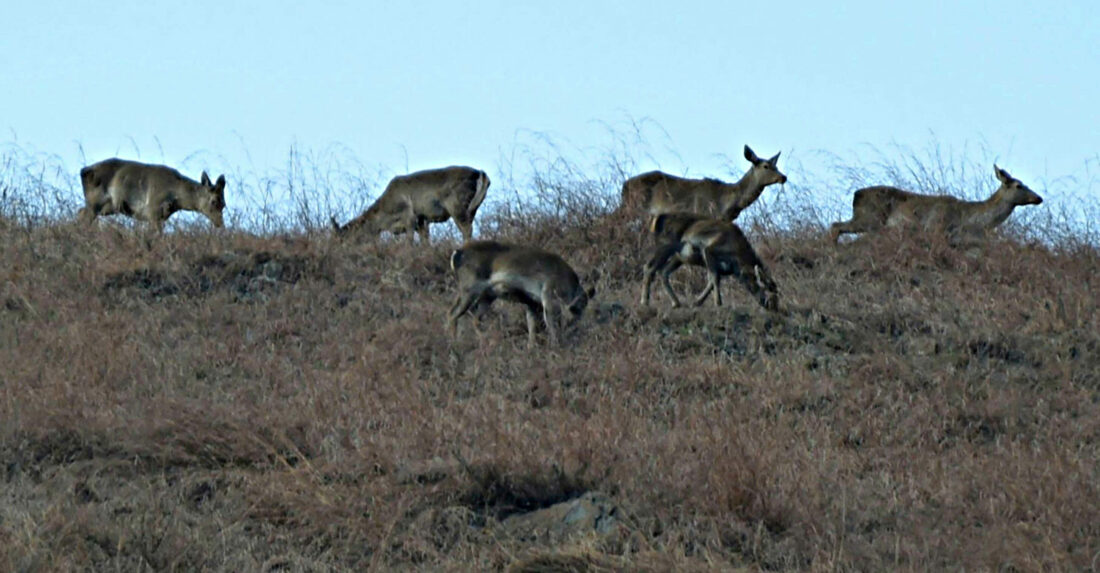
Hangul survival depends on maintaining suitable habitats and movement routes across landscapes around Dachigam National Park and adjoining areas. The authors note records of Hangul beyond its traditionally recognised stronghold, including in the Tral Wildlife Sanctuary and areas of the Sindh Valley. Such observations underline the importance of considering connected landscapes rather than treating individual protected areas as isolated units.
The Kashmir musk deer is associated with high-altitude temperate and subalpine forests, including birch and rhododendron habitats. The paper draws attention to its presence in Gurez Valley, where extensive suitable habitat remains outside the formal protected-area network. Poaching for musk pods, habitat fragmentation and the collection of timber and fuelwood are identified as threats.
The markhor, meanwhile, is concentrated in north-western Kashmir, particularly around the Kazinag landscape along the Line of Control. The paper identifies Kazinag National Park and adjoining wildlife sanctuaries as important for the species’ survival.
Protection Gaps
The paper identifies a significant gap between the region’s conservation value and the coverage of its formal protection network. It reports that the protected-area network covers approximately 2,171 square kilometres, or 13.57 per cent of the geographical area of the Kashmir Valley.

The authors describe this network as fragmented, with protected areas separated by settlements and other human-dominated landscapes. While national parks and wildlife sanctuaries safeguard important habitats, several high-value landscapes remain unprotected or insufficiently connected to existing reserves.
Gurez Valley is highlighted as a particularly important example. Despite its extensive alpine meadows, birch forests and habitat for threatened species, it has no notified wildlife protected area, according to the paper. The authors argue that such landscapes need to be integrated into regional conservation planning.
The study also notes that some protected areas are facing growing pressures from tourism and infrastructure. In parts of the Valley, development around reserve boundaries has increased habitat fragmentation, while wetlands have been affected by encroachment, siltation and changes in water conditions.
Human Pressures
Road construction, settlement growth and the conversion of land to horticulture are among the pressures identified by the authors. These changes can break up wildlife habitats and reduce the buffer between human habitation and forests.
Seasonal grazing presents another challenge. Gujjar and Bakarwal pastoralists move with their livestock between Jammu and the high-altitude pastures of Kashmir, making transhumance an important part of the region’s rural economy. However, the paper says grazing pressure can create competition between livestock and wild herbivores, while the movement of herds and associated dogs can disturb wildlife.
The authors argue for clearly delineated seasonal grazing routes, regulated use of pastures and measures to reduce the risk of livestock-borne diseases and pests. They point to the need to manage pastoral activity in ways that sustain local livelihoods while protecting sensitive habitats.

Human-wildlife conflict is also identified as a serious conservation and livelihood concern. The paper discusses attacks involving black bears and leopards, as well as damage to crops and domestic animals. It cites earlier research documenting incidents in agricultural fields, orchards and areas near human settlements, particularly during periods when people work outdoors in orchards.
Poaching Threats
Poaching is described as a major threat to wildlife, including musk deer, pheasants and migratory waterbirds. The paper recounts field observations of suspected active poachers and notes that satellite transmitters fitted to migratory birds under a research project were lost after the birds were reportedly killed.
Wetlands face additional pressures from encroachment, pollution, changes in hydrology and invasive plants. The authors stress that Ramsar-designated wetlands require sustained management at the catchment level to preserve their ecological character.
Climate change could intensify these problems by altering snowfall, shifting tree lines and changing the seasonal availability of water and forage. Such changes may also affect the distribution of wildlife and increase overlap between animals, livestock and people.
Conservation Priorities
The study recommends identifying and safeguarding wildlife corridors between protected areas and important unprotected habitats. It also calls for stronger community-based governance of conservation and wetland reserves, improved livestock management through seasonal zoning and grazing regulation, and measures to reduce disease risks associated with livestock movement.
Wetland conservation, the authors argue, must extend beyond the water bodies themselves to include their catchments, with attention to water quality, pollution and changes in hydrology. They also recommend standardised, repeatable biodiversity monitoring and transparent reporting of survey methods and effort to make future research more comparable.
The central conclusion is that the long-term survival of threatened species in Kashmir will depend on linking protected-area management with habitat connectivity, wetland stewardship and cooperation beyond reserve boundaries. The authors present the regional profile as a foundation for more consistent research and landscape-scale conservation planning across the Kashmir Himalaya.