by Dr Nisar Farhad
It was heartening to witness communities working together to protect the environment while preserving their cultural identity.
On Independence Day, I journeyed from Pulwama to Drang, Chadoora, ecovillages, and the Sukhnag River, discovering Kashmir’s natural beauty and cultural soul. The travelogue reflects how true freedom lies in connecting with nature, sustaining traditions, and cherishing the harmony of village life.
This year, on 15th August, while the nation unfurled the tricolour and celebrated freedom in cities and towns, I chose a different form of celebration. Along with my friend Mohmad Iqbal Malla, I set out from Pulwama at 10:30 a.m. to explore the natural beauty and cultural soul of Kashmir. We began from Drang in Tangmarg and returned via Chadoora, visiting ecovillages, rivers, and hidden valleys along the way.
The Charm of Drang
Drang, a quaint hamlet near Tangmarg, has slowly carved its place on the travel map of Kashmir. Best known for its spectacular waterfall fed by the glacial waters of the Ferozepora Nallah, this little gem transforms with the seasons. In winter, the fall freezes into a curtain of icicles, an awe-inspiring cascade that looks like a frozen dream. In summer and early autumn, the waterfall roars with full force, carrying the melted waters from the glaciers of Gulmarg.
Just forty-two kilometres from Srinagar and thirteen kilometres from the hill station of Gulmarg, Drang is often called a hidden wonder. While the waterfall is a man-made marvel, its winter transformation into a natural ice sculpture has made it one of the most photographed attractions in Kashmir. Against the backdrop of snow-covered hills, the frozen fall feels like nature’s own masterpiece, a scene so surreal it feels like stepping into another world.
For photographers, vloggers, and nature lovers, Drang is a paradise. The frozen walls of ice shimmer like crystal glass in the winter sun, while the snow-draped pine trees and whitewashed paths add to its ethereal charm. In summer, the scene is equally captivating with green meadows, flowing waters, and families gathered on its banks for picnics.
When we arrived in Drang at 12:30 pm, after covering nearly seventy kilometres from Pulwama, the scene was lively yet serene. Children played in shallow streams, their laughter blending with the thunder of rushing water. Families spread picnic mats under pine trees, enjoying the cool mountain air. A steaming cup of traditional Kashmiri kahwa in one hand and a plate of aromatic biryani from a local stall in the other added a distinct flavour to the experience.
In that moment, with the scent of pine in the air and the symphony of the waterfall drowning every other sound, we understood the true essence of freedom. It was more than a journey; it was a pause from routine, a reminder of nature’s healing embrace, and a celebration of Kashmir’s timeless beauty.
The Road Less Taken: Via Chadoora
While most visitors return from Drang through Tangmarg and Srinagar, we opted for a detour via Chadoora. The road, narrow and winding, unfolded with every turn, revealing a new canvas of Kashmir’s rustic charm.
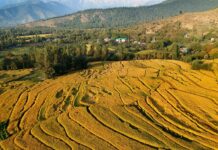
Golden paddy fields stretched endlessly, where farmers bent low with sickles in hand, their steady rhythm harmonising with the soft melodies of birds. The air was alive with the laughter of children darting through orchards, their kites painted in the hues of the national flag soaring proudly against the late summer sky.
By the roadside, elderly men sat on wooden benches outside small shops, sipping steaming cups of noon chai. Their calm gazes followed the passing scene, as though time itself had slowed in these villages. Each hamlet seemed to exist in its own world, unhurried and serene, offering fleeting but profound glimpses of authentic Kashmiri countryside, an experience no highway could provide.
Ecovillages: A Sustainable Kashmir
On our way, we paused to explore emerging ecovillages such as Baderkot, Ganwani, Gogaldara, Aripathan, and Arizal. These settlements represent a blend of traditional Kashmiri lifestyle and eco-friendly practices such as solar power, organic farming, and natural construction techniques.
It was heartening to witness communities working together to protect the environment while preserving their cultural identity. As we strolled through the villages, we noticed neatly stacked piles of firewood for winter, lush vegetable gardens thriving without chemicals, and women seated on verandas weaving carpets on traditional handlooms.
Sukhnag: The River of Comfort
Our journey reached its most soothing halt at the Sukhnag River, a name that translates to the River of Comfort. As we approached, the gentle murmur of its waters welcomed us, weaving into the breeze like a lullaby. Flowing through meadows and thick forests, Sukhnag felt less like a river and more like a hymn of peace written by nature itself.
The first splash of icy water on our tired feet was electrifying yet calming. Soon, we were bathing under sunlight dancing on the ripples. Around us, the valley exhaled silence, broken only by the distant call of a shepherd guiding his flock. In that moment, time slowed, and the world felt lighter, as though the river carried not just water but the weight of our weariness.
Nestled in the heart of District Budgam, Sukhnag is one of Kashmir’s hidden marvels. While names like Gulmarg, Pahalgam, and Sonamarg echo across travel brochures, this river lies quietly in the shadow of the Pir Panjal range, waiting to be discovered. Snow-draped peaks stood guard, and lush deodar and fir forests wrapped the valley in a green embrace. The landscape appeared chiselled by divine hands.
The river originates in the upper reaches of Tosamaidan, particularly from the serene Dammam Sar area, where forests cradle its infant streams. Reaching it is a delight in itself, just a forty-minute walk from the Tourist Reception Centre at Raiyar-Ich, Tangnar, leads to this untouched wonder.
Despite its charm, Sukhnag remains off the tourist map. If nurtured with care, it could become one of the Valley’s crown jewels, inviting travellers, empowering local communities, and offering opportunities in eco-tourism. For us, Sukhnag was not just a destination but an experience of stillness and renewal. The river flows through memory, carrying the essence of Kashmir’s beauty.
Reflections of an Independence Day
As we headed home under a sky scattered with stars, I realised our journey was more than a casual outing. It was a celebration of freedom in its truest sense, the freedom to explore, breathe untainted air, connect with the soul of nature, and witness living traditions of Kashmir’s villages.
While the nation marked Independence Day in bustling squares and decorated stadiums, I found my celebration in quiet valleys and rivers. Drang, Chadoora, the ecovillages, and the gentle flow of Sukhnag gifted me scenic beauty and a deeper sense of belonging. They reminded me that independence is not only a matter of history and politics but also the privilege to live in harmony with the land, its people, and the timeless spirit of community.
(The writer is a lecturer in Chemistry in the Department of School Education, Kashmir. Ideas are personal.)