by Syed Ahfadul Mujtaba
A mock interview sparks inquiry into how geography shaped Śāradā, Takri, and Hindko-Dogri-Kashmiri evolution, highlighting script transitions, oral traditions, and layered civilizational memory
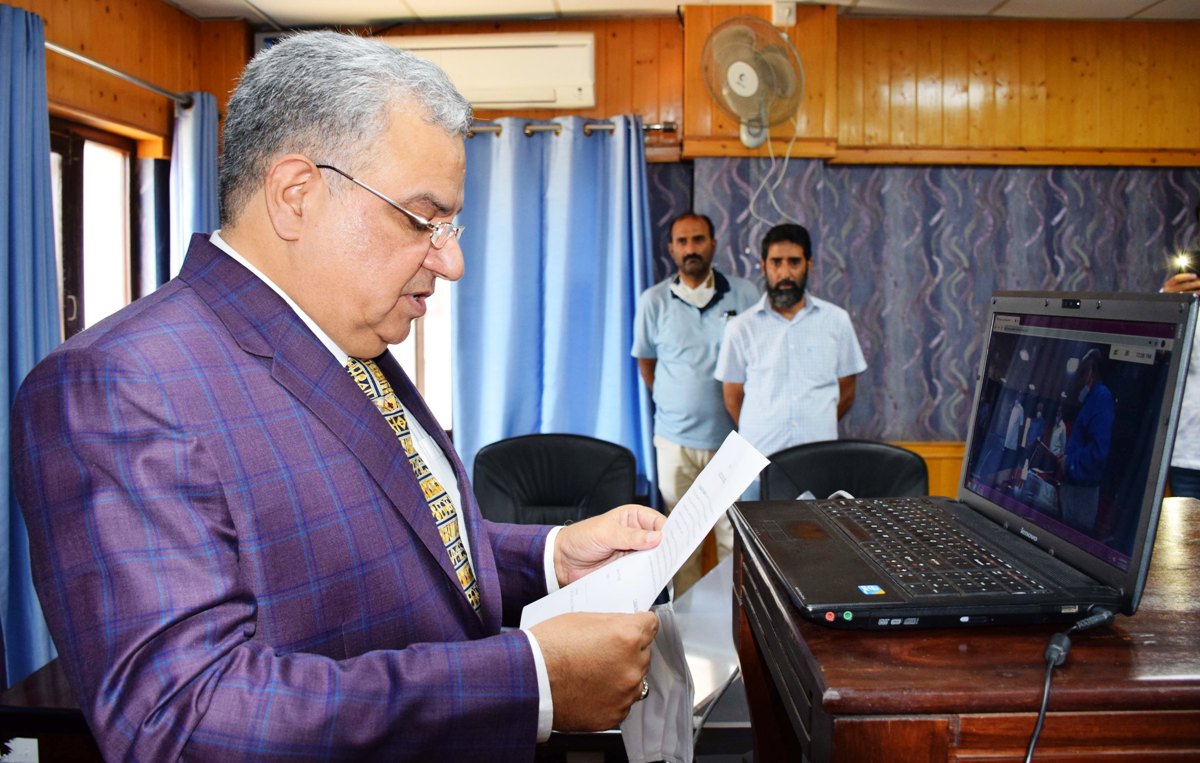
The inquiry began, unexpectedly, in a mock interview. A candidate trained in Geography was being assessed on regional awareness. What distinguished him was not merely his command of terrain and maps but his quiet insistence that languages themselves are landscapes. When asked about the north-western Himalayas, he did not begin with rivers or passes but with scripts, specifically the nearly forgotten Takri script.
That moment was arresting. A geographer had redirected attention from physical contours to cultural inscriptions, from valleys to voices frozen in writing. His argument was simple yet profound: languages and scripts are shaped by geography just as rivers and trade routes are.
This observation opened a wider field of reflection, one that leads us into the intertwined histories of Śāradā, Takri, Hindko, Dogri, and Kashmiri, and, importantly, the literary expression of Hindko in the Perso-Arabic script.
Geography as the Matrix of Language
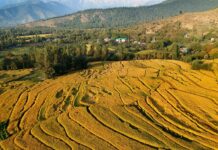
The north-western subcontinent, stretching from Kashmir through Jammu to Hazara and Peshawar, is a deeply fragmented geography. Mountain barriers such as the Pir Panjal and the greater Himalayas interrupt movement and communication, while river corridors along the Jhelum, Chenab, and Indus have historically served as arteries of trade and cultural exchange. Isolated valleys and connected trade routes coexist in the same landscape, producing very different linguistic outcomes depending on the degree of contact or separation a community experiences.
Such terrain creates conditions in which isolation fosters dialect formation, contact zones produce linguistic blending, and shifting polities drive script transitions. Within this geography, Hindko, Dogri, and Kashmiri evolved as distinct yet related linguistic forms, each carrying the imprint of the terrain from which it emerged.

Śāradā: The Classical Scriptal Layer
Śāradā, which flourished between the 8th and 12th centuries, was a script of high culture and scholarship. It served as the medium for Sanskrit texts and early Kashmiri writings and was closely associated with centres of learning such as the Sharada Peeth. Even as spoken dialects across the region were already diverging, Śāradā provided an intellectual unity, binding the learned communities of the north-west in a shared written tradition.
From Śāradā to Takri
With the decline of centralised scholastic culture, Śāradā evolved into Takri, a more regional script suited to the practical demands of administration, local record-keeping, and early vernacular writing. This transition marks a meaningful cultural shift: from the cosmopolitan manuscript culture that Śāradā represented to a more localised mode of linguistic expression. The script became humbler in its ambitions and, in doing so, became far more intimate with the communities it served.
Hindko, Dogri, and Kashmiri
Hindko is spoken across Hazara, Peshawar, and parts of Jammu and belongs to the Northwestern Indo-Aryan group. In Jammu and Kashmir, it is often labelled Pahari, though this is a broad term that encompasses several related but distinct varieties rather than a single unified language.
Dogri is centered in Jammu and was historically written in Takri. It is now rendered in both Devanagari and Perso-Arabic scripts and sits linguistically close to the Punjabi-Pahari continuum. Kashmiri, spoken in the Kashmir Valley, belongs to the Dardic subgroup and carries a historical written tradition in Śāradā, though it is today written predominantly in Perso-Arabic and Devanagari.
The Hindko Literary Tradition
Hindko has often been described as possessing a limited formal literary corpus, but this assessment is misleading unless carefully qualified. Its literary expression has flourished, though largely outside the institutional canon, and the medium of that expression has been the Urdu Nastaliq script. This choice of script reflects both the deep Islamic cultural influence on the region and the administrative and literary dominance that Urdu came to exercise across the north-west.
Genres of Hindko Literature
Hindko literature exists across a range of genres. Folk poetry forms its most enduring strand, alongside ghazals and nazms composed in a distinctly local idiom. Narrative ballads and oral epics preserve older modes of storytelling, while proverbs and riddles represent a dense, compressed form of communal wisdom that has been transmitted across generations. These genres do not form a seamless literary tradition in the institutional sense, but they constitute a vital and ongoing cultural archive.
Notable Contributors
Among the voices associated with Hindko literary expression, the Hazara poetic tradition holds a particularly important place, as exemplified by poets such as Saif-ul-Malook. Ghulam Mohammad Saqi and Zafar Iqbal Awan are also significant figures in this tradition. It is worth noting that attribution in Hindko literature can be complicated by its overlapping boundaries with Punjabi and Pahari traditions, and the regional nature of its preservation has meant that many voices remain inadequately documented.
The Oral to Written Transition
A defining feature of Hindko‘s literary history is that it remained predominantly an oral tradition before being transcribed into the Urdu script. This reflects both the absence of a standardised script comparable to Takri in earlier centuries and the subsequent integration of Hindko cultural production into the broader Urdu literary world. The transition from voice to page was gradual, uneven, and shaped by forces well beyond purely linguistic considerations.
Cultural Role
Hindko literature preserves local identity and memory in ways that more official or standardised literary traditions rarely can. It reflects rural life, the rhythms of trade culture, and the long history of interaction between Hindko communities and the neighbouring Pashto and Punjabi worlds. In this sense, it functions less as a monument and more as a living record, always in conversation with its environment.
Insights from the Linguistic Survey of India
The foundational work of George Abraham Grierson remains indispensable for understanding this region. His survey clarifies that the north-west forms a linguistic continuum in which terms like Hindko and Pahari are often geographical labels rather than precise linguistic designations. Language boundaries in this part of the world follow mountains and rivers far more faithfully than they follow political borders, a reality that resists the tidiness of official classification.
A Layered Civilisational View
Across the region, shared Indo-Aryan roots connect these languages at their deepest structural level, with the long evolution from Prakrit through Apabhramsha shaping the grammar and vocabulary of all the varieties that emerged. At the scriptal level, the sequence from Śāradā to Takri and then to Perso-Arabic and Devanagari traces a movement from unified classical prestige to regional diversity and, eventually, to the plural conditions of the present.
The divergence between Kashmiri and the other languages in the region illustrates this pattern well. Kashmiri, enclosed by the high walls of its valley, developed along a distinct trajectory, producing a language that feels meaningfully different from the Hindko and Dogri spoken in the foothills and plains below. Geography, in this sense, was not merely a backdrop but an active force in shaping linguistic identity.
Hindko as ‘Pahari’
In Jammu and Kashmir, Hindko is routinely referred to as Pahari. The difficulty is that Pahari is a cluster term, not a single language, and using it as though it were one flattens meaningful distinctions between related but distinct varieties. Grierson cautioned against such simplifications, noting that linguistic identity in this region is shaped by geography and community rather than by the rigid nomenclature that administrative convenience tends to prefer. The name matters because it affects how speakers are counted, how literature is categorised, and how cultural claims are adjudicated.
Cultural Memory
Śāradā preserves classical and written memory. Takri reflects regional administration and a more localised sense of identity. Hindko literature in the Urdu script embodies living cultural memory, the kind that is carried in song, in a proverb, in the telling of a story at a gathering rather than in a manuscript kept in an archive. Civilisation here is not only deposited in libraries but sung, spoken, and only later written in the scripts that history happened to make available.
These are not competing forms of memory but complementary ones, each capturing something that the others cannot. Together, they form a layered record of how people in this region have understood themselves and their world over many centuries.
The Interview Revisited

The candidate’s insight now resonates more deeply than it perhaps did when he first offered it. Geography does not merely determine physical boundaries. It shapes linguistic evolution, scriptal choices, and cultural memory in ways that outlast the empires and administrations that once seemed to govern such things.
From the refined elegance of Śāradā to the regional pragmatism of Takri and then to the lived voices of Hindko, Dogri, and Kashmiri, we witness a continuous interplay of terrain, tradition, and transformation. Within this continuum, the Hindko literary tradition, written in the Perso-Arabic script, stands as evidence that even where scripts change and classifications blur, language endures as the most faithful archive of a people’s history.
(The author, after retiring as IGP in Jammu and Kashmir Police, was a member of the Jammu and Kashmir Public Service Commission. Ideas are personal.)