by Sri Varshith Kumar Reddy E
Critical minerals and semiconductor supply chains have become the grammar of geopolitical power. India’s answer will define its economic century. And Jammu and Kashmir sits closer to the centre of that answer than most people realise.

In 2021, the world’s largest automobile companies idled assembly lines across three continents because they could not procure a silicon wafer smaller than a thumbnail. The disruption cost the global auto industry an estimated $210 billion in lost revenue. The culprit was neither a trade war nor a monsoon failure. It was a microscopic semiconductor, fabricated predominantly in one island nation off the coast of China. That episode did not merely expose a supply chain vulnerability. It announced, with the subtlety of a thunderclap, that the twenty-first century’s most consequential strategic asset is the chip and the rare minerals that give it life.
We are now living in the full expression of that shift.
The Trillion-Dollar Threshold
The global semiconductor industry crossed a historic milestone in 2026, with revenues on track to exceed $1 trillion for the first time in history, according to Omdia’s January 2026 analysis driven overwhelmingly by AI-related demand for memory and logic ICs, which together account for nearly all of the industry’s 30.7 per cent year-on-year growth. The Semiconductor Industry Association recorded $791.7 billion in 2025 revenues, a 25.6 per cent increase over 2024, with Q1 2026 sales alone touching nearly $300 billion. Logic chips are expected to grow 37 per cent this year; memory by 28 per cent. These are macroeconomic figures wearing the costume of technology statistics.
Behind every chip lies a chain of critical minerals consisting of lithium, cobalt, rare earth elements, gallium, germanium, graphite, and nickel, each now a node in an increasingly fraught geopolitical contest. China processes roughly 90 per cent of the world’s rare earths, refines 60 to 70 per cent of global lithium, produces over 80 per cent of battery-grade graphite, and dominates the processing of 19 of the 20 minerals most critical to the clean energy and digital transitions. Taiwan Semiconductor Manufacturing Company commands over 60 per cent of global foundry capacity and a commanding share of sub-7nm advanced logic fabrication. Two nations, between them, hold the architecture of the modern economy in their hands.
Weaponised Supply Chains
This concentration of capability has been converted into coercive statecraft with remarkable speed. China imposed two waves of rare earth export controls in April and October 2025, targeting materials indispensable to defence electronics and semiconductor manufacturing. In January 2026, Beijing extended these restrictions to Japanese firms, broadly curtailing exports of heavy rare earths and the powerful magnets made from them, affecting industries well beyond the defence sector. Gallium and germanium, the twin pillars of compound semiconductors used in telecommunications, radar, and electric vehicles, were placed under export licensing controls, with approvals to the US suspended.
The macroeconomic consequences cascade outward. Mineral supply disruptions feed inflationary pressures across electronics, automotive, clean energy, and defence manufacturing. Industrial investment decisions are now shaped by questions of allied sourcing, domestic processing capability, and supply chain resilience rather than comparative advantage alone. In February 2026, fifty-five foreign ministers gathered at the inaugural Critical Minerals Ministerial to advance coordinated frameworks for minerals security. Resource security has replaced energy security as the defining geopolitical concern of the age. Nations unable to secure critical mineral inputs or semiconductor access face structural constraints on manufacturing competitiveness, energy transition progress, and digital infrastructure expansion with constraints as growth-limiting as any monetary tightening cycle.
India: Ambition Meets Architecture
India imports approximately 90 per cent of its rare earths and is almost wholly dependent on global supply chains for the critical minerals underpinning its EV mission, semiconductor aspirations, and 500 GW renewable energy commitment. Every step forward in the green and digital transitions deepens this import dependence on materials that are increasingly weaponised in great power rivalry.
The National Critical Mineral Mission (NCMM), launched in 2025, is the government’s structural response. The Geological Survey of India ran 195 critical mineral exploration projects in 2024-25 and scaled up to 230 in 2025-26, with over 100 mineral blocks set for auction. A Rs 1,500 crore scheme to promote critical mineral recycling was launched in October 2025. Nine premier institutes have been recognised as Centres of Excellence for critical mineral R&D.
On semiconductors, the progress is tangible and accelerating. Micron Technology’s ATMP facility in Sanand, Gujarat, India’s first semiconductor plant, became operational in early 2026. Tata Electronics is building India’s first commercial 300mm fabrication plant at Dholera in partnership with Taiwan’s PSMC, targeting 50,000 wafers per month across 28nm to 110nm technologies, with first silicon projected for late 2026. In May 2026, the Union Cabinet cleared two additional semiconductor units worth Rs 3,936 crore, with Crystal Matrix Limited’s GaN-based Mini/Micro-LED display facility at Dholera and Suchi Semicon’s OSAT facility in Surat creating employment for over 2,200 skilled professionals. Tata Electronics also announced a strategic partnership with ASML in May 2026, signalling India’s intent to participate in the highest tiers of semiconductor manufacturing infrastructure.
The honest assessment is that India is building the foundation of a semiconductor ecosystem. The Dholera fab will initially produce mature-node chips, which are commercially viable and strategically important, yet a full generation removed from the cutting-edge sub-5nm logic that commands the highest economic premium. Vietnam has surged as an electronics assembly hub. South Korea, Japan, and Taiwan are reinforcing their positions through state-backed industrial policy at scales that dwarf India’s current commitments. India’s advantages are its large domestic market, its formidable design and software talent pool, the democratic governance credentials that make it an attractive alternative sourcing partner for Western technology companies, and its positioning in the Quad and the Minerals Security Partnership are real. Converting these into structural roles in the global technology supply chain is the task of this decade.
What Lies Beneath
To treat Jammu and Kashmir as peripheral to this conversation would be a category error of the first order.
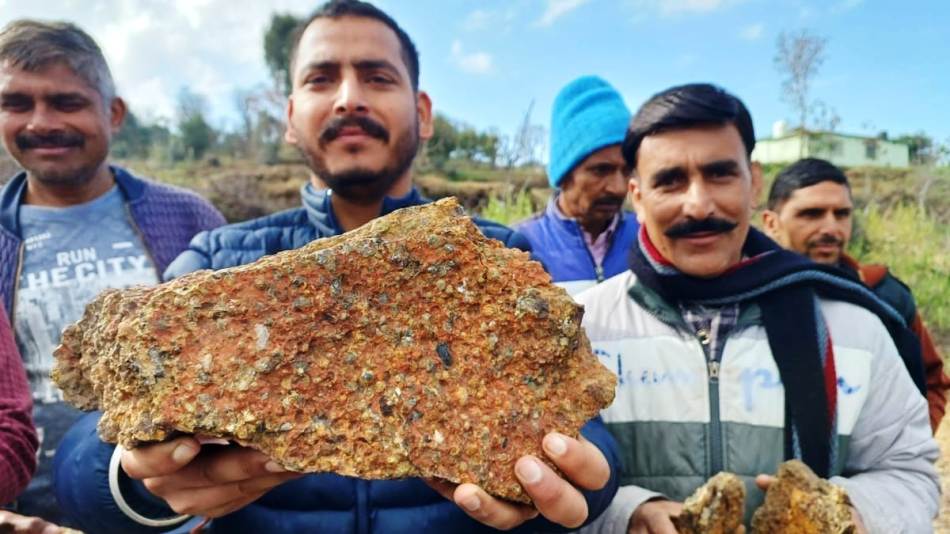
The region’s most consequential contribution to India’s critical minerals story arrived in early 2023, when the Geological Survey of India confirmed an inferred resource of 5.9 million tonnes of lithium ore at Salal-Haimana in Reasi district, which is India’s first significant domestic lithium find. The appropriate posture is calibrated: these are G3-stage inferred resources, meaning geological confidence is limited and substantial further exploration, feasibility assessment, and investment are required before commercial viability can be established. Premature euphoria serves no one; premature dismissal, in the current global mineral landscape, would be strategically indefensible.
J&K’s geology extends well beyond lithium. The region’s mineral profile includes bauxite, rare earth elements, magnesite, graphite, gypsum, and coal, a portfolio that intersects, at multiple points, with the twenty-first century’s critical minerals map. The J&K Geology and Mining Department set a revenue target of Rs 500 crore for FY 2025-26, a more than threefold jump from Rs 150 crore the previous year. In May 2026, the territory auctioned twelve limestone blocks, with new e-auctions for lithium, graphite, lignite, marble, sapphire, and granite either underway or planned. Policy intent is now moving from document to ground reality.
The more generative question for J&K, however, is what can be constructed above the ground it sits on.
J&K’s renewable energy endowment, its extraordinary hydroelectric potential across the Chenab and Jhelum systems, its solar irradiation in Ladakh, and its wind corridors position the region as a potential green energy and processing hub at precisely the moment when energy intensity has become a decisive variable in attracting advanced manufacturing. Critical mineral processing is enormously power-hungry. Lithium refining, rare earth separation, and aluminium smelting migrate toward clean, affordable, and reliable power. J&K could serve as a processing and green industrial corridor, helping India reduce its acute dependence on Chinese refining monopolies while creating durable regional employment.
The knowledge ecosystem case is equally compelling. Specialised research capacity in earth sciences, materials science, geological surveying, and clean technology, anchored in central universities and institutions already operating in J&K, and linked to national bodies like CSIR, GSI, and the NCMM’s nine Centres of Excellence, could seed the intellectual infrastructure that transforms geological endowment into long-term economic advantage.
The Policy Imperative
Identifying opportunity is the easier half of the exercise. Converting it into durable economic outcomes requires a distinct policy architecture at both the national and regional levels. Several priorities stand out.
Accelerate exploration to investable certainty. The J&K lithium inferred resource must progress through G2 and G1 classification with urgency. The Central government should frontload GSI funding for J&K surveys, and fast-track environment and social impact assessments using the NCMM’s institutional framework, so that mineral blocks reach auction with genuine investor confidence.
Build mineral processing capacity, linking J&K’s energy to national value chains. India’s NCMM must go further than mining: it needs a domestic refining and processing strategy. J&K’s hydroelectric surplus, once grid infrastructure is sufficiently expanded, should be harnessed to attract processing facilities for lithium, graphite, and rare earths. The Centre should create a dedicated Green Industrial Corridor designation for J&K under the NCMM framework, offering concessional power tariffs and capital subsidies for processing units.
Link the semiconductor and mineral policy at the national level. India’s semiconductor mission and its critical minerals mission currently operate as parallel tracks. A cross-ministerial coordination mechanism bringing together MeitY, the Ministry of Mines, and the Ministry of New and Renewable Energy is overdue. India cannot build a credible semiconductor ecosystem while remaining a net importer of every mineral that goes into fabrication.
Invest in J&K’s knowledge infrastructure as an industrial policy. Skill development programmes in J&K aligned with mining engineering, materials science, and clean energy technology should be integrated into the NCMM and the National Skill Development Corporation’s project pipelines. Research partnerships between J&K’s central universities and India’s premier science institutions should receive dedicated funding. The goal is a regional talent base capable of contributing to the knowledge economy of the materials transition, not merely to extraction.
Environmental governance as a competitive advantage. J&K’s ecological sensitivity with its rivers, forests, and biodiversity is a constraint that, managed well, becomes a reputational asset. Transparent and rigorous environmental governance, meaningful community benefit-sharing, and independent social audits will be what differentiates J&K’s mineral development story from those of India’s more troubled mining regions. Cutting corners here is a cost deferred, not a cost avoided.
The Ecosystem Is the Asset
The next phase of economic power will belong to nations capable of building resilient ecosystems around their resources by integrating geology with processing, energy with industry, research with manufacturing, and talent with technology.

Chile has lithium in abundance and remains a raw material exporter. The Democratic Republic of Congo produces 70 per cent of the world’s cobalt and captures a fraction of its value. Taiwan hosts the world’s most advanced fabs on an island of 36,000 square kilometres facing existential geographic exposure. The geography of economic power in the decades ahead will be written by those who treat supply chains as systems, not as assets to dig up and dispatch.
For India, this demands institutional execution commensurate with policy ambition by closing the distance between the NCMM’s exploration targets and actual commercial production, between semiconductor mission approvals and first-silicon discipline, between PLI disbursements and genuine value-added manufacturing depth. For Jammu & Kashmir, it demands seizing a rare historical convergence when its geological identity, renewable energy endowment, and strategic importance to India’s national priorities align in the same moment that the world is reorganising its supply chains around precisely the materials the region may hold.
In the twenty-first century, the nations that will define the geopolitical order are those that think harder than they dig. Rocks and wafers are the raw material. Institutions, ecosystems, and strategic intelligence are the finished product. India has the ambition. J&K has the endowment. What both need now is the governance to turn geology into destiny.
(The author is a pracademic working on government policy and public institutions. Ideas are personal.)