Omar Abdullah has volunteered to step down from the throne if it is linked to a fresh election for restoring the statehood of Jammu and Kashmir, Faiqa Masoodi reports

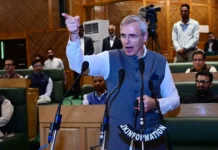
Chief Minister Omar Abdullah has reignited the debate over Jammu and Kashmir’s political future by making public his readiness to vacate the throne if that clears the way for restoring statehood.
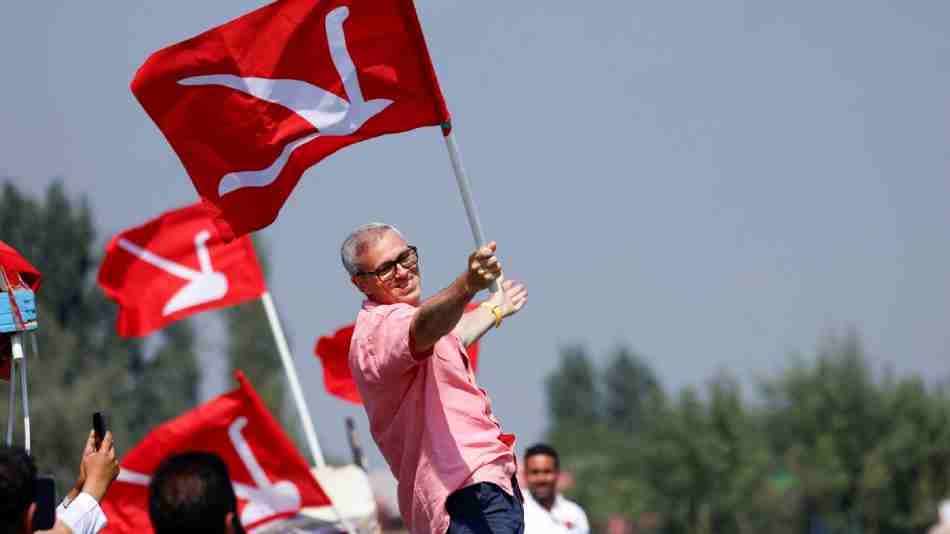
“I have no attachment to my chair,” he said, responding to reports that the Centre may favour fresh elections before granting full statehood. “If the message is that the Assembly will be dissolved for statehood to be restored, then so be it. Let them do it. Who has stopped them?” He asserted that statehood is not for lawmakers or the government, but for the people of Jammu and Kashmir.
The debate was triggered by a news story in Greater Kashmir suggesting the Centre may announce statehood only after the political class in Jammu and Kashmir agrees to a fresh election. Omar said he is aware of the source but asserted his government has no formal or informal communication. However, the news report indicated the central government has received favourable opinions from some top constitutional experts.
A Public Right
Omar Abdullah, who was sworn in as Chief Minister in October 2024, has maintained that statehood must not be treated as a political favour. “Don’t try to scare us. This statehood is our right,” he said, adding that the NC will not become an obstacle in the process.
Other senior NC leaders, including Farooq Abdullah, have also reiterated that the party is willing to step aside if that clears the way. The leadership has signalled openness to dissolving the assembly if it removes doubt about intent or legitimacy.
Earlier, on June 6, Omar had publicly raised the demand during the launch of the first train journey to Kashmir from Katra, warning against delaying the issue any further.
Post-2019, the Government of India has reiterated its intent to restore statehood to Jammu and Kashmir but without offering a specific timeline.
No Legal Requirement
The political grapevine was that the central government was planning to announce a dwarfed statehood on August 15. After the new election, issues came up, now the informed source indicates no such announcement is expected. But the issue remains: is a new election required for statehood?
The Constitution does not explicitly require the dissolution of the incumbent Assembly for its elevation to statehood. Technically, Parliament can pass a new law or amend the Jammu and Kashmir Reorganisation Act, 2019, to convert the existing UT into a state with or without dissolving the assembly.
Article 168 of the Indian Constitution, which governs the composition of state legislatures, and Article 239A, concerning UTs with legislatures, do not mandate the dissolution of a UT assembly when its status is altered. Further, Articles 3 and 4 empower Parliament to create new states or alter existing ones, with no requirement for assembly dissolution. The President is only required to refer the proposal to the legislature concerned for its views, which are not binding.
Expert Opinion
Legal experts remain divided. Senior advocates Rakesh Dwivedi and Gopal Sankaranarayanan argue that the assembly elected under the 2019 Act can continue as the state assembly once statehood is restored, through appropriate amendments. Others believe that a fresh mandate may still be required to ensure legitimacy under the new constitutional arrangement.
“Omar Abdullah’s offer to dissolve the assembly is a political message, not a constitutional requirement,” Prof Gul Wani, Kashmir’s respected political scientist, told Deccan Herald. “It reflects a willingness to allow people to revalidate their leadership in a changed constitutional context. The current assembly was elected under the limited mandate of a Union Territory. Once statehood is restored, its legislative powers, especially over law and order, will expand, warranting a new democratic mandate.”
Historical Precedents
Historical precedents support both legal interpretations. When Goa transitioned from a UT to a state in 1987, its existing legislature continued only briefly before being dissolved to allow fresh elections under the new framework. Similarly, Manipur and Tripura saw reconstituted assemblies after becoming states in 1972. In contrast, when Himachal Pradesh became a state in 1971, there was no existing assembly to dissolve, and elections followed under the new structure.
Delhi and Puducherry continue to function as Union Territories with legislative assemblies under special legal provisions, without becoming full states.
This indicates that the process of dissolving or reconstituting assemblies depends on the structure of the enabling legislation, not a constitutional compulsion. The restoration of Jammu and Kashmir’s statehood, therefore, can proceed with or without dissolving the existing UT assembly, subject to the legislative course adopted by Parliament. Politicians, however, admit the transition is a political decision, and it can be implemented either way. They assert that the BJP is unhappy over a party holding a landslide mandate and wishes to see other forces coming up in the fresh election.
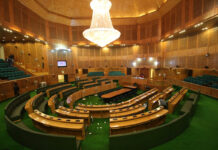
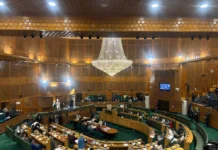
Recently, the Assembly passed a resolution urging the Centre to restore the region’s special status and constitutional guarantees. The BJP opposed the resolution, while opposition parties supported it, calling it a reflection of public demand.
Despite repeated demands, the Centre has skipped offering a timeline for the return of statehood. However, the Supreme Court, in its December 2023 ruling, directed that statehood must be restored “at the earliest,” without imposing a deadline.
Political Response
The People’s Democratic Party (PDP) has strongly criticised these fresh election reports. Its Spokesperson, Dr Mehboob Beg, said such discussions aim to delay and confuse rather than act on the promise of restoring statehood. He questioned the legality of converting a state into a UT, calling it unprecedented and outside the scope of existing law. He believes the Centre lacks clear intent, using re-elections and delimitation as tools to defer action.
BJP MP and Rajya Sabha member Gulam Ali Khatana dismissed these reports, suggesting that fresh assembly elections are a precondition for restoring statehood. “Mere speculations,” he said, asserting the incumbent assembly has a five-year mandate.