How a 63-year-old man with a 20-year grudge nearly killed Farooq Abdullah at a wedding, and what the security catastrophe revealed about the fault lines running through Jammu and Kashmir, reports Syed Shadab Ali Gillani
The wedding was winding down. Plates had been cleared, the music had softened, and the evening was folding gently into the Jammu night. Dr Farooq Abdullah, 88, a five-time Chief Minister and son of the man who built modern Jammu and Kashmir, rose to leave. He had stayed long enough. The families would be grateful.
Outside the Royal Park banquet hall in the Greater Kailash neighbourhood, his convoy waited. It was 10:45 PM on March 11, 2026. Around him walked some of the most senior figures in the government, Deputy Chief Minister Surinder Choudhary, the Chief Minister’s Advisor Nasir Aslam Wani, and a cluster of ministers. It was, by any measure, a high-security moment. It was also, fatally, not treated as one.
A man slipped from the crowd. He moved from behind. He pressed the muzzle of a .32-calibre revolver to Abdullah’s neck and pulled the trigger.
The shot that followed would have killed one of India’s most durable political figures. Instead, an NSG commando’s split-second reflex, grabbing the gunman’s hand and wrenching the barrel upward, redirected the bullet into the night sky. Kamal Singh Jamwal, 63, a retired man who lived quietly off rental income from a few shops in the old quarters of Jammu, was pinned to the ground within seconds.
Abdullah himself barely understood what had happened. “I felt a sudden heat near my neck,” he said the next morning, “but I did not grasp it was a shot at first. I thought it was firecrackers.”
Usually jovial and quick with a smile, particularly at Jammu’s wedding gatherings, Abdullah appeared visibly shaken at the press conference. The footage of the incident seemed to have confronted him with the stark reality of how narrowly he had escaped death.
20 Years Later
Kamal Singh Jamwal did not panic after the shot. Witnesses described a man who was eerily composed, restrained, with his hands already in custody, and none of the desperation one might expect from a failed assassin. When police interrogated him, he was almost matter-of-fact.
“I wanted to eliminate Farooq Abdullah for 20 years,” Jamwal told investigators, after security detail of the politicians captured him after his assassination bid and drove him to the police station. “Today I had my chance, but he survived. I used my own weapon.”
Jamwal had arrived at the function legitimately. His cousin Shatrujit Singh’s son was among those being married that evening; the event at Royal Park was a family occasion for him, not an infiltration. He offered no political manifesto, no organisation, no network. Only “personal reasons,” repeated as a stone dropped in water with no explanation of what lay beneath.
The portrait that emerged from his neighbourhood was one of studied ordinariness. Charan Singh Jamwal, who is not related to the accused, is the president of the Purani Mandi Association and has known Kamal Singh for years. He was struggling to reconcile the man he knew with the one now in police custody.
“He was known as a completely clean individual,” Charan Singh said. “He avoided fights, arguments, or even raising his voice. Whenever he walked through the neighbourhood, he kept his head down, quiet, unassuming. There was never any complaint, case, or hint of wrongdoing against him in all these years.”
Yet details accumulated that complicated the clean picture. In his youth, Jamwal had been affiliated with the Panthers Party, the regional formation led by Bhim Singh, which aspired to become the Jammu voice. After Singh’s death, he drifted away from electoral politics and, according to the Purani Mandi Association president, toward a pracharak role with the Sangh Parivar, the constellation of right-wing Hindu nationalist organisations. Meanwhile, a cabinet minister, Satish Sharma, separately alleged that Jamwal had past connections to a drug distribution network in Jammu, at a time when cough syrup abuse was a documented problem in the region.
The investigators’ task is to determine whether any of these threads connect to a motive, or whether a 20-year-old, privately nursed obsession arrived at its moment on the night of a wedding.
Chaos at the Exit
Bimla Luthra, a National Conference leader who was seated beside Abdullah at the time, recounted the seconds before and after the shot with unnerving clarity.
“I was sitting right next to Dr Abdullah, enjoying snacks and juice, when he said, ‘Let’s leave now,'” she said. “As we accompanied him toward the exit, a man suddenly appeared from the crowd and pointed his gun straight at Dr Sahab. Fortunately, the commando grabbed his hand in an instant, then everyone surrounded and cornered him.”
A second eyewitness, a longtime National Conference member from Jammu who was in the crowd, described the broader scene: “After dinner, Dr Sahab decided to leave early. As we escorted him to the exit, a man came from behind and aimed his pistol. Alert guards grabbed his hand and weapon just as he fired, redirecting the shot skyward and averting tragedy. No police were there, even though the party president, Deputy CM, and ministers were present. I have never seen this man near Dr Abdullah or at any party event.”
CCTV footage from the venue later confirmed the sequence: a police officer and an NSG commando intercepting the attacker as he raised the weapon, a second commando pinning him to the ground. Abdullah was rushed into a convoy vehicle and sped away
The man who would speak about it most calmly the following morning was Abdullah himself. Facing reporters at his Jammu residence, he was composed, almost philosophical.
“I do not know this man at all,” he said. “He claims he waited 20 years out of personal resentment, but I have no idea what drove him. I have never harmed anyone, and I had never seen him before.” He added that Home Minister Amit Shah had telephoned him personally to promise a full investigation.
A Security Failure
Farooq Abdullah holds Z-plus security, the highest civilian protection tier in India after the Prime Minister, assigned by the National Security Guard. Nine individuals currently hold this security status. That a 63-year-old man with a revolver in his jacket could press that weapon against one of these individuals’ necks at a public function, attended by multiple ministers and the Deputy Chief Minister, is a question that has shaken the security establishment.
His son, Chief Minister Omar Abdullah, put it with characteristic restraint on social media that night: “Allah is kind. My father had a very close shave. What is known is that a man with a loaded pistol was able to get within point-blank range and discharge a shot. It was only the close protection team that deflected the shot and ensured that the assassination attempt failed. There are more questions than answers at the moment, including but not limited to how someone was able to get this close to a Z+ NSG-protected former CM.”
Deputy Chief Minister Surinder Choudhary, who was walking alongside Abdullah when the shot was fired, offered an account notable for what it revealed about the breakdown. It was not Abdullah’s NSG detail alone that subdued the attacker; it was Choudhary’s own security personnel, along with the guards assigned to Advisor Nasir Aslam Wani. “You can gauge the situation from the fact that it was my security personnel who took the assailant to the police station,” Choudhary said. This might be a classic case in Jammu and Kashmir’s history where the most senior politician’s potential killer is caught by
The Lt Governor, Manoj Sinha, ordered a comprehensive investigation and directed the Director General of Police to pursue the case without limitation. The NSG announced it would conduct a full security audit of all Z-plus protectees.

Protests, Concern
The political response was swift and, true to Jammu and Kashmir’s layered politics, reflected multiple agendas at once.
In the Rajya Sabha, Mallikarjun Kharge, president of the Indian National Congress, cited the incident as evidence of a deteriorating law-and-order situation. “An attack was carried out on Farooq Abdullah,” he said, adding that “if the attacker had got even a minute or two more, he could have killed him.” Leader of the House JP Nadda, however, assured members of a thorough inquiry but cautioned against “giving the incident a political colour” before the investigation concluded.
Condemnation came from across party lines. Mehbooba Mufti of the People’s Democratic Party called it a “grave security lapse.” At the same time, Mirwaiz Umar Farooq demanded a probe into how “an assailant got so close with a loaded weapon.” M K Stalin, Chief Minister of Tamil Nadu, termed it “a matter of grave concern for our democracy.” Sajad Lone, president of the Jammu and Kashmir People’s Conference, tweeted: “Condemn the cowardly firing. Thanks to Allah Almighty that they are safe.”
The ruling party in Jammu believe it was a conspiracy and must be investigated.
A Warrant Pops Up
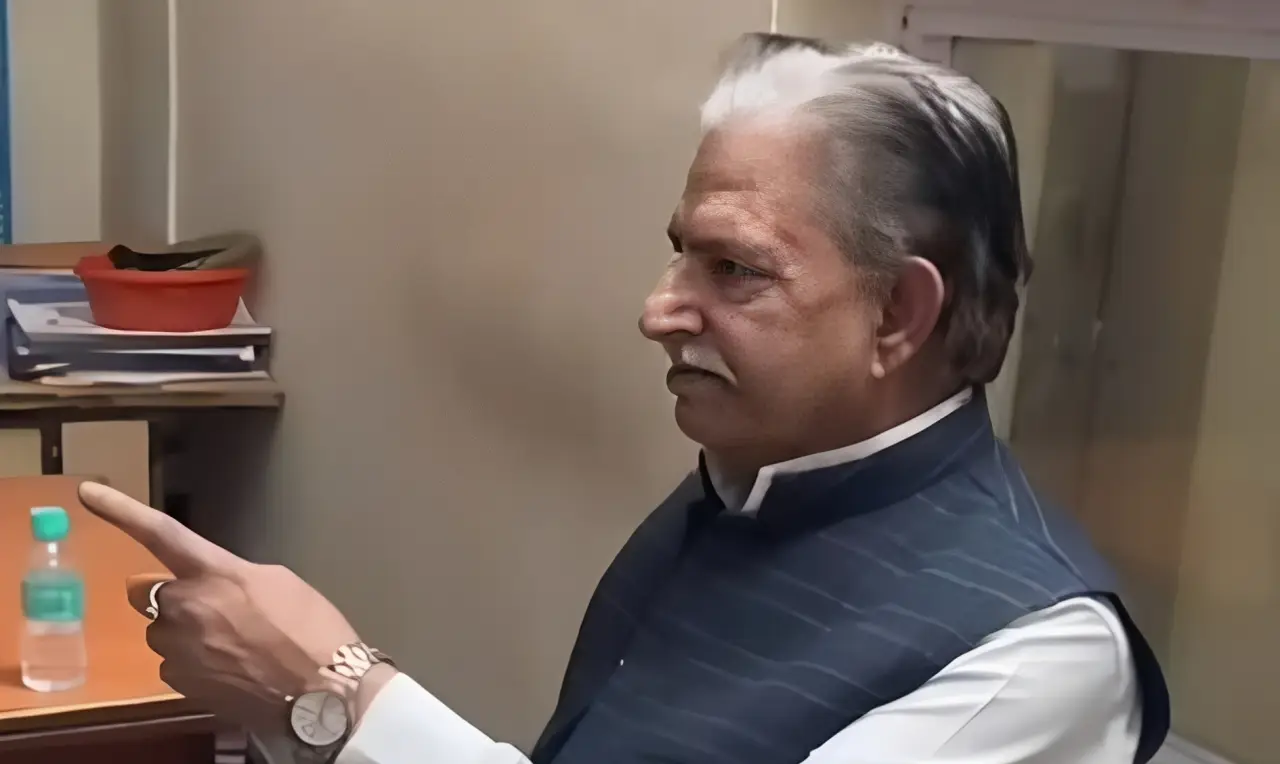
The 1937-born Farooq Abdullah is Jammu and Kashmir’s senior-most politician. Though he dislikes going to jail, unlike his father, Dr Abdullah has navigated coups, insurgencies, elections that were rigged or disputed, the revocation of Article 370, and the conversion of the state into a UT. In addition to being a five-time Chief Minister, he was a Union Minister. He survived a serious kidney transplant.
A day after he survived the assassination bid, Abdullah addressed a news conference and later attended the Iftaar party of miner Javed Rana. Soon, he took off for Srinagar as it was important. A Srinagar court issued a non-bailable warrant against Abdullah for failing to appear in proceedings related to the Jammu and Kashmir Cricket Association financial scandal.
These could have been the most challenging 48 hours in Farooq’s life, in which he survived a bullet, received calls from the Home Minister, was celebrated at rallies, and was issued a warrant.
Questions Remain
Jamwal is in police remand for five days. Investigators are working to establish motive, confirm whether he acted alone, and examine any possible links to organisations or networks. He has told reporters and police alike that he acted of his own will and at no one’s instruction.
“We have been promised that the conspiracy will be investigated,” the party’s Jammu leader, Ajay Sadhotra, said. “The absence of the cops at the venue must be investigated first.”
Post Script
Jamwal is in police remand. Police have seized his revolver and recovered the empty cartridge. Post-assassination bid reports suggest that he is the son of a police inspector who owns a patch of land in Kulgam but lives in Jammu. At the wedding, he was a barati.