SRINAGAR: Environmental experts, former civil servants, conservationists and civil society members on Thursday called for immediate and coordinated action to protect Jammu and Kashmir’s fragile ecosystem, warning that unchecked environmental degradation could lead to severe water shortages, biodiversity loss and increased vulnerability to natural disasters.
The concerns were raised at a seminar on Protection of Natural Environment in Jammu & Kashmir organised by the Group of Concerned Citizens (GCC) at the Institution of Engineers in Srinagar. GCC comprises mostly of the retired civil servants and government officers.
The seminar brought together former bureaucrats, environmentalists, scientists, retired military officers, academics, students and residents to deliberate on the growing ecological challenges confronting the region, including retreating glaciers, shrinking wetlands, declining forest cover, illegal riverbed mining and unplanned urban expansion.
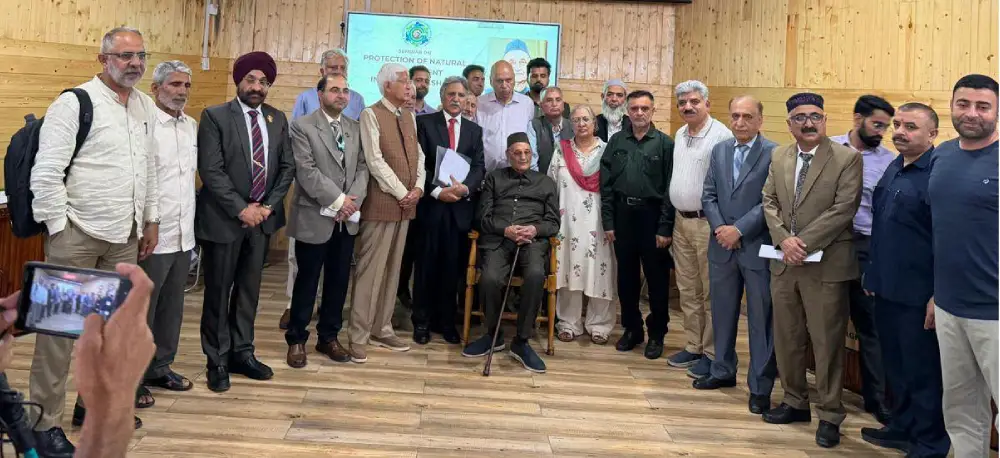
Delivering the keynote address, former Sadr-e-Riyasat Dr Karan Singh said Jammu and Kashmir’s environmental condition had deteriorated significantly over the decades.
Recalling the region’s changing landscape, he said Dal Lake had shrunk considerably from its original size, while wetlands such as Hokersar and Anchar had almost disappeared. He also expressed concern over the shrinking of Wular Lake and warned that indiscriminate development in the Himalayan region could have serious ecological consequences.
Dr Singh said development models suitable for the plains should not be replicated in ecologically sensitive mountain regions and reiterated his opposition to indiscriminate widening of roads in the Himalayas.
In his opening remarks, GCC Chairman and former IAS officer Khurshid Ahmed Ganai described environmental protection as central to Jammu and Kashmir’s identity and survival. He said water scarcity, once unimaginable in the region, had emerged as one of its most pressing challenges due to melting glaciers, encroachment of water bodies and siltation of reservoirs.
Ganai urged the media to play a greater role in creating public awareness on environmental conservation and said safeguarding natural resources required collective responsibility rather than government action alone.
Wildlife conservationist and former Director General of CAPART, MK Ranjitsinh stressed that habitat conservation was essential for protecting wildlife. Recalling the relocation of villages from Dachigam during the Maharaja’s rule, he said those measures had contributed to the survival of the Hangul and underscored the importance of conserving forests, wetlands and biodiversity.
Retired Lieutenant General RS Reen warned that Kashmir was witnessing unprecedented environmental changes, pointing to melting glaciers, drying springs and declining water levels in the Jhelum River as evidence of mounting ecological stress.
He also expressed concern over encroachments on flood channels and wetlands, cautioning that the region remained vulnerable to flood disasters if corrective measures were not taken. Reen said environmental degradation had been accelerated by human activities alongside the effects of global warming.
Environmental activist Raja Muzaffar highlighted the impact of illegal riverbed mining, particularly in the Doodhganga and other rivers across the Valley. He said mining activities continued despite interventions by the National Green Tribunal and warned that they were causing significant ecological damage.
Former Director of the Bombay Natural History Society Asad Rahmani said the Hangul population had declined sharply over the decades and called for sustained scientific conservation efforts, habitat protection and greater community participation to safeguard endangered species.
Environmental activist Manzoor Ahmad Wangnoo said thousands of springs and forests across the region required urgent attention and stressed the importance of environmental responsibility among citizens. Referring to community-led conservation initiatives, he said public participation had contributed to improvements in the condition of Nigeen Lake, Khushalsar, Gilsar and several springs in Srinagar and Ganderbal districts.
Other speakers included GCC Vice Chairman Latief-u-Zaman Deva, former IFS officer Manzoor Ahmad Tak and scientist Dr Majid Farooq, who also emphasised the need for stronger environmental policies, sustainable development and wider public engagement.
The seminar concluded with participants calling for coordinated efforts by government agencies, experts, civil society and local communities to protect Jammu and Kashmir’s glaciers, rivers, lakes, wetlands and forests from further degradation.