SRINAGAR: Jammu and Kashmir is in the grip of an intensifying dry spell, with official data showing a seasonal rainfall deficit of 17 per cent from October 1 to December 10, 2025. Six districts in Kashmir, including Srinagar, have recorded below-normal rainfall, while four districts in the Jammu region have received large excess precipitation.
Meteorological figures indicate that the Kashmir Division received an average of 64.5 mm of rainfall against a normal of 77.5 mm during the period under review. Srinagar logged 38.6 mm against a normal of 73.1 mm, Pulwama 29.4 mm against 52.5 mm, Shopian 16.5 mm against 74.5 mm, Badgam 23.1 mm against 58.3 mm, Bandipora 27.5 mm against 79.1 mm, and Baramulla 28.3 mm against 84.8 mm. These districts fall in the deficit category, defined as 20–59 per cent below normal.
In contrast, several districts in the Jammu region recorded significant excess rainfall. Jammu received 74.7 mm against 54.3 mm, Kathua 89.1 mm against 56 mm, Reasi 103.4 mm against 67.1 mm, Doda 129.8 mm against 84.2 mm, and Samba 48 mm against 18.3 mm.
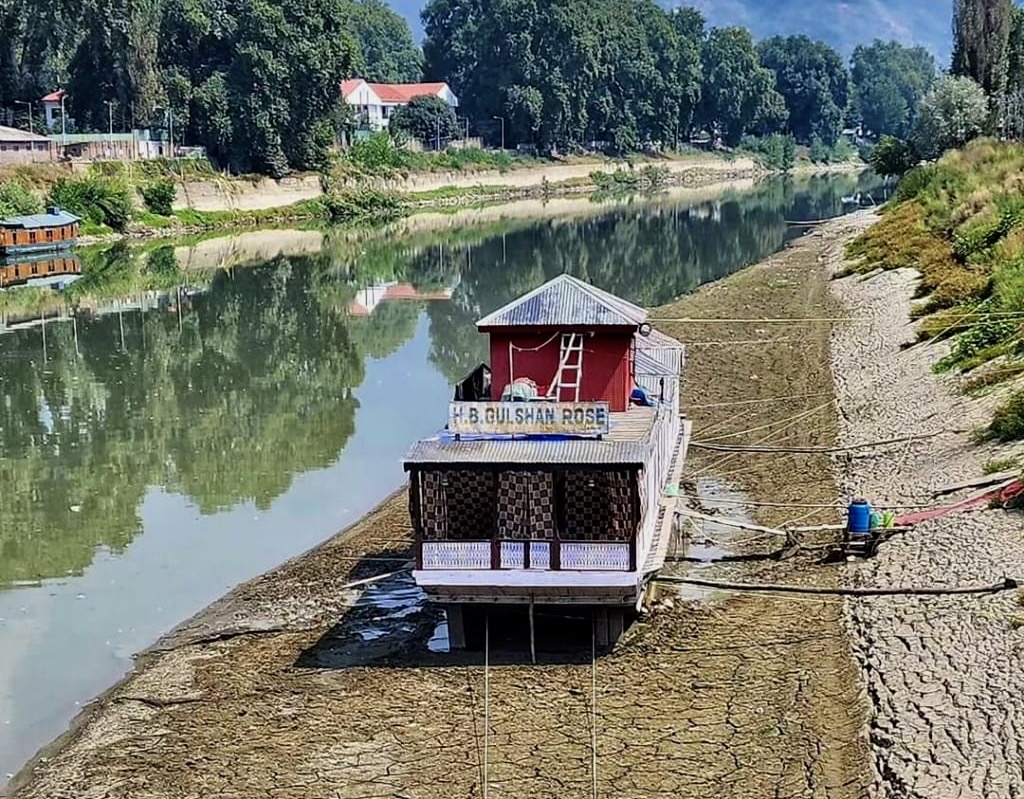
The persistent dry conditions have resulted in the drying of several major springs across Kashmir, disrupting drinking water supply in many rural pockets. The Jhelum River, the Valley’s lifeline, has also witnessed a sharp decline in water levels. At the Sangam gauge in south Kashmir, the river fell to 0.65 metres on December 10, the lowest level this season.
Field officials said the fall in river discharge and spring flow is evident across multiple locations, though they maintained that the Valley’s overall drinking water situation remains under control.
The Standardised Precipitation Index (SPI), a key drought-monitoring tool, currently shows negative values across the Valley, signalling dry conditions of varying intensity.
Residents and local community representatives in parts of north and south Kashmir reported that springs supplying drinking water to hundreds of households have been running low or drying up for weeks.
The concern has grown further after engineering officials acknowledged that the continuing dry spell, which began in October, has significantly reduced the intake at several points feeding irrigation and drinking water schemes. The reduced discharge in the Jhelum has exposed long stretches of its riverbed, especially at Sangam, where the level has dropped to 0.56 feet in recent readings.
They said the situation has put added pressure on systems that depend on the river, although areas drawing water from Wular Lake have not reported disruptions. The lake, functioning as a natural holding reservoir, continues to release water steadily to meet local requirements.
Compounding the situation is an extended dry phase since November 5. Some officials noted that the region is currently experiencing an 85.8 per cent rainfall deficit over recent weeks, with the expected 43.1 mm of rainfall almost entirely missing.
Despite the dipping water levels, authorities reiterated that there is no immediate threat to drinking water availability in the Valley. Residents, however, have been advised to conserve water and keep track of minor streams and spring levels, particularly in the south Kashmir districts where deficits remain stark.
Meteorological officials said no major weather activity is likely before December 19, and no improvement is expected unless fresh western disturbances approach the region.