A peer-reviewed study identifies precision irrigation, artificial intelligence-based disease diagnosis and drone monitoring as the most promising technologies for Kashmir’s horticulture sector, but warns that poor digital infrastructure, limited technical skills and fragmented landholdings could slow their adoption.
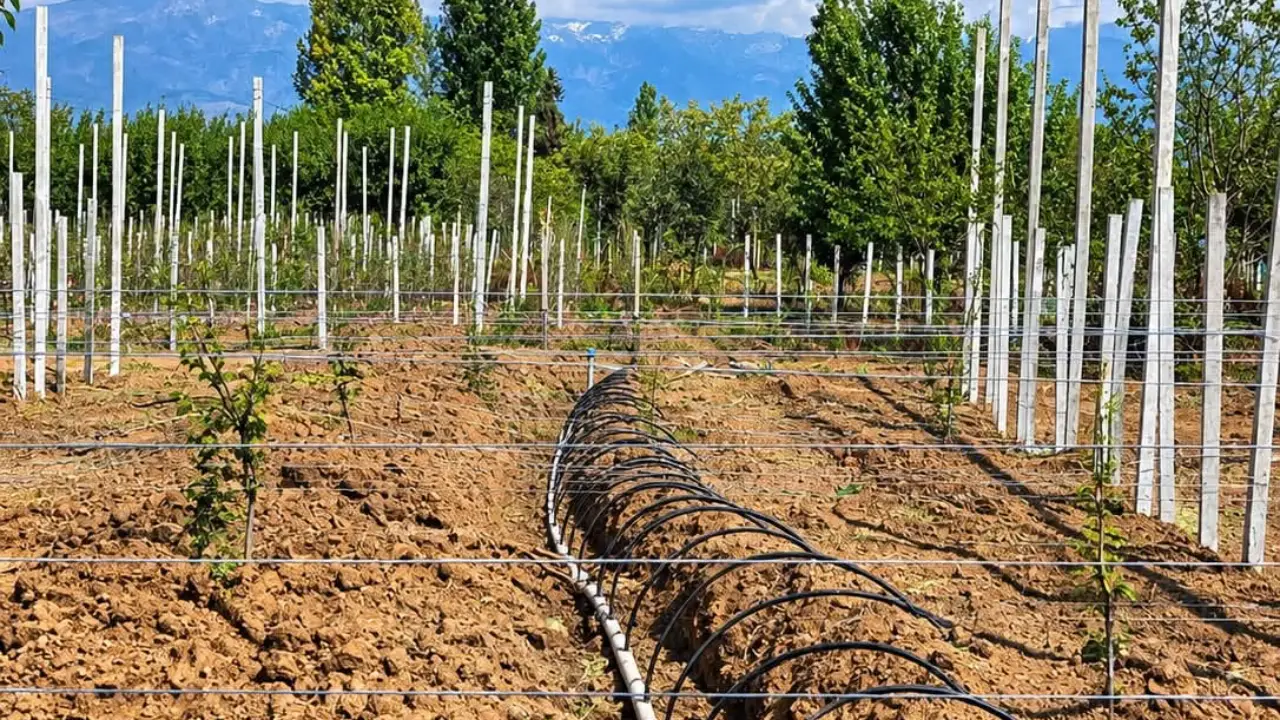
SRINAGAR: Precision irrigation systems and artificial intelligence-based disease detection have emerged as the most promising technologies for transforming Kashmir’s horticulture sector, according to a new study that identifies significant opportunities for smart farming but warns that inadequate digital infrastructure, high investment costs and a shortage of technical skills could prevent orchardists from benefiting. The study finds that technologies capable of improving water efficiency, identifying crop diseases at an early stage and monitoring orchard conditions could help address some of the major challenges facing fruit cultivation in Jammu and Kashmir.
Titled “Future Prospects of Smart Horticulture in Kashmir Under Emerging Technological Innovations”, the research evaluates seven emerging agricultural technologies and ranks them according to their technological readiness, economic feasibility, institutional support, infrastructure availability, environmental sustainability and market accessibility. Precision irrigation secured the highest score, followed by AI-based disease diagnostics and drone-assisted orchard monitoring. Mobile-based agricultural advisory platforms ranked fourth, while automated harvesting systems occupied the last position. The authors argue that technologies offering immediate economic benefits and requiring comparatively manageable investments are more suitable for Kashmir’s orchard-based agricultural structure than expensive automation systems.
The paper was authored by Arshad Bhat of the Amity Institute of Liberal Arts, Amity University Mumbai, Maharashtra, and Abid Sultan of the Institute of Business and Policy Research, Sher-e-Kashmir University of Agricultural Sciences and Technology of Kashmir (SKUAST-Kashmir), Srinagar. It was published in Applied Fruit Science (2026).
Productivity Gap
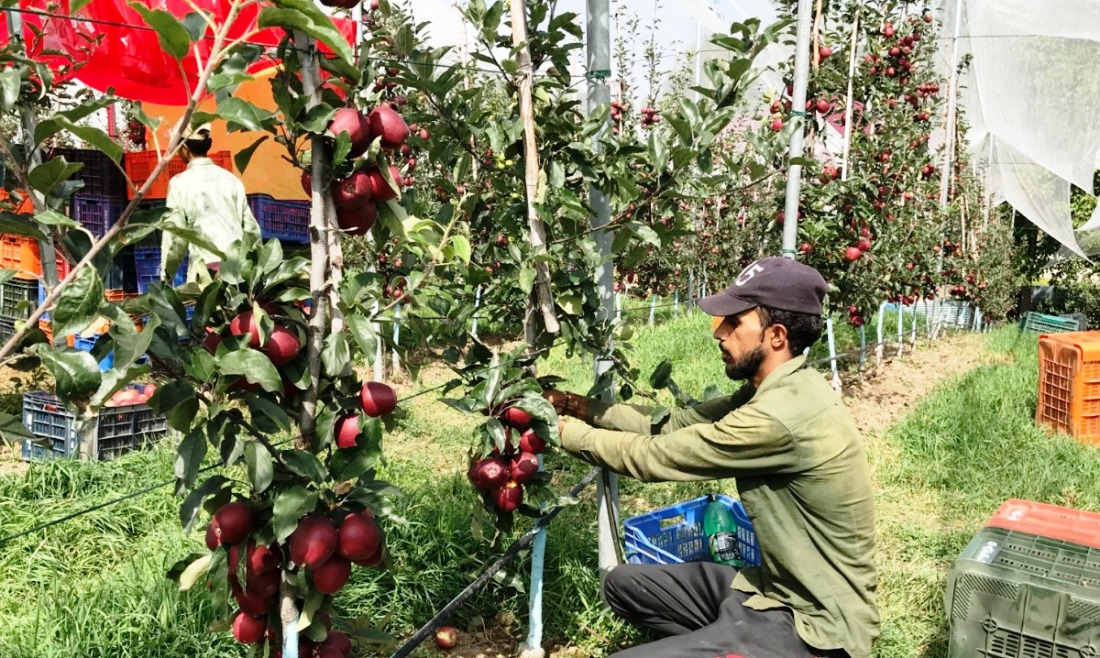
Horticulture remains one of the principal economic activities in Jammu and Kashmir, supporting rural livelihoods through the cultivation of apples, walnuts, almonds, cherries, pears, apricots and saffron. Apple cultivation, in particular, forms the backbone of the Kashmir Valley’s horticultural economy, providing income to thousands of farming households and contributing significantly to the region’s agricultural exports. However, the researchers identify a gap between the expansion of horticultural production and improvements in productivity per hectare.
Using official data covering the period from 2014 to 2024, the study calculates that the area under horticulture increased from 331,200 hectares to 367,800 hectares, registering an annual compound growth rate of 1.05 per cent. Fruit production increased from 2.12 million tonnes to approximately 2.57 million tonnes during the same period, growing at an annual rate of 1.93 per cent. Export earnings recorded the highest growth, increasing from $0.79 billion to $1.19 billion, with an annual growth rate of 4.14 per cent. Productivity, however, increased at a comparatively slower rate of 0.87 per cent, rising from 6.40 tonnes per hectare in 2014 to 6.98 tonnes per hectare in 2024.
The authors interpret this difference as an indication that the expansion of horticulture has contributed more to overall production growth than improvements in output from individual hectares. They argue that increasing productivity will require more efficient resource management, better disease surveillance, improved orchard monitoring and technologies capable of helping farmers respond to changing climatic conditions. Climate variability, pest infestations, labour shortages, inefficient resource utilisation and market uncertainties are identified as additional pressures on the sector.
Research Design
To evaluate the potential of emerging technologies, the researchers adopted a mixed-method approach combining secondary information, expert assessments and a field survey of apple growers. The study drew on government reports, research publications, policy documents, annual reports of the Jammu and Kashmir Directorate of Horticulture, National Horticulture Board publications and material from the Ministry of Agriculture and Farmers Welfare and SKUAST-Kashmir.
The expert assessment involved 40 participants, including 15 horticultural scientists, 10 agricultural extension professionals, five policymakers, five agritech entrepreneurs and five experienced orchardists. Their opinions were collected between January and March 2026 through a structured evaluation schedule based on a five-point Likert scale. The researchers also conducted interviews with 150 apple growers selected through multistage random sampling in Shopian, Baramulla, Kupwara and Pulwama districts during 2025–26. The survey examined farmers’ socio-economic backgrounds, awareness of emerging agricultural technologies, access to institutional support and existing levels of technology adoption.
The researchers used a Smart Horticulture Prospects Index (SHPI), developed through the Analytic Hierarchy Process, to compare the suitability of different technologies for Kashmir’s horticultural conditions. The index incorporated six assessment indicators, with expert judgments accepted only when their consistency ratio remained below 0.10.
Technology Rankings
Precision irrigation emerged as the strongest candidate, receiving an SHPI score of 0.842, followed by AI-based disease diagnostics at 0.801. Drone-assisted orchard monitoring ranked third with 0.765, while mobile-based advisory platforms received 0.734. Internet of Things (IoT)-enabled sensor networks secured fifth position with 0.694, followed by Geographic Information Systems (GIS) and remote sensing at 0.657. Automated harvesting systems ranked last, with a score of 0.508.
The researchers say the rankings reflect the importance of technologies that can address immediate agricultural challenges without requiring extensive mechanisation or substantial changes to existing orchard structures. Precision irrigation was prioritised because it can improve water-use efficiency and help farmers regulate the amount of water supplied to crops according to soil moisture and climatic conditions. AI-based disease diagnostics ranked second because of their potential to identify crop infections at an early stage, allowing farmers to respond before diseases spread across orchards.
Drone technology was considered particularly useful for monitoring large orchard areas, assessing canopy health, identifying crop stress and supporting precision spraying. By comparison, automated harvesting received the lowest ranking because of its high capital requirements, limited mechanisation and the prevalence of small, fragmented orchard holdings in Kashmir.
The study’s separate expert assessment largely reinforced these findings. Precision irrigation received the highest weighted mean score of 4.62 out of five, followed by AI-based disease detection at 4.48. Mobile advisory applications scored 4.32, while drone technology received 4.24. IoT-based orchard monitoring scored 4.13, GIS and remote sensing received 3.97, and robotic harvesting ranked last at 3.45.
Orchard Applications
The researchers identify several ways in which emerging technologies could be integrated into the cultivation of different fruit crops across Kashmir. For apple orchards, AI-based diagnostic systems could help detect diseases such as apple scab, Alternaria and powdery mildew at an early stage. Early identification could enable orchardists to take timely preventive measures, potentially reducing crop losses and unnecessary pesticide applications. Drone-assisted multispectral imaging could provide information about canopy vigour, allowing farmers to identify areas requiring pruning, nutrient management or other interventions.
The researchers also highlight precision fertigation, which combines irrigation with the application of fertilisers, as a potential way to improve fruit size, colour and overall quality. IoT-based weather stations could monitor local climatic conditions and provide information useful for forecasting disease outbreaks. The potential applications extend beyond apple cultivation: soil-moisture sensors could help walnut growers determine when irrigation is required, precision frost-warning systems could protect cherry blossoms, remote sensing could assist pear growers in estimating yields, and automated fertigation could support improvements in almond quality and production.
The researchers particularly emphasise the relevance of frost-warning systems, canopy-temperature sensors and automated weather stations in Kashmir, where frost, hailstorms and unpredictable weather conditions can damage flowers, affect fruit setting and reduce yields. They also suggest that precision irrigation could improve apple fruit size, total soluble solids and firmness, while fertigation could contribute to better colour and yield. Soil-moisture monitoring, meanwhile, could help improve water-use efficiency in walnut orchards.
Digital Framework
The study proposes a smart orchard management framework that connects different technologies through a centralised decision-support system. Under this model, soil and weather sensors installed in orchards would collect information about moisture levels, temperature, humidity and other environmental conditions. The information would be transmitted through Internet of Things networks and analysed using artificial intelligence systems, with the resulting data helping farmers make decisions about irrigation schedules, disease management, fertiliser application and weather-related risks.
For instance, soil-moisture sensors could indicate when an orchard requires irrigation, while weather-monitoring systems could provide early warnings about conditions favourable to disease outbreaks or frost damage. The authors suggest that integrating these technologies could help move orchard management away from conventional practices based largely on observation and experience towards more data-driven decision-making. However, they acknowledge that the usefulness of such systems depends on the availability of reliable connectivity, affordable equipment and technical assistance.
Adoption Barriers
Despite the potential benefits, the researchers identify several structural and institutional obstacles that could restrict the adoption of smart horticulture in Kashmir. Poor digital infrastructure, inadequate technical knowledge, fragmented landholdings and high initial investment costs are among the principal weaknesses highlighted in the study’s SWOT analysis. The authors argue that the financial burden of purchasing and maintaining advanced equipment could discourage small orchardists, particularly those who lack access to institutional credit.
Limited digital literacy could also prevent farmers from effectively using mobile applications, sensor networks and other technology-based agricultural services. The study identifies technological readiness, economic feasibility and institutional support as the three most important factors determining the prospects of smart horticulture. Together, these account for 63 per cent of the total weight assigned to the six assessment indicators. Technological readiness received the highest weight of 0.24, followed by economic feasibility at 0.21 and institutional support at 0.18. Infrastructure availability accounted for 0.15, environmental sustainability for 0.12 and market accessibility for 0.10.
The researchers argue that technological availability alone will not guarantee adoption. Farmers must also be able to afford the equipment, understand its operation and access institutions capable of providing training and technical support. The study identifies farmer-group membership, access to credit, extension services, education and digital literacy as important variables in its proposed analysis of technology adoption.
Production Outlook
The researchers also examine the potential long-term contribution of smart horticulture to fruit production in Jammu and Kashmir. Using an exponential growth model, they project that fruit production under a smart-horticulture scenario could increase from approximately 2.6 million tonnes in 2025 to more than 3.5 million tonnes by 2040. The projection is presented as an indication of the potential gains from integrating emerging technologies into horticultural practices, rather than an observed increase in production.
The authors acknowledge that their research does not establish a direct causal relationship between technology adoption and increases in production. They also caution that their findings must be interpreted in light of the study’s limitations. The farm survey covered only four districts and relied on cross-sectional data, meaning it captured farmers’ circumstances at a particular point rather than tracking changes over several years. The researchers further acknowledge that self-reported interviews may be affected by recall and response biases, while the econometric models described in the paper can establish associations rather than causation.
Policy Priorities
The researchers argue that the successful adoption of smart horticulture will require coordinated intervention from government institutions, agricultural universities, technology providers and farmer organisations. They recommend investment in rural digital infrastructure, particularly reliable internet connectivity and accessible technology services. Farmer training and extension programmes are also identified as essential for improving digital literacy and helping orchardists understand how to use emerging technologies.
The authors call for institutional support and financial assistance to make smart farming equipment more accessible, particularly to small and marginal growers. They also highlight the importance of public-private partnerships in developing affordable technology solutions suited to local agricultural conditions. The study links its findings to Everett Rogers’ diffusion-of-innovations theory, which explains how new technologies spread through communities depending on factors such as perceived benefits, affordability, compatibility and institutional support.
The researchers argue that technologies must be adapted to the specific requirements of Kashmir’s horticultural sector rather than introduced without considering local farming conditions. They conclude that smart horticulture could improve productivity, resource-use efficiency and climate resilience, but its success will depend on whether farmers can access and afford the technologies. For Kashmir’s apple industry, the findings suggest that the immediate transformation may not necessarily come from expensive robotic machinery or fully automated orchards, but from practical interventions such as precision irrigation, early disease detection and accessible digital advisory services. Sustained investment in infrastructure, farmer education, research and institutional support will be necessary to translate the potential of these technologies into measurable improvements in orchard productivity.