Kashmir’s centuries-old raw hide trade, once a fortune, has shrunk 90 per cent since 2014, leaving traders facing an uncertain future, reports Afreen Ashraf
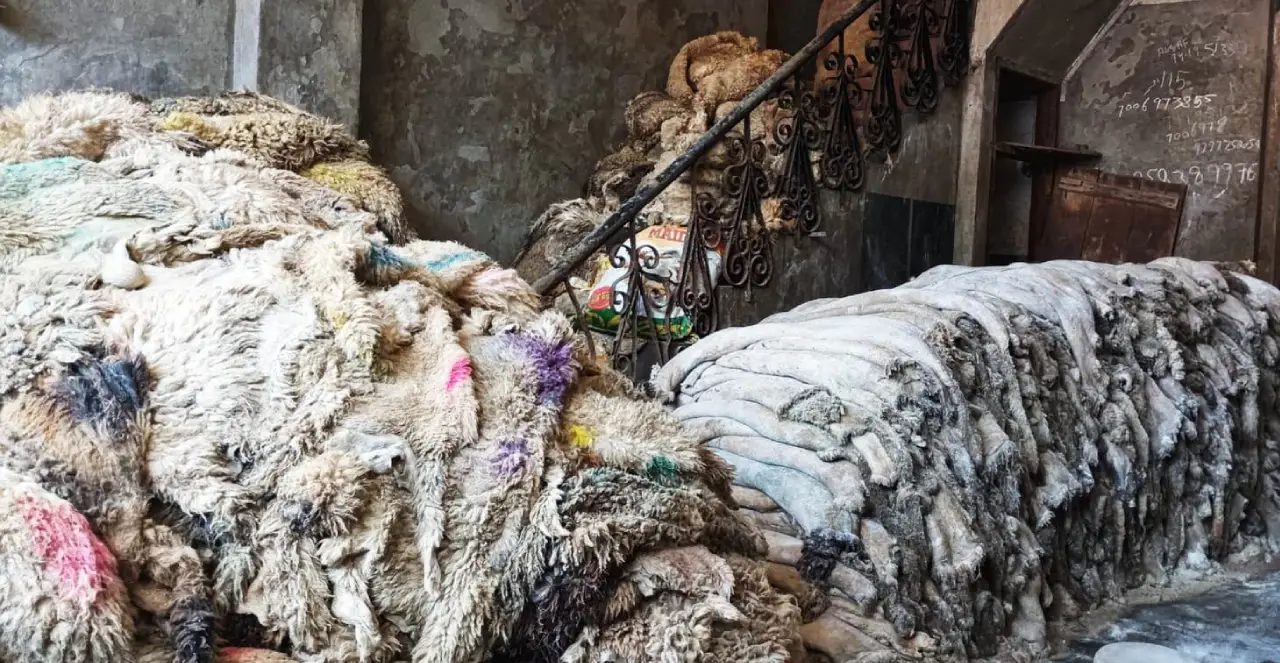
In Srinagar’s Jamallatta quarter, one of the city’s oldest hide-trading neighbourhoods, Kawa and Brothers‘ go-down is stacked floor to ceiling with salted sheep hides, leaving only narrow passageways for workers to move through. Inside, 73-year-old Mehrajuddin Kawa works steadily, lifting and arranging the hides for consignment beyond the Valley.
For Kawa, the scene is familiar. He has worked in the trade for fifty years after having inherited it from his father. His family’s association with the business goes back further still. “Our elders told us this work has been in the family for nearly 600 years,” he claimed. But today, standing amid stacks that once promised prosperity, he is uncertain whether the next generation will continue. “I have seen its prosperous days as well as its decline, but I have never witnessed conditions as difficult as they are today.”
He is not alone. Across Kashmir, traders in the hide industry are grappling with a steady fall in earnings and demand, turning what was once a dependable livelihood for generations into an increasingly difficult one to sustain.
Thousand Livelihoods
The raw hide trade has long been a pillar of Kashmir’s economy, linking the Valley to markets across the world. Leather craftsmanship is believed to have flourished during the Mughal era, when Kashmiri artisans gained recognition for finely made shoes, boots, belts and bags traded well beyond the region.
At its peak, the industry supported thousands of families. According to estimates by the Jammu and Kashmir Entrepreneurship Development Institute (JKEDI), it had the potential to generate nearly Rs 600 crore annually, with more than 35,000 people directly or indirectly dependent on it for their livelihoods.
Mutton and chevon (goat meat) dealers in Srinagar insist that over two lakh sheep hides are transported out of Kashmir every month as raw material for the leather industry. Hides collected from across Kashmir travel to major tanning centres in northern India, particularly Kanpur, where they are processed into leather before entering domestic and international markets, including Europe.
“Most of the hides collected here are sent to Delhi and Jalandhar, where they enter the leather manufacturing chain,” Abdul Ahmed Khanglo, a workshop owner at Safa Kadal, said. “From there they are eventually used to make jackets, shoes, bags and other leather products.” Those in the trade argue their work remains indispensable, forming the first link in a much larger leather value chain. “Without collectors and processors, animal hides generated by slaughterhouses, butcher shops and households would quickly become waste, creating both environmental and sanitation concerns,” said Riyaz Ahmed, a hide collector in downtown Srinagar. He noted that the labour-intensive process turns what would otherwise be discarded into valuable industrial raw material, eventually feeding the production of footwear, garments, bags, belts and gloves. An estimated three million hides become available across the region each year, with Eid-ul-Adha alone contributing a bulk of it in two-and-a-half days.
Today, much of this economic sector is falling apart.
Prices fall
The trade has witnessed a severe decline over the past decade. According to the All Kashmir Raw Skin Dealers Association, the industry has shrunk by nearly 90 per cent since 2014.
“We have around fifteen people working with us,” Kawa informed. “Earlier, this business provided employment to many more families, but over the years the work has reduced considerably. The decline has affected everyone associated with the trade.”
Traders who once handled thousands of hides each season now struggle to find buyers, and warehouses that once overflowed with stock often sit half empty. Prices for raw sheep hides have fallen sharply depending on size and quality. Most now sell for as little as Rs 15 to Rs 30 per piece, while only better-quality hides occasionally fetch Rs 70 to Rs 90.
“The biggest setback has been the fall in prices. Today a hide may sell for Rs 15, Rs 30 or at best Rs 100, and unfortunately most of the hides fall in the lowest category,” asserted Kawa. “It becomes very difficult to earn a reasonable return when prices are this low.”
A Day in The Trade
For nearly 30 years, Farooq Ahmed, a resident of Pandach (Ganderbal), has begun his day before dawn on a scooter, navigating the same lanes in search of raw sheep hides.
“Every morning I take my scooter to nearby villages to collect hides from butchers,” he informed, describing a route that takes him to around 10 butcher shops. “I manage to gather roughly twenty hides per day.”
Ahmad loads the hides onto his scooter, transports them to his small workshop, cleans them, rubs them with salt and preserves them carefully to prevent decomposition before sale. “It is a tiring job,” he admitted. “The whole day goes into collection and processing.”
Despite the effort, the returns remain thin. “I have a family to feed but this work is not paying enough,” he regretted, adding that the job leaves him little time to consider other work even as it fails to sustain his family. “Now we have to operate on less return. We are often uncertain whether a season’s work will generate enough income to cover cost.”
A similar weariness marks the older generation. Abdul Ahmed Khanglo in Srinagar’s Safa Kadal, has known no other profession since childhood. “I am seventy-eight years old now, and I have been associated with this trade since my childhood,” he said, describing it as something his family inherited and almost every member has been part of. “I cannot think of a change at this stage of life.”
Fractured Links
The decline is not the result of a single disruption but a slow, layered weakening of the system the trade once depended on. Traders said it has been a combination of local breakdowns, national policy shifts and global changes in the leather industry.
For decades, Kashmir’s hides moved into a wider national network, reaching tanning and processing centres in Kanpur and nearby industrial belts that converted raw hides into finished leather for domestic and international markets. That backbone has weakened: the closure and instability of tanneries in key hubs has repeatedly disrupted the chain, including the closure of nearly 300 tanneries in Kanpur, Unnao and Banthar ahead of the Kumbh Mela, reported in 2019.
Traders also point to regulatory and operational difficulties within the country. These include restrictions on cattle slaughter in several states, uncertainty over transport permissions, and the gradual disappearance of local tanning facilities. That has narrowed the space in which the trade can function, leaving fewer buyers and weaker negotiating power. This is despite the fact that India continues to be one of the top beef exporters in the world.
Global shifts in production have compounded the decline. Over the past decade, a significant share of leather manufacturing has moved from India to countries such as Bangladesh, Indonesia and Pakistan. In these countries lower costs and more competitive supply conditions have drawn international buyers, weakening demand from traditional Indian supply chains that Kashmir depended on.
The Covid-19 pandemic deepened the fragility. Between April 2020 and March 2021, India’s leather exports fell by 27.39 per cent as lockdowns disrupted factories, halted retail demand and broke international supply chains. The cascading impact filtered down to smaller traders and collectors in Kashmir through fewer buyers, lower prices and shrinking margins, even as costs remained unchanged.
There has been some recovery since: exports reached around USD 852 million during July-March of FY 2024–25, with the broader industry valued at USD 4.83 billion in exports and approximately USD 19 billion domestically. But traders in Kashmir said these figures do little to reflect their ground reality, which they describe in terms of declining procurement, unstable demand and the slow erosion of a system that once connected local livelihoods to far wider markets.
Last Generation
As markets have shrunk and orders declined, the effects have rippled through every layer of the trade – falling prices, reduced procurement, diminishing returns for traders already burdened by rising costs.
For Kawa, the transformation has been difficult to accept. Standing among stacks of salted hides in his inherited warehouse, he recalled a different era when the trade was bustling, offering not just income but dignity, and allowing generations to build secure livelihoods around the profession.
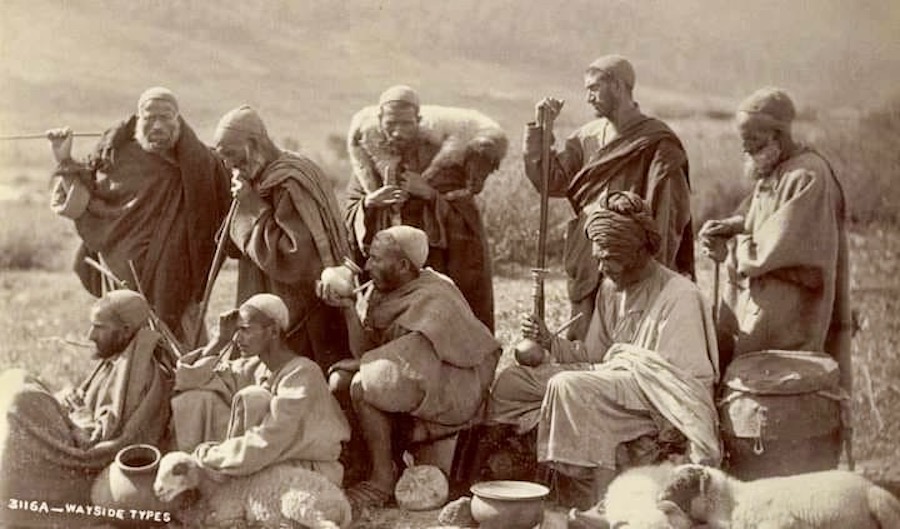
Dealers Kashmir lamented that the decline is not merely economic but also a result of what they call government negligence. Kawa said the situation has worsened over the last two years, with each season bringing fewer buyers, falling prices and growing instability. On ordinary days, he said, the trade still brings in nearly 200 to 300 hides, but what once ensured steady earnings now barely covers costs. “The government has done very little to support people associated with this trade,” he regretted, adding that repeated appeals have gone unanswered and many traders “no longer expect help.”
At one point in time, the government in Jammu and Kashmir had invested a lot of effort in creating linkages with the best leather producers, mostly based in Chennai. A few licences were issued and units were set up in Lassipora industrial estate. A lot of allied infrastructure was created. Some units are still operational but they are so tiny that they cannot even manage and process even a month of raw material that Kashmir’s mutton market produces.
For him, the deepest loss is not economic but the uncertainty of continuity. “As long as I am alive, I will continue this work,” he talked about his unflinching resolve, “but after me, I cannot say what will happen. Perhaps that will be the end of Kawa Brothers.” Walking through his go-down, he added quietly, “I am certain if this crisis prevails longer, my children would not carry this profession as legacy as I did.”
The question facing the trade nowadays, he said, is no longer whether it has changed but whether it can survive. The answer may depend on whether a new generation sees value in continuing a profession that has sustained families for centuries but now stands at the edge of disappearance. If the decline continues, the loss will not be economic alone. It will mark the end of a centuries-old occupation, the knowledge passed between generations, and a quiet but significant chapter of Kashmir’s commercial history.