As tourists flood Srinagar in private vehicles, local taxi drivers face collapsing incomes while the city’s roads, planned for a fraction of this volume, buckle under unprecedented congestion, Shyma Rauf reports
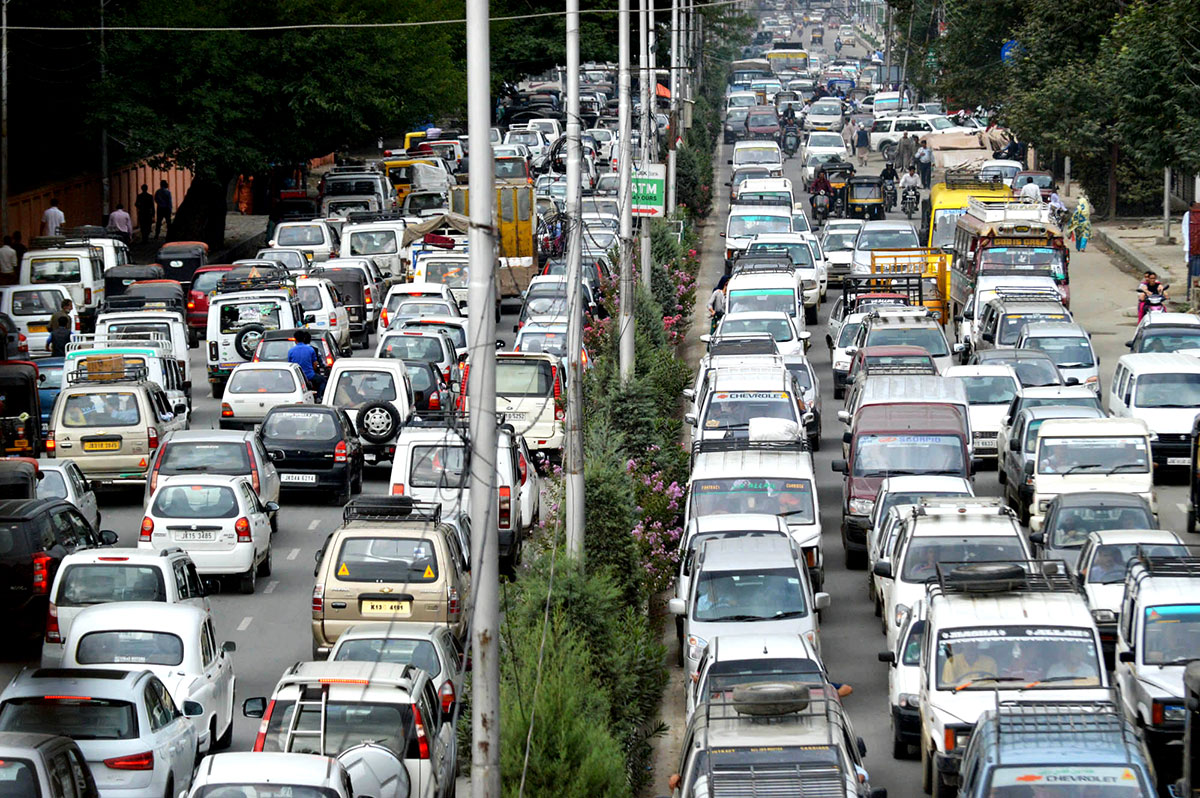
With Kashmir’s tourism industry booming, traffic jams have become routine. Increasingly, tourists arrive in their own private vehicles, a trend that has worsened road congestion and hit local taxi businesses hard. The surge raises a further question: Is the city’s infrastructure equipped to absorb this volume of vehicles?
Regional Transport Office data shows 83,000 non-local cars entered the city by June 2026. Of the 5.21 lakh tourists who visited, 2.94 lakh (56.4 per cent) arrived by road. That marks a sharp jump from 2025, when only 30-40 per cent of 11,16,043 tourists chose road travel.
This shift has caused hours of congestion on Srinagar’s Boulevard, while deepening the woes of local taxi drivers. As the hospitality sector thrives, the local taxi service is taking a hit. A tourist taxi stand near the Tourist Reception Centre, usually empty during peak season as drivers stay busy with fares, now sits filled with 7-seaters that have nowhere to go.
Driver Distress
Adil Ahmad, president of the drivers’ association, describes the work as reduced to mere survival. “It is hand-to-mouth earning now, there is no saving. Three hundred families’ livelihoods are attached to this business, and now the work is slow, employment is bleak,” he said. “I have been in this business for 16 years, and I am seeing it decline gradually. So many cars are lying in the parking lot, which was not the case a few years ago.”
Fayaz Ahmad, a taxi driver of about 20 years, said non-native vehicles are barred from entering Kashmir. “Cars from outside of Kashmir should not be allowed to enter,” he said, describing the toll on drivers’ livelihoods. “Even when we go to locations like Gulmarg or Pahalgam, our cars are stopped, and that also affects our business.”At 55, he pointed to the economics of his trade: “We have cars worth Rs 30 lakh here; these are not economical like the Ambassadors we had earlier. We barely get money for insurance and are not even able to clear our EMIs.”
City Limits
The challenge extends beyond economics to infrastructure. In May 2026, automobile retail sales in Jammu and Kashmir grew by 36.72 per cent, with passenger vehicle sales up 60.65 per cent compared to May 2025. Experts believe the city struggles to accommodate its own vehicle population, let alone the added influx.
Aijaz Ahmad Bhat, SSP Traffic Srinagar, called the congestion a persistent strain on his department. “This traffic is a pain in the neck for the department. The inconvenience to the people reached a tipping point. The department does not have enough manpower to handle it,” he admitted. “Srinagar is not adept at handling this influx of vehicles; our city is not meant for such traffic. We have to plan for a city like Switzerland, not Japan.”
A 2020 Comprehensive Mobility Plan by RITES Limited, a public sector undertaking under the Ministry of Railways, had already flagged the problem. The report noted a sharp rise in registered motor vehicles between 2011 and 2018, linking it to acute congestion and pollution. It found the city’s Volume-to-Capacity ratio exceeding 1.0, meaning traffic demand outstrips available road capacity.
Iftikhar Hakim, Chief Town Planner from 2008 to 2023, pointed to the same unresolved gap. “The city is not even able to handle its own vehicles, let alone vehicles from outside Jammu and Kashmir. There is a volume-capacity issue here. The smart city project was handled haphazardly and not organised,” he said. The RITES report also found most key corridors operating at a poor Level of Service, with average peak-hour speeds of just 14 kmph.
Transit Gaps
A functioning public transport network could ease much of this pressure, but the report described existing systems as unorganised and inefficient. It attributed the rise in two-wheelers and cars partly to improving economic conditions combined with the absence of a citywide public transport system, which has pushed more traffic onto already strained roads.
SSP Bhat agreed that robust public transport is essential. “Local transport needs to be made robust, and we need to take traffic off the roads, local or non-local. Local train or tram systems should be introduced, and they must be green because this traffic has ecological implications,” he said. Hakim noted that a light rail transit system was proposed in 1992, and again in 2012 and 2020, but has never been implemented.
Meanwhile, over Rs 3,600 crore in Smart City project spending has failed to resolve civic problems, compounding issues like waterlogging alongside the traffic crisis.
A Permit Model
Drivers point to Ladakh, where outside vehicles generally cannot be used for internal sightseeing without an Inner Line Permit, a system that both controls traffic volume and channels tourism income to local operators. Mehraj-ud-Din, 50, a driver for over two decades, wants Kashmir to adopt something similar. “If you go to Ladakh, your cars will be stopped, and then people take local taxis. There should be a permit system here too because we have to bear tremendous loss,” he said.
Adil Ahmad echoed the demand. “Tourism is the backbone of Kashmir. There is a permit system in Ladakh, but no such thing here. We cannot do anything about it; our business is tanking.”