Melting glaciers, vanishing lakes, and recurring cloudbursts reveal Kashmir’s fragile ecology buckling under mounting pressure.
The shrinking ice Shivling at Amarnath, reduced from roughly seven feet to about one within five days this July, is not merely a religious curiosity to be noted and forgotten once the pilgrimage season ends.
It is the most visible marker of a valley whose natural defences are failing faster than policy can keep pace with. This is now the third consecutive year the formation has failed to hold its shape even a week into the Yatra, and scientists point to a convergence of causes: four consecutive winters of below-normal snowfall, rising regional heat, and the sheer body heat of thousands of pilgrims passing daily through an enclosed cave.
The pattern repeats across the wider landscape. Nearly half of Jammu and Kashmir’s recorded lakes have vanished since 1967, according to a government audit, stripping the valley of natural sponges that once absorbed heavy rain. Thousands of hectares of forest cover have thinned over the past two decades, loosening slopes that once held together under pressure.
The result is a region where cloudbursts, once an occasional feature of the monsoon vocabulary, now arrive almost annually. Kishtwar has borne this shift twice in four years, first at Honzar in 2021, then far more devastatingly at Chositi in 2025, where a cloudburst tore through a crowded pilgrimage gathering and claimed dozens of lives.
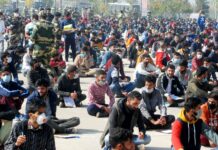
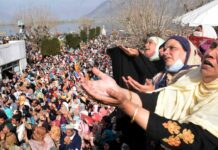
None of this can be separated from the sheer scale of human movement through the region. Over two crore tourist visits and more than five lakh Amarnath pilgrims passed through in a single recent year, much of that traffic concentrated in ecologically sensitive high-altitude zones, Gulmarg, Sonamarg, the Amarnath cave itself. Unmanaged footfall and vehicular emissions in fragile alpine terrain accelerate the very degradation that then threatens the tourism economy through landslides, blocked routes, and disrupted seasons.
To its credit, government response has grown more serious: early warning apps, GLOF risk categorisation across two dozen glacial lakes, phased flood-management works on the Jhelum, and pre-positioned rescue infrastructure ahead of major weather warnings. These measures matter and they save lives. But they address symptoms the region already knows how to recognise.
The deeper reckoning, acknowledged even within the government’s own submissions to the Assembly, is that development and ecological protection can no longer be treated as separate tracks. Afforestation, wetland restoration, tourism carrying-capacity limits, climate-resilient crop choices, and floodplain zoning are no longer precautionary extras. They are the only route by which a valley drained by one overburdened river, in a Himalayan range warming faster than much of the world, can continue to hold the weight of the millions of lives and centuries of devotion that depend on it.