In Kashmir, dozens of daily-wage power workers have died or been disabled on duty without safety, insurance, or compensation. Regularisation promises remain stalled, leaving families devastated and unsupported, Syed Shadab Ali Gillani reports
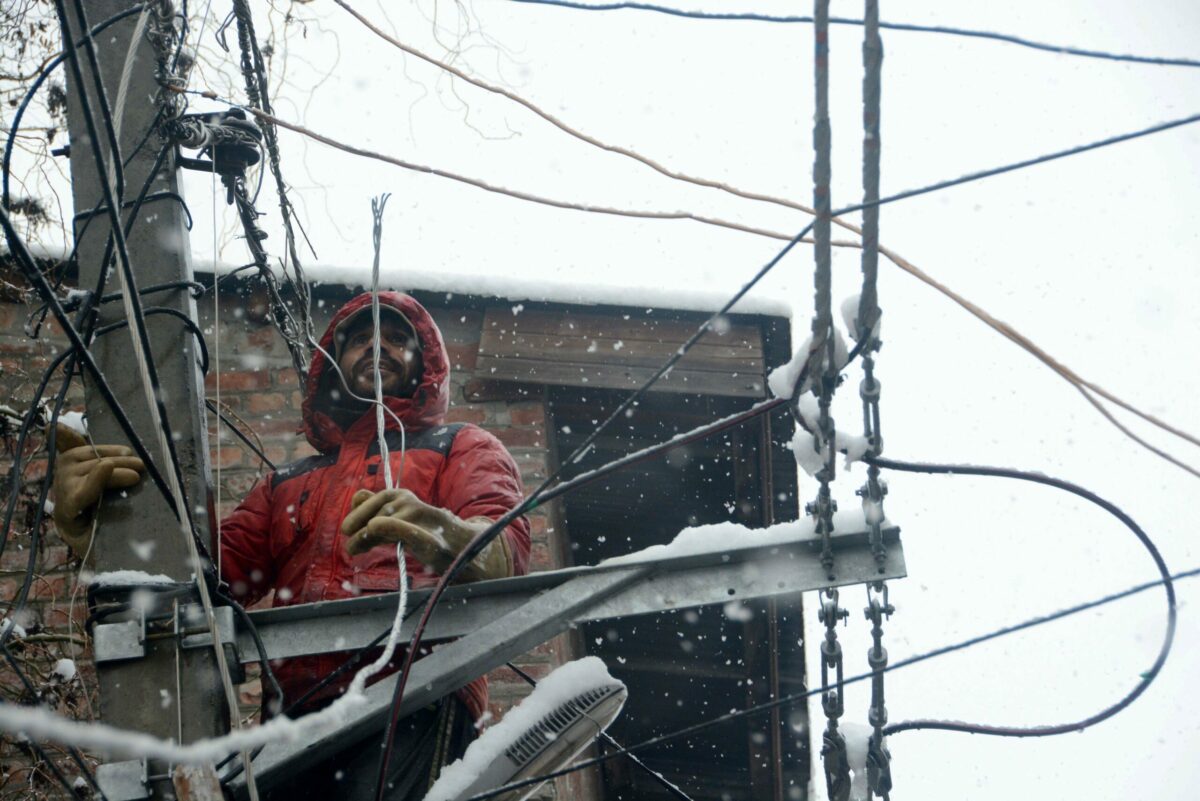
In Chakora village of Shopian, the home of Mohammad Yaqoob has fallen eerily silent. The lineman, a daily-wage worker for Kashmir Power Distribution Corporation Ltd (KPDCL), had spent over three decades navigating dangerous electric lines. On a cold February evening, he stepped out for another shift. He did not return.
His eldest son, Gowhar, 27, received a call late that night.
“He told me he had to go on duty,” Gowhar said, his voice weighed down by shock and sorrow. “But around 11 pm, we got a call… they said my father had been electrocuted. By the time we reached the hospital in Shopian, he was gone.”
The family, now left without its quiet anchor, includes Yaqoob’s wife, two sons and a daughter. His younger son is still dependent. Gowhar is a driver. Until recently, Yaqoob’s salary of Rs 9,600 sustained them all.
“I told him many times to leave it. I said, we do not need this work. We will earn and feed you,” Gowhar recalled. “But he spent his whole life on it. He could not sit idle at home. He left 9 pm. By 11, I got the call… they told me my father was electrocuted and taken to Shopian. When we reached the hospital, he was no more.”
There was no job security. No safety gear. No insurance. Nothing has been promised either. “I only hope the government understands our pain. At least give a job to my younger brother or some compensation.”
The grief in Gowhar’s voice echoed what countless others have endured.
Working Without a Net
Across Kashmir, similar tragedies have shattered families.
Irshad Ahmed from Bandipora was in his early twenties when he joined a group to cut down poplar trees. As the area lineman, he was asked to help. A sudden electric shock struck him and threw him from a height.
“The shock and fall injured my head. Half of my head is gone already,” he said.
His injuries were severe. He underwent 11 surgeries. The left side of his body remains paralysed. “I now work as a labourer to make a living, even though the people of my village do not give me work, because they are scared.”
Irshad still does not know whether he was a permanent daily labourer or a temporary daily labourer. “I only worked for two years and received two salaries before this life-altering accident.”
His life, reduced to uncertainty and rejection, mirrors that of others who were forgotten after their injuries.
In Anantnag, another lineman met with a similar fate. He had worked with the PDD for over three decades before it was unbundled into three corporations. Then, while repairing a high-tension wire, a powerful shock took his arm.
“I am not able to perform my tasks normally now. And I am not able to earn and make a livelihood,” the 50-year-old said. He looked helpless as he listed his responsibilities. “I was the only breadwinner of my family of five. I have three daughters and none of them is married. I do not know what to do now,” he said.

11 Lives in Seven Months
Since January 2025, eleven KPDCL employees have died while on duty. The dead include regular employees and daily wagers. Among them were a junior engineer and a technician, both electrocuted.
Pirzada Hidayatullah, President of the Jammu and Kashmir Electrical Engineers Graduates Association (JKEEGA), confirmed the deaths. Despite repeated assurances, the regularisation process has seen negligible progress. Very few have been regularised. The number is too small to count as meaningful,” he said.
He pointed out that statutory orders issued after 2019 clearly state that daily labourers in the PDD can be regularised at entry-level posts. That legal provision remains unimplemented.
“Our appeal to the government is to act on these SOs without further delay. Regularising them will help in two ways: it will fill the vacant entry-level positions in the department, and it will provide job security to thousands who are currently working without any formal protection.”
For the families already grieving, and for workers still risking their lives, this is more than a procedural demand. It is a lifeline.
No Cover, No Compensation
Pirzada said that the matter of insurance had been taken up with both the Managing Director of KPDCL and the Principal Secretary of the Power Department. However, he pointed out that the insurance scheme through JK Bank does not extend to daily wagers.
The Managing Director, Pirzada added, had written to the relevant authorities, but no concrete policy had emerged. A welfare scheme that had existed before 2019 had not been meaningfully revived. Although references to these workers appear in recent policy documents, no implementation has taken place.
“There is no effective insurance or compensation mechanism in place for these workers,” Pirzada said. “Practically and legally, they receive nothing.”
In 2022, around 206 daily-wage workers in the PDD were regularised, mostly in Jammu. In Kashmir, the figure remained minimal. Despite the existence of a regularisation framework in the department, implementation was lacking.
Currently, around 5,000 daily wagers work in the Power Department across Kashmir. Of the eleven PDD workers who died on duty this year, Pirzada said at least five to seven were daily wagers. Their families had not received any compensation from the department. During the COVID-19 crisis, when some of these workers died, engineers collected contributions themselves and directly supported affected families in the absence of official aid.
“These workers are performing essential services in difficult conditions,” Pirzada said. “Many are restoring power during adverse weather or emergency breakdowns. Their work is critical to public service delivery.”
A Tragic Loss
In June 2025, a tragic incident unfolded at the Receiving Station in Budgam. Hitesh Wali, a Junior Engineer, sustained severe injuries when an auxiliary transformer exploded. The blast sent a splash of hot oil across his body. Despite efforts to save him, he succumbed to his injuries.
“We have reached out to the Chief Minister and have been told there is interest in resolving this,” Pirzada said. “I will be meeting the Principal Secretary (Power) shortly to again press the urgency of the matter.”
A limited regularisation process had taken place in 2024 and 2025, but Pirzada called it “not substantial.”
“We urge the government to move quickly on this. Regularisation, insurance, and basic compensation mechanisms must be put in place without further delay,” he said.
According to Pirzada, at least 96 workers in the PDD have died on duty since 2020. Many more are now living with life-altering injuries.
Without Arms
In another devastating case, a frontline worker from a Srinagar neighbourhood was called to repair a fault. As instructed, he climbed a pole without protective gear or a standard uniform.
He asked nearby residents to switch off the current. They complied, but mistakenly turned off the wrong line. The moment he touched the live wire, a surge of electricity passed through his body.
“I fell to the ground and both of my arms were severely burned,” he said. The injuries were so severe that doctors had to amputate both arms. Now unable to work, he depends on his children for basic tasks. His wife now washes utensils in neighbourhood homes to earn a living. “I appealed to the government to compensate us,” he said, “but nothing substantial happened.”
Files Gathering Dust
According to Irfan Ahmad Kawa, Chairman of the All J&K PDL-TDL Electric Employee Union, the system has failed to acknowledge these workers properly.
“Let me clarify first, there is no such designation as daily wager in the formal structure of the PDD anymore,” Kawa explained. “The workers we are talking about are PDLs and TDLs, Permanent Daily Labourers and Temporary Daily Labourers. These terms are rooted in legacy designations that go back to 1981, when batch-wise regularisation was still happening. Up until 2019, we were issuing regularisation orders as per SRO-381.”
He said that the unbundling of the PDD in September 2019 and its conversion into corporations like KPDCL and JPDCL disrupted the process. The Chief Secretary had directed that all Class-IV recruitment must now go through the Jammu and Kashmir Services Selection Board under SO 404. The previous departmental mechanism for regularisation had been discontinued.
However, in 2020, a new statutory order was introduced. The government and the department signed SO-109.
Stalled Promises
The policy had made a clear provision: PDLs and TDLs appointed before the unbundling of the department could still be considered for regularisation, consistent with earlier frameworks. On this basis, a new Recruitment Rule was drafted in 2022, tailored specifically for the power corporations. This rule, Irfan said, permitted the regularisation of only PDL and TDL workers, not those classified as need-based.
The rule cleared all required institutional hurdles. It was vetted and approved by the General Administration Department, Finance, and Law Departments, and even by the office of the Lt Governor. Approximately 12,000 workers were covered under its scope. Despite this, implementation remained stalled within the Kashmir Power Distribution Corporation Limited (KPDCL).
While the Divisional Level Committee (DLC), which was required to authenticate and certify the regularisation cases, began functioning in Jammu’s JPDCL, its counterpart in Kashmir had yet to show any signs of movement. Irfan said the files were simply not being processed.

Some progress had taken place. In Kashmir Power Corporation Limited (KPCL), one round of scrutiny was conducted. The department asked for Life and Conduct Certificates, which were duly submitted. The process involving the Competent Technical Authority (CTA) was completed. Yet, even after fulfilling all formalities, the files were frozen. “In the meantime, our workers continue to die,” Irfan said.
Since 2020, at least 96 field workers have died of electrocution while on duty. That figure, he said, was a conservative estimate. In the past two months alone, five to six workers have lost their lives. These workers formed the backbone of the grid. They were the first to respond to faults and breakdowns, often venturing out during storms and in severe weather, working without protective gear.
The suffering did not end with death. More than 400 workers were now living with permanent disabilities caused by on-duty accidents. Many had lost limbs. Others could no longer work. Earlier, Irfan explained, when a TDL worker died or was incapacitated, the department would offer a job to a family member as compensation. That, too, had changed.
In 2023, the General Administration Department issued an order reversing this policy. All appointments made on compassionate grounds between 2017 and 2023 were to be withdrawn. SRO-43, which previously offered a route for such employment, was no longer accessible.
Now, even in cases of death, grieving families had to furnish police reports, medical documentation, and other formalities merely to qualify for a one-time compensation payout. “There is no employment, no follow-up. That is all they get,” Irfan said.
Lingering Pain
By now, the policy itself left no room for ambiguity. Irfan pointed to the 2022 Recruitment Rule, the SO-109 order, and multiple departmental approvals already in place. “We are not even talking about all casual workers. Just PDL and TDL. Still, the files are gathering dust.”
He offered to share the recruitment rules to show that everything existed on paper. “Only the implementation is missing. Our only demand now is: let the process move. Let the committee meet. Let these workers, many of whom have given 15 to 20 years to the department, be regularised. Before another death is added to the list.”
Mahmood Shah, Managing Director of KPDCL, stated that the department was working to ensure that an inclusive policy would soon be approved and implemented. He confirmed that PDL and TDL employees were not covered under any insurance or legal safeguards. The board, he said, had already accepted the proposal. What remained now was final clearance from the General Administration Department.
“We are often told that our work is risky. But it is always that we suffer,” a lineman from Srinagar said. “We have no insurance coverage, no compensation, nothing. Some of us keep waiting for the compensation. Some of us are for the jobs. Others wait for a silent and painful death. Some have been left limping, others are left with hopelessness. There must be some kind of rehabilitation at least.”