by Mir Rameez Raja
SRINAGAR: A ground-breaking ancient DNA study from Ladakh has pushed back the timeline of genetic interaction between Tibetan and South Asian populations by at least 2,800 years, providing the earliest direct genomic evidence of sustained contact across the western Himalayas.
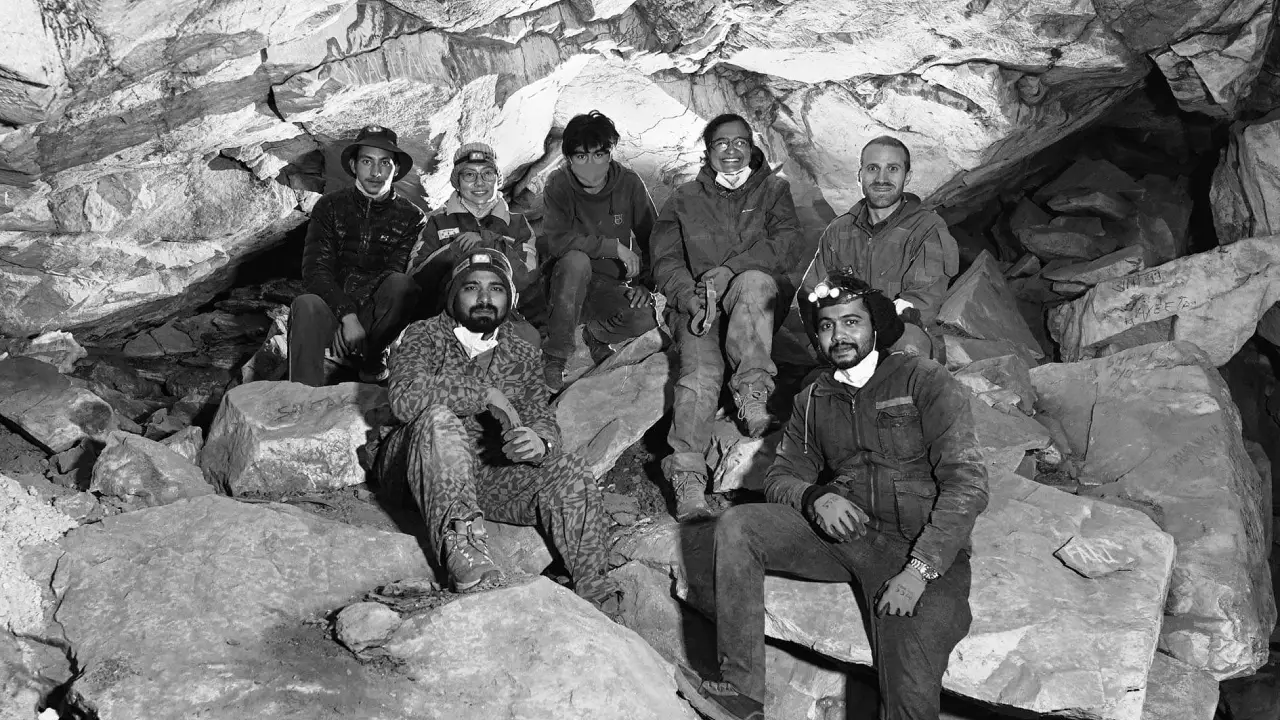
The research, based on genome-wide analysis of 10 individuals excavated from the Old Lady Spider Cave in Ladakh, found that the population carried an almost equal mix of ancestry related to ancient Tibetans and North Indians, revealing that this unique Himalayan community had already formed centuries before the rise of the Tibetan Empire.
Published in Science Advances, the study, Ancient genomes from Ladakh reveal 2800-year-old admixture between Tibetans and South Asians, fills a major gap in South Asian archaeology, where ancient DNA remains scarce. The research was led by Nick Patterson of Harvard Medical School, with Veena Mushrif-Tripathy of Deccan College Post-Graduate and Research Institute, Pune, Quentin Devers, Lijun Qiu, Sonam Dolma, Gregory Soos, Swapan Mallick, Nadin Rohland, and renowned geneticist David Reich of Harvard University.
The researchers analysed skeletal remains excavated in 2021 from the Old Lady Spider Cave (Abi Srinjamo Bao), situated at an altitude of nearly 4,000 metres above sea level above Yogma Kharbu village in western Ladakh. Archaeological excavations were conducted under the auspices of the Archaeological Survey of India (ASI), which also authorised the export of samples to Harvard University for specialised ancient DNA analysis.
The cave has its own history. According to local legend, Abi Srinjamo, or the Old Lady Spider, was a monstrous creature that lived in a deep cave high in the mountains of Ladakh, preying on travellers and leaving their bones scattered across the cave floor. Finally, she was slain by the legendary Tibetan hero Kesar, who killed her with a single arrow. The cave consists of several chambers linked by narrow tunnels, with human skeletal remains covering the floor from the second chamber onward. It was identified in 2015 during surveys for the INTACH documentation of Purig’s historical sites, prompting a multidisciplinary research project, the outcome of which was the study.
The cave contained the remains of men, women, children and elderly individuals, indicating it had served as a burial site for an entire community. Radiocarbon dating placed the burials between 1,690 and 1,347 years before present, with most individuals dating to around 1,500 years ago.
Genome-wide sequencing of ten individuals revealed an exceptionally homogeneous population unlike almost any found in South Asia today.
“Their ancestry is unusual,” the authors wrote. “Very few groups today have a similar approximately 50–50 per cent South Asian/Tibetan mix.”
Using principal component analysis and multiple statistical models, the researchers found that nearly half the ancestry of these ancient Ladakh residents came from a population genetically similar to present-day Dogras and North Indian Brahmins, while the remaining half derived from a population closely related to ancient Tibetans.
The study stresses that these modern communities were used only as genetic proxies and should not be interpreted as direct descendants or cultural identities of the ancient people.
“We do not think that Indians admixing into Ladakh were culturally Brahmins,” the authors clarified. “Identifying these ancient people with modern cultural groups makes little sense.”
To determine when the ancestral populations mixed, researchers employed a statistical tool known as DATES, which estimates the age of admixture by analysing the length of DNA segments inherited from different ancestral groups.
Long uninterrupted DNA segments indicate recent mixing, while shorter fragments accumulate over generations through recombination. The analysis revealed a clear exponential decay pattern consistent with a single ancient admixture event.
Assuming a generation length of 29 years, the researchers calculated that the mixing began approximately 1,343 years before the individuals lived, placing the event at around 2,800 years before present, or roughly 800 BCE.
“Admixture of these groups began at least 50 generations before the date of the individuals,” the paper concludes.
This finding indicates that the mixed population had already become well established more than a millennium before the people buried in the cave lived.
While the findings demonstrate early contact between Tibetan and South Asian populations, the researchers caution against assuming that the admixture itself occurred within Ladakh.
“Our results do not imply that the detected admixture took place in Ladakh,” the paper states.
Instead, they suggest that the mixed population could have formed elsewhere along the Himalayan arc, including present-day Nepal, before later moving into Ladakh.
“Admixture could have occurred in what is now Nepal, and then members of the admixed population moved to Ladakh,” the researchers note.
Regardless of where it originated, the population had become established in the western Himalayas long before the emergence of the Tibetan Empire in the seventh century CE.
The genetic findings complement archaeological evidence that Ladakh functioned as an important crossroads linking Tibet, Kashmir, Central Asia and the Indian subcontinent.
Bronze Age petroglyphs document contacts with Central Asian cultures including the Afanasievo, Okunevo and Andronovo traditions, while later Iron Age rock art reflects connections with Saka populations of the Central Asian steppes.
Material culture also points to an east-west divide emerging after about 2,300 years before present. Eastern Ladakh developed ceramic traditions associated with western Tibet and the Himalayas, whereas western Ladakh—where Old Lady Spider Cave is located—displayed ceramics influenced by Central Asia during the Hellenistic, Kushan and post-Kushan periods.
Kharoṣṭhī and Brāhmī inscriptions further connect the region with the wider Kushan cultural world.
The authors say their genetic results now provide direct biological evidence supporting these long-suspected interactions.
The research involved extensive laboratory work designed specifically for highly degraded ancient DNA. Scientists extracted DNA from 11 specimens, including eight bones and three soft tissue samples.
To maximise recovery, they prepared 64 sequencing libraries, enriched them for approximately 1.35 million genetic markers, and sequenced them using Illumina NovaSeq platforms.
After quality control, usable genome-wide data were obtained from 10 unique individuals, six of whom yielded exceptionally high-quality genomes.
The researchers also determined genetic sex, identifying six females and four males, and discovered that two individuals were second-degree relatives.
Radiocarbon dating was performed using accelerator mass spectrometry at Pennsylvania State University, with collagen quality confirming excellent preservation of the skeletal material.
The study suggests that this ancient population did not disappear completely.
Using additional statistical modelling, researchers found evidence that populations such as the Minero of Ladakh and, to a lesser extent, the Balti retain ancestry derived from this ancient Ladakh group.
According to the study, Minero populations can be modelled as roughly 56 per cent Old Ladakh and 44 per cent Dogra-related ancestry, while Balti populations also appear to preserve a substantial genetic contribution from the ancient Himalayan population.
“This implies genetic drift shared between these groups and the Old Ladakh individuals,” the authors wrote, adding that the population “did not completely disappear and instead left a legacy in present-day people.”
Researchers also examined whether the ancient Ladakh individuals carried the well-known Denisovan-derived EPAS1 genetic variant, which enables Tibetans to thrive in low-oxygen, high-altitude environments.
Of nine chromosomes that could be analysed, only one carried the Denisovan-derived haplotype.
The researchers conclude there is no evidence that the high-altitude adaptation underwent strong positive natural selection in this mixed Ladakh population after the ancestral groups merged.
The authors say the study represents one of the oldest genome-wide datasets from anywhere on the Indian subcontinent and provides a rare glimpse into prehistoric Himalayan population history.
“Our data are consistent with Old Ladakh individuals being a mixture of approximately half ancestry related to North Brahmins and Dogra and half ancestry related to sampled ancient Tibetans,” the paper concludes.
The researchers emphasise that much remains unknown and call for further excavations and ancient DNA studies across the Himalayas to determine how widespread this previously unknown population was and how long it persisted.
“An important direction for future work,” they write, “is to sample additional remains to understand the geographic and temporal span, as well as the cultural associations, of this previously unknown population that lived in the Himalayan region for more than a millennium.”