SRINAGAR: Ladakh’s tourism administration on Tuesday rolled out a cluster of policy, branding and infrastructure initiatives aimed at positioning the Union Territory as a year-round, sustainable and globally competitive destination, with a clear emphasis on cultural preservation, environmental responsibility and community livelihoods.
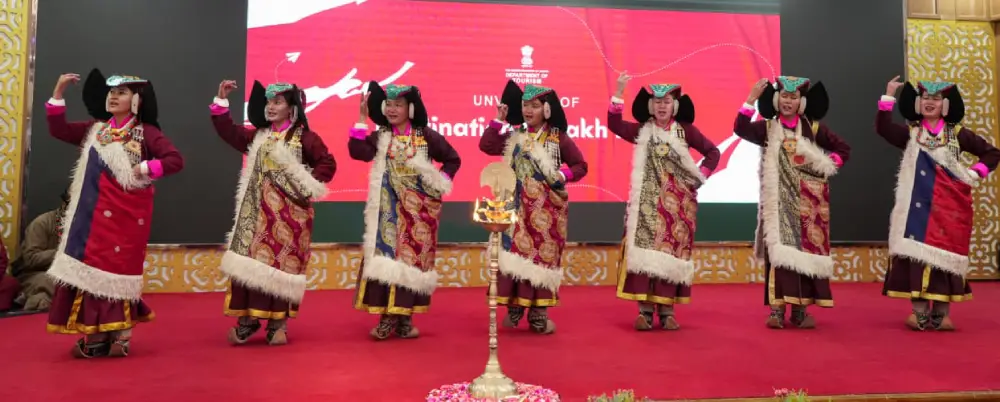
At the centre of the push was the unveiling of the new ‘Destination Ladakh’ tourism identity, designed by the women-led creative collective Team Stringmo. Officials said the logo, inspired by the Bhoti letter “La”, visually captures Ladakh’s mountain passes, historic trade routes and cultural continuity, and will serve as the core branding element for national and international tourism promotion. The administration described the new identity as a strategic move to consolidate Ladakh’s presence on the global tourism map while aligning growth with ecological limits and local traditions.
Alongside the branding launch, the Department of Tourism announced a slate of ongoing and upcoming projects backed by the Ministry of Tourism. These include the Swadesh Darshan 2.0 Julley Leh Biodiversity Park project, approved at a cost of Rs 23.16 crore; the Swadesh Darshan 2.0 Line of Control and Hunderman Village Experience in Kargil at Rs 11.45 crore; and the development of Mushkoo Valley under the Challenge Based Destination Development scheme at Rs 9.77 crore. Tribal homestays are also being expanded in Suru, Aryan and Sham valleys under the PM-JUGA scheme, with an allocation of Rs 4.59 crore.
Officials said experiential tourism infrastructure is being strengthened through projects such as a water screen projection show at the Tourism Facilitation Centre in Kargil, estimated at Rs 12.07 crore, and a sound-and-light show at Leh Palace costing Rs 8.57 crore. Both are expected to be commissioned in 2026 and are intended to enhance visitor experience without putting pressure on fragile natural sites.
A major policy intervention announced at the event was the launch of the ‘Celebrate Ladakh’ Tourism Calendar, which fixes dates for key festivals for the next three years. The administration also declared nine UT-level festivals to create a structured and recognisable festival hierarchy. These include the Apricot Blossom Festival, Ladakh Astro Week, Changthang Nomadic Festival, Suru Summer Festival, Zanskar Festival, Ladakh Festival, Himalayan Film Festival, Ladakh Bike Week and the Ethnic Food Festival.
Tourism officials said Ladakh currently hosts more than seventy festivals across districts, but the absence of a clear hierarchy had resulted in fragmented branding and inconsistent promotion. The new framework is expected to improve coordination, enable advance marketing by tour operators and airlines, and position Ladakh as a predictable, year-round destination. Two flagship events — the Ladakh Festival in Leh and the Suru Summer Festival in Kargil — have been proposed for national-level promotion under the Centre’s ‘Two Festivals per State’ scheme.
In a move aimed at improving safety in Ladakh’s remote and high-altitude zones, the administration operationalised a streamlined mechanism for private tour operators to procure satellite phones. Following approval by the Ministry of Defence in 2022 for tourism-related satellite phone use, the Department of Tourism coordinated with BSNL to develop a secure procurement process. A formal Standard Operating Procedure issued on December 17, 2025, now allows tour operators to directly obtain satellite phones from BSNL, Leh, a step officials said would significantly strengthen emergency communication and rescue coordination.
Environmental safeguards were also foregrounded through the launch of the Sewage Treatment Plant Incentive Scheme–2025. The voluntary scheme targets hotels and guesthouses with 10 to 19 rooms and offers financial assistance covering 75 per cent of STP equipment costs, capped at Rs 5 lakh. An additional ten per cent incentive is available for women-owned establishments. The initiative is designed to curb untreated wastewater discharge, protect Ladakh’s fragile ecology and promote responsible tourism practices, with incentives to be released through Direct Benefit Transfer after verification and commissioning.
Tourism authorities outlined parallel policy measures, including the Ladakh Homestay Policy 2023 and the Ladakh Mountaineering Policy 2024, as well as plans for familiarisation tours, business-to-business meetings and a Winter Conclave to widen Ladakh’s tourism outreach. They said the emphasis going forward would be on balanced seasonal spread, predictable event calendars and stronger national and international promotion.
Representatives from Kargil highlighted the economic impact of creative and community-led tourism initiatives, noting that women-led enterprises such as Team Stringmo have enabled households from economically weaker backgrounds to sustain themselves through cultural work. Calls were also made to strengthen adventure tourism, sports events and institutional support in regions such as Suru Valley to broaden tourism’s benefits among local youth.
Taken together, officials said, the launch of the Destination Ladakh identity, the structured festival calendar, safety reforms and environmental incentives signal a shift towards a more organised, sustainable and community-centred tourism model, aimed at generating long-term livelihoods while safeguarding Ladakh’s cultural and ecological heritage.