SRINAGAR: Kashmir’s rich Buddhist heritage and its historic links with the ancient seat of learning at Nalanda took centre stage on Sunday as scholars, policymakers and cultural leaders gathered for the Srinagar-Nalanda Dialogue, a conference aimed at reviving India’s civilisational traditions and strengthening cultural diplomacy.
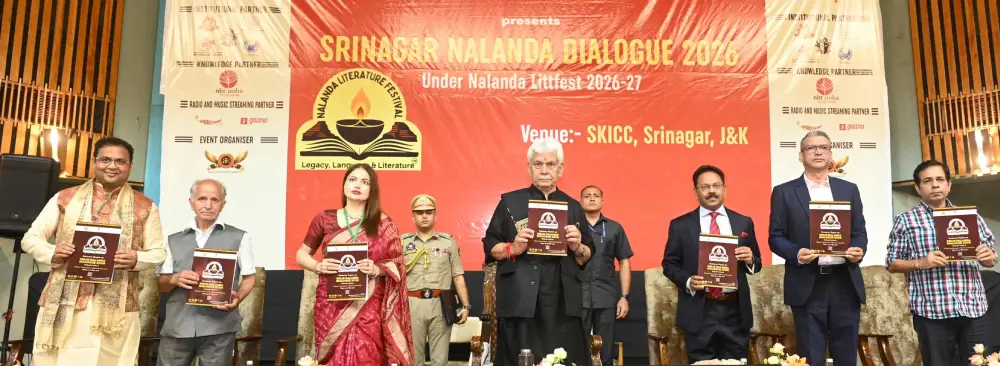
The event, organised by the Ministry of Tourism, Jammu and Kashmir’s Department of Culture, the Indira Gandhi National Centre for the Arts (IGNCA), the National School of Drama and Nava Nalanda Mahavihara University, formed part of the Nalanda Literature Festival.
Addressing the gathering, Lieutenant Governor Manoj Sinha said the dialogue represented an opportunity to revive India’s great traditions of knowledge and spirituality while shaping a future-oriented educational framework that connects younger generations with both their civilisational roots and modern technology.
“Together, the scholars of Jammu and Kashmir and Nalanda shaped one of the world’s oldest living civilisations. This heritage is our guiding light. The Srinagar-Nalanda Dialogue is our opportunity to carry that light forward with wisdom, courage and a new vision for Viksit Bharat,” Sinha said.
The conference brought renewed attention to Kashmir’s historic role as a major centre of Buddhist learning. Historians note that, like Nalanda, Kashmir emerged as an important hub of Buddhism from around the 3rd century BCE to the 8th century CE and is widely believed to have hosted the Fourth Buddhist Council during the Kushan period.
The discussion comes amid growing interest in the Valley’s Buddhist past following the recent discovery of a vast 2,000-year-old Buddhist complex at Zeganpora village in south Kashmir, considered one of the largest ancient Buddhist sites unearthed in the region.
Emphasising India’s cultural diversity, the Lieutenant Governor said the country’s strength lay in its ability to unite varied traditions and identities.
“From Bihar to Jammu and Kashmir, from the temples of Tamil Nadu to the monasteries of Ladakh, from the ghats of Kashi to the valleys of Kashmir, each region preserves its distinct cultural identity and rhythm of life. Our shared aim should be to weave these diversities into a harmonious unity that enriches the nation’s collective consciousness,” he said.
Sinha also highlighted the historic role of ancient centres of learning such as Nalanda, Takshashila and Vikramashila, which attracted scholars and travellers from across Asia and beyond.
Referring to Kashmir’s own intellectual traditions, he described the region as the home of the historic Sharda Peeth, which drew students and scholars from distant lands for instruction in subjects ranging from mathematics and philosophy to music and literature.
“The Srinagar-Nalanda Dialogue reminds us that the moment has come to renew this tradition as a modern, relevant intellectual project. Just as scholars in ancient times travelled from Nalanda to Jammu and Kashmir carrying manuscripts, philosophies and scientific ideas, we must revive open exchange and deep engagement of ideas,” he said.
Noted Kashmiri linguist Padma Shri Prof. Shafi Shouq traced the region’s historical connections with ancient centres of learning stretching from India’s Northeast to Taxila and Gandhara.
“The entire belt from India’s Northeast to Taxila and Gandhara was a vast watershed of ideas. It assimilated and generated new ideas, and the entire world paid attention,” he said.
Prof. Shouq said the influence of Gandhara on Kashmir’s culture and society was so deep that traces of it continue to survive in local language and traditions.
A statement issued by the organisers described the Srinagar-Nalanda Dialogue as “a movement to revive the culture of thoughtful engagement and knowledge sharing”, adding that it sought to create a platform where diverse voices could come together to promote a more informed, connected and harmonious society.
Among those present at the event were Vice-Chancellor of Nava Nalanda Mahavihara University Prof. Siddharth Singh, Director General of Tourism Suman Billa, National School of Drama Director Chittaranjan Tripathy, Central University of Kashmir Vice-Chancellor Prof. A. Ravinder Nath, University of Kashmir Vice-Chancellor Prof. Nilofer Khan, senior government officials, scholars, literary personalities and students.