by Dr Suheel Rasool Mir
The Zamzam spring, in both its sacred essence and emotional resonance across the broad religious spectrum, stands as a holy spatial marker rooted in aprofound socio-religious context.
After a taxing day, having delivered four lectures to sociology students at the Government Degree College Hajin, I entered the staff room, dehydrated and exhausted. I requested a glass of water from my colleague, Dr Tabasum, who responded with a warm smile, “We have Zamzam—please serve yourself.” At that moment, the term Zamzam stirred something profound within me. What had moments earlier been a simple craving for water transformed into a feeling of veneration, as I realised I was no longer seeking the ordinary but the sacred.
This essay seeks to understand the sanctity of Zamzam water and to explore how emotionality and divinity contribute to its symbolic significance within religious belief systems. It also delves into how this sacred water invokes sentiments that transcend the physical, embodying a powerful sociological symbol.
Water, in all its essence, holds a central place in cultural and faith-driven systems, forming the bedrock of socio-cultural interaction through antiquity. From the Phoenicians to the Greeks and into contemporary times, water has consistently played both a cohesive and centrifugal role in shaping the patterns of social life. In this continuum, the Zamzam spring has remained deeply revered among Muslims worldwide, expanding its significance as a symbol rich in sociological meaning and iconography.
Scriptural references and historical accounts affirm the enduring impact of this sacred place. Originating from an underground spring in Makkah, Saudi Arabia, Zamzam water is known to contain high levels of calcium, fluoride and magnesium—minerals vital for human health. Its genesis, rooted in the Quran, recounts the story of the Prophet Ibrahim, his wife Hagar, and their infant son Ishmael. When Hagar, fearing her son’s imminent death from thirst, frantically searched for water, she found none. In response to her prayers, a spring miraculously gushed forth beneath Ishmael’s feet—a divine blessing that continues to flow to this day. Muslims from across the globe visit the well, believing in its spiritual potency and divine origin.
The French sociologist Émile Durkheim distinguished social facts as either sacred or profane. Water, as a fundamental element of existence, may embody both these dimensions. Ordinary water, readily available, is profane. In contrast, water imbued with emotional and religious symbolism—such as Zamzam—resides in the realm of the sacred. This dichotomy amplifies the socio-cultural and religious value of the Zamzam spring. Millions of Muslims visit this site to partake in its spiritually revered waters, believed to possess healing properties. Since its miraculous origin, the spring has never run dry. It continues to symbolise divine mercy, for it was this very water that sustained Prophet Ibrahim’s family in their time of dire need, making it a wellspring of faith and emotion for generations.
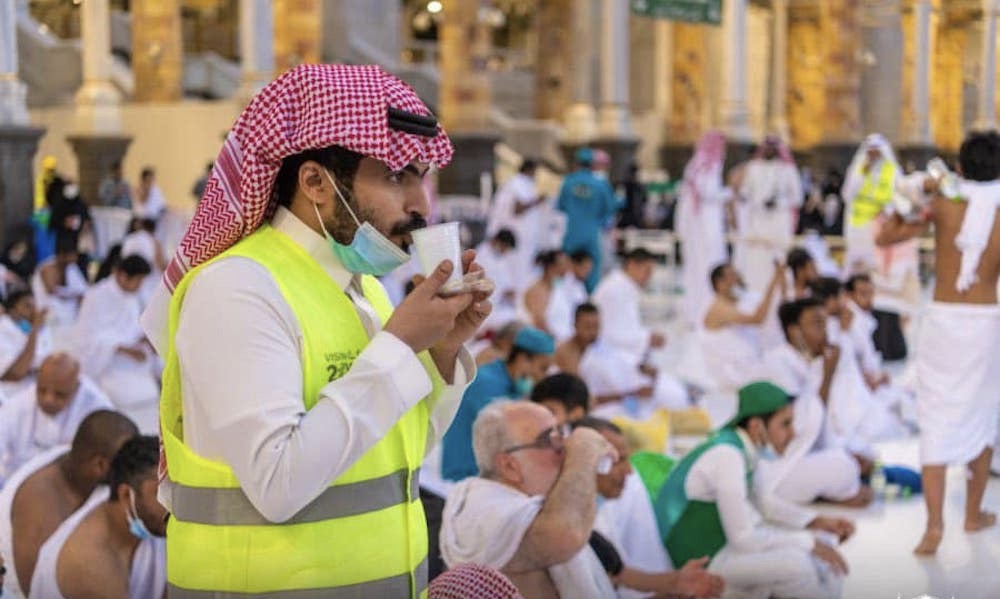
Pilgrims performing Hajj inevitably visit the Zamzam well, consuming its waters with the belief that it purifies both body and soul. Upon their return, they carry bottles filled with Zamzam to their home countries as sacred tokens of the pilgrimage. Loved ones, in turn, receive these bottles with reverence, often facing the direction of the Kaaba before drinking, invoking blessings and offering prayers. This ritual bestows not only spiritual significance but also deep social value upon the water. The sacredness of Zamzam thus elevates the Hajj experience, becoming both a symbol of spiritual fulfilment and collective unity. In its global journey—from the spring in Makkah to households around the world—Zamzam water affirms its place as a unifying force, a sanctified element that transcends borders and embodies the spiritual aspirations of the Muslim ummah.
There is often a curious interplay of surprise and reverence when Muslims encounter water from the Zamzam spring, forming a unique triad of symbol, emotion and sanctity that defines a deeply social and globalised existence. The affective sensations evoked upon consuming this water elevate it beyond the physical realm, transforming it into a lasting symbol of spiritual sustenance.
To understand how one transitions from immersion in ecological worldviews and eco-spirituality to a critical engagement with modern scientific and socio-economic paradigms, and ultimately to ecological activism, it is pertinent to refer to the philosophy and movement of Deep Ecology. The Deep Ecology Cycle, alongside Teasdale’s articulation of the inner and outer dimensions of spirituality, offers a framework that resonates with the sacred qualities of Zamzam. These ideas, though rooted in environmental thought, mirror the deeply spiritual experience associated with this holy water.
Zamzam water consistently evokes positive emotions tied to faith and the broader sense of the Muslim Ummah. In non-Arab Muslim societies, this water is not consumed casually but is reserved for significant moments—illness, sacred ceremonies, and blessings. It serves as a vital component of the intangible cultural identity of Muslims. Before drinking, believers recite verses from the Quran, imbuing the act with sacred intent. Drawing upon Durkheim’s concepts of the sacred and the profane, this article explores how faith transforms the ordinary into the sacred, instilling awe and reinforcing solidarity within the global Muslim community.
The spiritual and emotional bond Muslims share with Zamzam forms the foundation for understanding how water and belief shape the rhythms of daily life. The term Haji—denoting one who has completed the pilgrimage—inevitably conjures images of the spring, infused with spiritual resonance and emotional depth. These feelings, nurtured through ritual and memory, sustain communal cooperation and cohesion among Muslims across geographical and cultural divides.
In a world increasingly dominated by greed and rampant consumerism, which has led to the commodification of nature and the environment, Muslims continue to hold fast to the sacredness of Zamzam. Their faith in its purity and divine origin stands in stark contrast to the materialist reduction of natural resources.
Water, often analysed through geomorphological or geographical lenses, possesses an intrinsic affective and cultural symbolism. From the springs of the Himalayas to the well of Zamzam, water extends beyond its physical properties, acquiring sanctity and iconographic status. This spiritual geography reinforces the importance of place and emotion in understanding water not merely as a natural resource but as a vessel of collective memory and faith.
The sociological imagination attached to the essence of water in sacred sites reflects a heightened ritualisation of its presence and use. Within mainstream public consciousness, water is typically perceived through spatial and consumptive dimensions. Yet, this utilitarian view often obscures its deeper ontological and sociological significance. The Zamzam spring, in both its sacred essence and emotional resonance across the broad religious spectrum, stands as a holy spatial marker rooted in a profound socio-religious context.
The sentiments and emotive associations tied to this ‘religious water’ extend into the complex dynamics that contribute to the formation of communal unity. Though the sacramental use of holy water in secular spaces is rare, its symbolic weight affirms enduring beliefs in its sanctity. Water, in its ubiquity, potency, and restorative nature, carries meaning derived not only from its physical properties but also from its role within sacred traditions. From a theological standpoint, this sacredness underscores processes of spiritual refinement—the holy and the act of becoming holy. These elements are not merely bridges between the corporeal and the eternal but are also seen as divine gifts bestowed upon humanity.
Across belief systems that transcend time and geography, water is abstracted and consecrated in similar ways. Cultural customs may diverge, yet they often reflect parallel beliefs about the sacred nature of water. It becomes a living force, a commonly accessible medium through which disciples engage with the divine. Environmental historian Verena Winiwarter describes this intersection as “socio-natural sites”—configurations of practices and arrangements that bind humankind to nature. In this framework, water assumes an ‘active’ role, shaping daily human experiences through spiritual, emotional and ecological dimensions.
Depending on one’s beliefs, the divine powers associated with water may be limited or all-encompassing. It may function as a cleanser of sin—as in ablution or baptism—or facilitate the fulfilment of religious obligations. These various forms of holy water, though typologically distinct, are united by their sacred purpose and operate within defined spiritual functions. Such typologies invite a more thoughtful consideration of the mechanisms and meanings that render water sacred.
From this vantage point, the Zamzam spring assumes a deeply topophilic and sacred status—its sanctity derived both from its physical site and its transference into other spaces. When believers carry water from the spring as a spiritual souvenir, they do more than transport liquid; they transfer a fragment of the sacred geography into new contexts. This act enhances the symbolic scope of Zamzam, positioning it as a vital locus for understanding the embedded nature of water in religious life and its role in constructing unique social structures.
(The author’s work ‘Cultural Encyclopaedia of the Dard Tribe: Journey Through Gurez and Ladakh’ is a sociological and anthropological resource on Dards. Ideas are personal.)