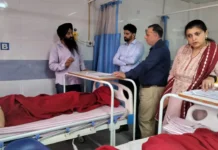
SRINAGAR: As Kashmir’s walnut harvest exposes hundreds of seasonal workers to the risks of climbing tall trees without formal safety equipment, a new research paper has found that 25 of 95 labourers admitted to SKIMS Soura following harvesting injuries died, with falls from height emerging as the dominant cause of serious injury.
The study, From Injury to Economic Strain: Assessing the Unseen Costs of Labour Risks in Kashmir’s Walnut Harvesting Industry, says 12 of the 95 injured workers were brought dead to the hospital, while another 13 died within 24 to 72 hours of admission. The cases were marked by severe spinal and head injuries as well as internal-organ damage, including lung injuries and internal bleeding.
The research was conducted by Sameer Yousuf, an independent researcher with a postgraduate qualification in Economics and NET qualification, and was published in April 2025 (Volume 12, Issue 4 of the Journal of Emerging Technologies and Innovative Research (JETIR).
The research focuses on a side of Kashmir’s walnut economy that, the author says, has received considerably less attention than production, exports and economic returns: the physical danger faced by the workers who climb trees, harvest the crop and undertake associated manual tasks.
According to the paper, data were collected from 150 walnut labourers in Kupwara and Ganderbal, while secondary data were obtained from 95 labourers admitted to SKIMS Soura following walnut-harvesting injuries. The paper says the research examined injuries, working conditions and the resulting economic consequences for workers and their families.
The study identifies falls from height (FFH) as the principal risk associated with walnut harvesting. Workers climb trees to reach the crop and, according to the research, generally do so without safety harnesses, fall-arrest systems or other protective equipment.
The paper says most of the injuries recorded in the SKIMS data were caused by falls from height. These included serious spinal injuries, head trauma and internal-organ injuries. In some cases, the injuries resulted in partial or complete disability, potentially preventing workers from returning to the occupation on which they depend for their livelihood.
The study also points to the particular danger posed by weather conditions during the harvest. Rain can make tree climbing more hazardous, while there is reportedly no systematic safety training to prepare workers for the risks involved.
“Workers climb trees without any safety harnesses or other safety equipment,” the paper says, adding that labourers themselves recognise walnut harvesting as physically demanding and dangerous but lack systematic training and support to reduce those risks.
The research found that the largest group among the 150 surveyed workers was aged between 18 and 35 years. They accounted for 83 workers, or 55.3 per cent of the survey sample. Another 42 workers, or 28 per cent, were aged between 35 and 50, while 25, or 16.7 per cent, were above 50.
The study says the 18-35 age group also constituted the majority of those affected in the SKIMS injury records. The author links this to the fact that younger workers are more likely to undertake the physically demanding task of climbing walnut trees. Injuries among workers above 50 were nevertheless described as notable, with the paper suggesting that reduced physical resilience could increase the severity of injuries among older workers.
The findings underline a contradiction at the heart of the seasonal walnut economy: the workers undertaking some of its most physically demanding tasks are also those whose health and earning capacity can be most severely affected when accidents occur.
The surveyed labourers reported working between 7.5 and 8.5 hours a day during the walnut harvest season.
The principal harvesting implement identified by the study is a long wooden stick made from bamboo and specifically used for walnut harvesting. The paper says the equipment used by workers is not considered safe and that proper safety equipment is generally absent.
Workers also reported back pain, joint pain, burning eyes and fatigue. The study attributes these complaints largely to the physically demanding and hazardous character of the work.
The wages earned by walnut labourers are described in the study as relatively higher than those available in some other manual labour occupations in the region. But the paper says the earnings remain insufficient to meet all living expenses. It also notes that payment is generally made after the harvest season, with some workers receiving small performance-based bonuses.
This becomes particularly consequential when an injury takes a worker out of the labour market.
The central argument of the paper is that a walnut-harvesting injury is not simply a medical event. It can become an economic crisis for an entire household.
The study examines the consequences in terms of medical expenditure, lost wages, reduced productivity and the longer-term inability of injured workers to continue earning. It argues that workers suffering serious injuries can face prolonged recovery, disability and financial instability, while families of workers who die are left without an important source of income.
The paper further argues that the consequences extend to the walnut industry itself. Injuries can reduce labour availability, affect productivity and delay harvesting. The author says the fear of serious injury or death may also discourage workers from entering or remaining in walnut harvesting, contributing to a labour shortage.
The paper says the absence of compensation mechanisms further compounds the problem, particularly for families of workers who die or become permanently disabled.
Yousuf’s study positions itself against a body of research that has traditionally concentrated on the economic importance of Kashmir’s walnut sector, its production, market dynamics, exports and contribution to rural livelihoods.
The paper notes that walnut cultivation provides income and seasonal employment to thousands of people, particularly in areas such as Kupwara, Ganderbal and Baramulla. But it argues that the labour force sustaining this economic activity has largely remained outside the focus of sectoral research.
The study therefore attempts to shift the focus from the economic output of walnuts to the human cost of producing them. Its stated research questions include identifying the most common injuries, assessing their effects on workers’ economic well-being and productivity, and examining their broader consequences for the walnut industry.
The research uses a descriptive and exploratory design, combining quantitative data with qualitative interviews.
For its primary sample, the study selected 150 walnut labourers from Kupwara and Ganderbal through what it describes as stratified random sampling. The sample was intended to include workers with different ages, genders, harvesting roles and levels of experience, including harvesters, sorters and processors.
Researchers administered a structured questionnaire covering workers’ backgrounds, working hours, physical demands, tools, safety protocols, wages, compensation, healthcare access and the social and economic consequences of their work.
The researchers also conducted semi-structured interviews with injured workers to understand the physical and psychological consequences of accidents, their recovery experiences and their views on safety improvements.
The SKIMS Soura medical records were used as secondary data to supplement the survey and provide information on workers who had required hospital admission following harvesting injuries.
The study calls for a substantial change in the way walnut harvesting is carried out.
One of its principal recommendations is mechanisation. Mechanical pruning and automated harvesting equipment could reduce the need for workers to climb tall trees and consequently lower the risk of falls.
It also recommends compulsory safety training covering climbing techniques, equipment use and personal protective equipment. The paper specifically proposes making harnesses, helmets and fall-arrest systems mandatory for workers operating at height.
The author further calls for health insurance and compensation systems for walnut harvesters, arguing that workers and their families need financial protection against serious injury or death.
Government policy, the study says, should include mandatory safety protocols, periodic medical examinations and awareness programmes aimed at both workers and employers.
The paper also proposes restrictions on who should undertake tree-climbing work, although its recommendation on age requires careful policy consideration: it suggests restricting participation by workers below 25 while simultaneously arguing that older workers may have reduced physical resilience.
The author acknowledges that the findings cannot automatically be generalised to all walnut-growing areas of Kashmir.
The primary survey covered only Kupwara and Ganderbal, and the paper explicitly identifies this geographic limitation. It also acknowledges the possibility of sampling bias because the sample was drawn from only two districts.
The journal abstract says that data from the 150 labourers and 95 SKIMS cases were collected between August and September.
Despite these limitations, the study offers a different way of looking at Kashmir’s walnut economy. Its principal contention is that the value of the crop cannot be assessed only through production, exports and income: the physical risks borne by the workers who harvest it are also part of the industry’s real cost.
The paper concludes that the combination of mechanisation, safety training, protective equipment, insurance, compensation and stronger government oversight could reduce injuries and fatalities while making walnut harvesting more sustainable.